By Sharyn Church | Deputy Director
The Learning and Achieving Through Arts Project continues to meet its objectives as a national model in arts education. There are many factors which informed the success of the LATA program. Firstly, the LATA model is solidly grounded in the theory that one can improve school culture by fostering aesthetic experiences.[1] This theory holds that because we emphasize raising students' test scores in today's schools, aesthetic experiences provide an opportunity for educators to balance intellectual and rational approaches by exploring human creativity. Research reviewed by Karen F. Osterman and reported in Students' Need for Belonging in the School Community considers students' sense of acceptance within the school community. The concern is how schools address what is defined as a basic need, the need to experience belongingness. The findings suggest that students' experience of acceptance influences multiple dimensions of their behavior, yet schools adopt organizational practices that neglect and undermine students' experience of membership in a supportive community. The research is echoed in the voice of many researchers and educators who assert that "one of the most fundamental reforms needed in education is to make schools into better communities of caring and support for young people.”[2]
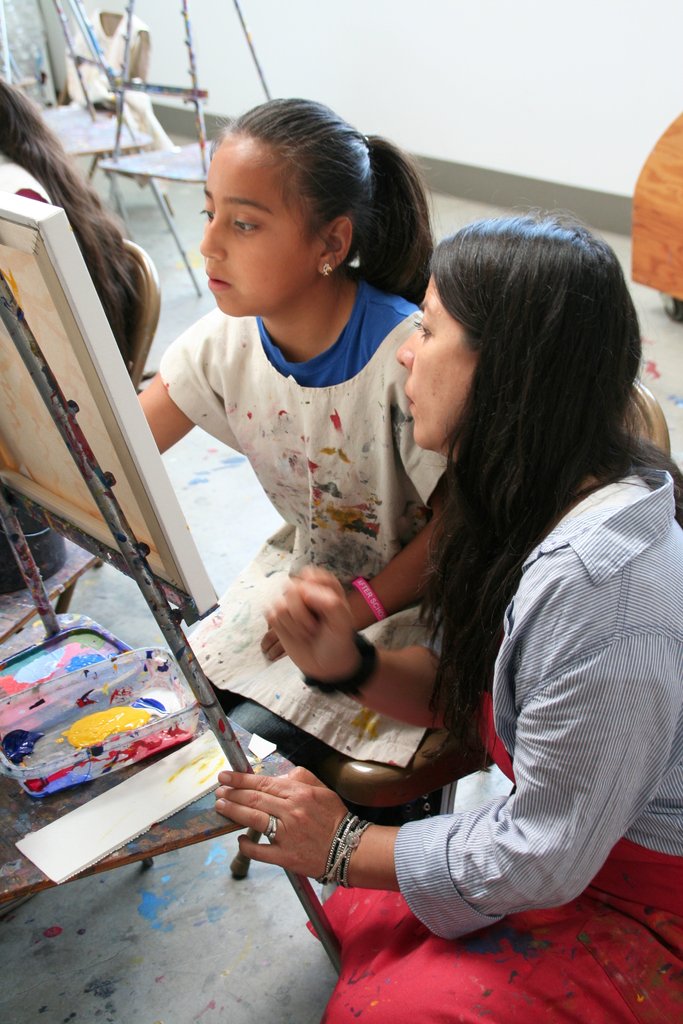
Secondly, the LATA teacher trainings are specifically designed to provide teachers with professional development that is in-depth and extensive in order to ensure optimal impact on their teaching practice. The coaching element, which engages the trained Teaching Artists to assist the Classroom Teachers in their development toward becoming art educators, is expanded through those classroom teachers as they become peer coaches with other teachers at their schools. For the teachers participating in the coaching component, the development of a creative classroom community will occur through the implementation of arts and arts-integrated lessons and strategies.
An important lesson learned during the grant period was the importance of grounding our professional development training in the language of child brain development. Independent research has demonstrated that the arts can improve children’s school performance and build both creativity and competency. Inner-City Arts’ LATA program embraces brain-compatible strategies in the classroom; participating teachers receive hands-on support from our professional development staff as they explore ways to integrate the arts into their classroom. Inner-City Arts provides classroom teachers with an introduction to the brain which serves as a platform upon which to understand the neuroscience that underlies a given student’s classroom experience. Our staff helps teachers identify arts-based strategies and activities that can support brain engagement. We have been receiving excellent feedback regarding our training sessions that used neuroscience concepts to evaluate student engagement in learning.
Thirdly, Inner-City Arts’ relationship with leading researchers has positioned our campus as ground-zero in the movement to ensure that arts based strategies are employed across curricula to facilitate learning, problem solving, language development and cognitive development. In order to foster improvements in instructional practice that are fundamental in nature and broad in reach, the vision of the program is to place the arts at the center of learning throughout schools, in order that students matriculate through grade levels with growing potential to achieve high-level standards across content areas. Most significantly, Inner City Arts offers a safe learning environment for children, teens, families, and the broader community to engage in creative exploration without fear or judgment. LATA enables urban youth to experience a well-rounded education that cultivates values such as respect, patience, self-discipline, integrity, tenacity, and teamwork. Robust arts programs for disadvantaged populations, such as those provided at Inner City Arts, close achievement gaps by offering students unique ways to unlock their
academic potential and realize their competence.
As with any school-day arts education model, there are minor limitations associated with LATA, particularly with respect to the program’s evaluation component. It is difficult to accurately measure whether the arts learning and life skills development that takes place in the studio carries over into the classroom and into the student’s daily life. Because our teaching artists are not preparing a classroom teacher’s daily lesson plans, and are not going into a child’s home to monitor out-of-school behavior, it is always a challenge to verify that classroom teachers are indeed integrating the arts into their classrooms and parents are using arts-based strategies to support their children. Inner-City Arts responds to this challenge in a number of ways. First, as noted above, we provide professional development training to classroom teachers during the seven week session; teachers are allowed to reflect on the learning that is taking place in the studios and brainstorm ways in which to integrate these concepts into the core curriculum. A teacher survey is administered in order to assist our staff in determining each teacher’s successes and challenges relative to classroom integration. Second, a number of family art days and culminating events are scheduled in order to draw parents and families to our campus to see their children’s work and learn new methods for supporting their
development.
[1] Hurley, J. C. (2002). Art and Human Potential, Principal Leadership, 3(4), 25.
[2] Hargreaves, Earl, and Ryan (1996) (p. 77).
Links:
Project reports on GlobalGiving are posted directly to globalgiving.org by Project Leaders as they are completed, generally every 3-4 months. To protect the integrity of these documents, GlobalGiving does not alter them; therefore you may find some language or formatting issues.
If you donate to this project or have donated to this project, you can receive an email when this project posts a report. You can also subscribe for reports without donating.