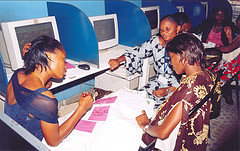
By Tobias Eigen | Founder and Executive Director
Dear Kabissa members, supporters and friends,
I am struck by the relevance to today’s networked world of Frantz Fanon’s warning: A community will evolve only when a people control their own communication. The fact is that we are increasingly ceding control over our means of communicating with each other to privately run social networks, especially Facebook and Twitter. These are great platforms and I continue to recommend that organizations take advantage of them as part of their overall social media strategy. However, as evidenced perhaps most starkly by the Arab Spring, it is becoming apparent that networks like Kabissa that are run by and for civil society need to be strengthened to create a sustainable and functional "communications commons" that is independent from those commercial platforms.
With that guiding thought, read on for an update on Kabissa’s strategic evolution from social business to volunteer-run civil society network, the upcoming launch of our updated community website with improvements we think you will like, and a request for your input on a somewhat revolutionary idea to help Kabissa members spread their organization data more widely by joining the "Open Data movement".
As always, thank you for your support, partnership and encouragement.
In solidarity,
Tobias Eigen,
Kabissa Founder and Executive Director
P.S. On a personal note: I am shifting this summer from Berlin, Germany to Bainbridge Island, near Seattle in the Pacific Northwest of the United States. I am sad to be leaving friends and family in Berlin as well as this time zone shared by many African friends and colleagues, but looking forward to reconnecting with friends, family, and Kabissa members in the Pacific Northwest and PST time zone.
 Historically, Kabissa operated as a nonprofit business. Between our founding in 1999 and 2007, Executive Directors managed staff, interns and volunteers to carry out the organization’s programs and services. The Board of Directors played a support role in setting policies and priorities, maintaining the nonprofit's overall direction, defining the mission of the organization, approving strategies and budgets presented by the staff, and ensuring that plans and programs are implemented. Our target beneficiaries were civil society organizations in Africa. Potential donors and friends of Kabissa in the United States were nurtured to help with Kabissa’s sustainability but were considered separately from our target beneficiaries in Africa.
In 2008, Kabissa closed its Washington DC office and became a volunteer-run network organization with no staff. Our mission remains the same, to help African civil society organizations put ICT to work for the benefit of their communities, but the way we do it is now different:
We are actively recruiting volunteers! We received 80 (!) applications in April, many of them from Africa. The immediate task now is to identify and bring on board suitable team leaders who will take charge of filling their teams, which are:
Setting up the teams is a rather painstaking, experimental process but we are excited about the opportunity to leverage our own global network to build up our capacity to maintain and grow Kabissa as a network, a platform, and as an organization.
If you are interested in joining one of these teams or contributing even on a short-term basis and have not yet contacted us, please complete the form at http://kabissa.org/about/volunteering - thanks!
 In case you missed it: in March, we announced the results of a very illuminating survey we did in collaboration with WiserEarth West Africa.
“This survey illustrates the hunger among African civil society activists to utilize emerging Information and Communications Technologies to help advance the missions of their organizations,” said Camilla Burg, WiserEarth Communications & Outreach Director.
“The next step is to supply the resources needed to make a truly wired future a reality. The availability of online communication and collaboration tools and the ability to use them properly profoundly impacts the way that civil society functions,” added Tobias Eigen, Kabissa Executive Director. “This survey helps us understand how far we have come in that respect, guiding our priorities as we nurture and support our membership and evolve the functionality of our online community platform.”
Read the full announcement and download the survey results and source data: Unleashing the potential of social networks and the Internet in West Africa: A study into collaboration and communication among civil society organizations
The survey we did with WiserEarth encouraged us to continue to develop and improve the Kabissa online platform, which plays an important role in providing a civil society owned space that complements the larger for-profit social networks like Facebook, LinkedIn and Twitter.
In brief, the improvements to the Kabissa online platform will include:
We are actively working on the upgrade and will launch “Kabissa 3.0” as soon as possible - please complete the volunteering form if you are interested in helping out with coding, copy writing and testing. Thanks!
We learned about the benefits of the emerging Open Data movement at the Open Data for Development Camp conference which took place in May 2011. Kabissa was invited to brainstorm the idea of Kabissa offering our organization data via Open Data, and we were very warmly received by conference participants who are looking actively for reliable organization data. (To learn more about the outcomes of the conference, read the blog post by Tobias Eigen: Open Data is data that can be freely used, reused and redistributed by anyone.)
We created a page at http://www.kabissa.org/open to start an open discussion with the Kabissa community about an idea we have to leverage Open Data to spread Kabissa organization data beyond our own website.
Currently our data is not available as Open Data. In order to access and use the data in the Kabissa organization directory, you need to visit the Kabissa website and either browse the map or do a database search - unless of course you happen to already have the direct URL to an organization profile page or come across it via an Internet search.
Open Data presents an opportunity for Kabissa organizations to be found in many more places. Some examples might include:
To be clear, we are not talking here about personal details of individuals or any email addresses - we are talking about the key organizational details that members are already making available via their profile pages on Kabissa and that we all want to share as widely as possible. On Kabissa, this information is managed by the organizations themselves.
What do you think? Read the full proposal at http://kabissa.org/open and add your vote to the poll at the bottom. Your feedback will help inform the board of directors, who will decide at our next board meeting whether or not to go Open Data. Thanks!
Project reports on GlobalGiving are posted directly to globalgiving.org by Project Leaders as they are completed, generally every 3-4 months. To protect the integrity of these documents, GlobalGiving does not alter them; therefore you may find some language or formatting issues.
If you donate to this project or have donated to this project, you can receive an email when this project posts a report. You can also subscribe for reports without donating.