By Susan Berta, Orca Network | Program Coordinator
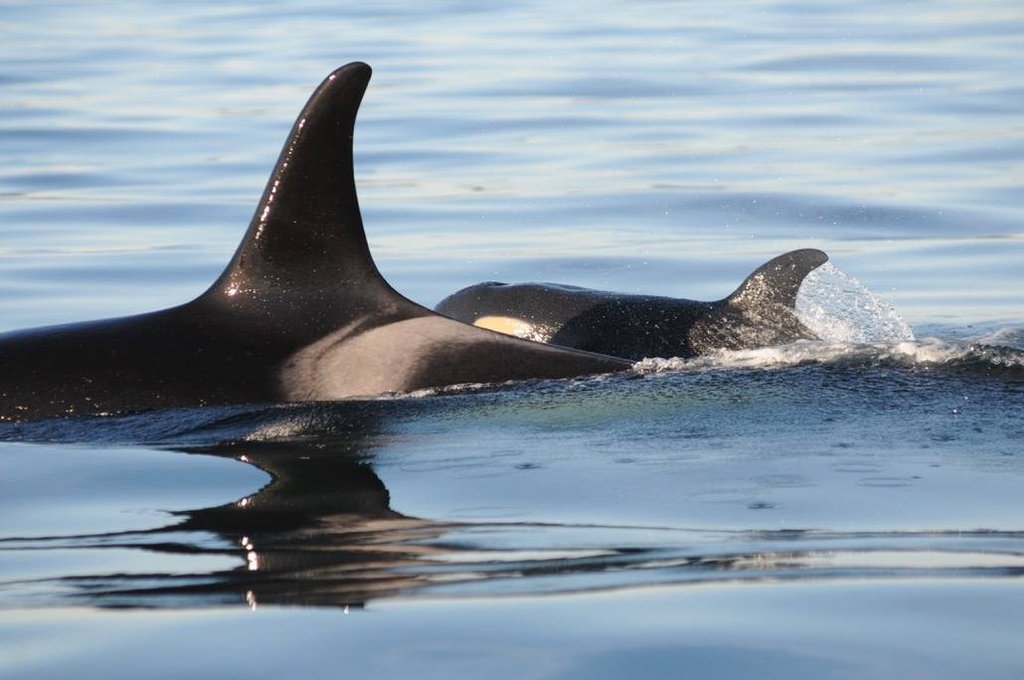
These past few months have brought us two new orca calves for J pod, but J pod has also suffered the huge loss of a reproductive aged female, and her unborn calf (also female).
On December 4, we were saddened by this news:
"A deceased orca was found earlier today near Courtenay, BC in northwest Georgia Strait and was identified as 18-year old J32, known as Rhapsody. Photos sent by Canada's Dept. of Fisheries and Oceans were identified by Ken Balcomb at the Center for Whale Research. J pod last visited Puget Sound in late November, and J32 was last identified and photographed with her family November 26 east of Victoria BC by the Center for Whale Research.
J32 was thought by many to be in the late stages of pregnancy last summer due to her wide girth when she breached, as she often did. J32's mother was J20, who died in 1998 when Rhapsody was only 2 years old. She was raised by her aunt, J22 Oreo. She is survived by J22 and her cousins J34 Doublestuf and J38 Cookie, leaving only three survivors of the former J10 matriline, and only 77 members of the Southern Resident Community.
We cannot express how tragic this loss is for this struggling, precariously small, family of resident orcas of the Salish Sea. This loss brings the overall number of Southern Resident orcas below their number in 2005 when they were listed as endangered under the Endangered Species Act. The loss of J32 marks the fourth death of a Southern Resident orca in 2014. The last surviving Southern Resident baby was born in August of 2012." (from Orca Network news release)
Then we finally received some GOOD news at the end of December - on December 30th:
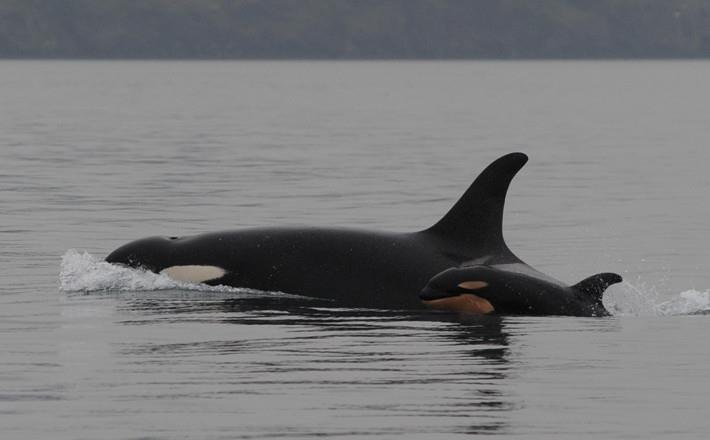
"This afternoon Ken Balcomb of the Center for Whale Research confirmed seeing and photographing 42-year old J16 (Slick) with her newborn baby - now known as J50! This good news brought the Southern Resident orca population back up to 78 members, and J50 was soon determined to be female, also good news, as the more reproductive aged females in the community, the better their chances for increasing their population.
Then February 12, 2015, more good news from the Center for Whale Research - another new J pod calf had been sighted with mom J19. "This brings us to twenty-six whales in J pod, the most viable pod in the endangered Southern Resident Killer Whale population of the US and Canada Pacific Northwest. K pod has 19 individuals, and L pod has34 individuals for a totalpopulation of 79 SRKW’s as of today."
Orca Network continues to work on educating and advocating for the need for increased Chinook salmon runs throughout the Southern Resident orcas' habitat, which includes the Salish Sea in the Pacific NW, as well as the Pacific coast from Monterey, CA northward to SE Alaska.
And our Whale Sighting Network continues to grow, involving citizens who help track the whales and collect data for researchers and agencies working to help the Southern Resident orcas, while at the same time educating the public and creating advocates for orca and salmon restoration efforts.
To find out more about our Southern Resident orcas and other whales, visit our website, and follow our Facebook page to find out where the whales are, and to read the latest news and action items.Thank you for your support, which enables us to continue our work on behalf of the whales of the Salish Sea ~
Project reports on GlobalGiving are posted directly to globalgiving.org by Project Leaders as they are completed, generally every 3-4 months. To protect the integrity of these documents, GlobalGiving does not alter them; therefore you may find some language or formatting issues.
If you donate to this project or have donated to this project, you can receive an email when this project posts a report. You can also subscribe for reports without donating.