By Constance Hunt | Executive Director, KWENCH
Dear Donors:
In the wake of Kenya’s post-election violence, KWENCH is raising money to restore water connections in the informal settlement of Mathare, one of Nairobi’s largest slums. Water vending businesses in Mathare have traditionally been controlled by the Mungiki, a violent cult. Like most illegal vendors, the Mungiki break into the main water lines of the Nairobi Water and Sewer Company (NWSC) and run cheap, plastic piping known as “spaghetti” piping to kiosks inside the slum. The spaghetti ruptures easily, allowing contaminants, including raw sewage, to enter the water supply before it reaches the consumer. The water is also very expensive, partly because the Mungiki must pay bribes to the NWSC to avoid disconnection.
In July of last year, the NWSC cut off all illegal supply lines to Mathare, leaving residents without a source of water. From that time, NWSC has been supplying Mathare with free water from standpipes with the intention of establishing legal water connections by the end of 2007. Then the post-election riots broke out and all progress towards safe and legal supplies came to a halt.
Now that calm is being restored to the slums of Nairobi, neither the NWSC nor Mathare’s residents have sufficient funds to build water connections. In addition, during the post-election violence here, rioters ruptured the NWSC’s main pipes. Right now, because of the free water and broken pipelines, the NWSC is losing enormous amounts of revenue and the notion of providing legal water connections to the slums is a distant and receding dream.
KWENCH wants to rectify this situation by establishing safe, legal and inexpensive water supplies for Mathare. This will be accomplished by training registered Community Based Organizations (CBOs) to sell water. CBOs who opt to join this program will receive assistance from KWENCH in the form of fundraising for high quality equipment and training in operation and maintenance of equipment and business management. In return, the CBOs will be required to amend their constitutions to establish water vending as one of their objectives. They will further be required to include in their constitutions pledges to post their NWSC account numbers on their water tanks or kiosks (to assist clients in filing any complaints about their service), pay their bills on time, refuse to pay bribes, maintain uncontaminated water supplies and police their pipelines and equipment to prevent leakage and illegal water connections.
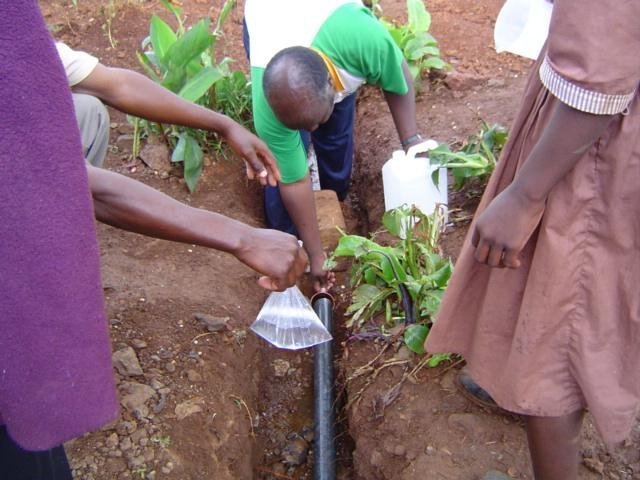
The water provided as a result will be safe because it will be transferred to points of sale in high-quality metal pipes and because the CBOs will know how to maintain their equipment. It will be inexpensive because the NWSC has a policy of charging only 10 Kenyan shillings per cubic meter to legal connections in informal settlements – one of the lowest rates in Africa, and because the large storage tanks we hope to provide will serve as a buffer against rising prices caused by scarcity when water supplies are irregular and unreliable.
Perhaps best yet, the CBOs comprise all the major ethnic groups in Mathare. KWENCH believes that by motivating these groups to work together to plan, construct and manage the settlement’s water supply, the groups will find common cause and help to restore lasting peace.
The cost of installing two water points in each of Mathare’s ten villages is approximately US$700,000, which KWENCH is trying to raise from a number of different sources. Donors to globalgiving can contribute to this project by supporting training, which will cost about US$3,600 for 100 people. Because the post-election violence has resulted in devaluation of the Kenyan shilling, your dollars can go quite far to help the destitute in Kenya.
Sincerely,
Constance
Project reports on GlobalGiving are posted directly to globalgiving.org by Project Leaders as they are completed, generally every 3-4 months. To protect the integrity of these documents, GlobalGiving does not alter them; therefore you may find some language or formatting issues.
If you donate to this project or have donated to this project, you can receive an email when this project posts a report. You can also subscribe for reports without donating.