By Femke Rijpkema and Joanna Hosaniak | Project Leaders
Dear donor,
What if the ships moving through international waters are helping fund a system built on forced labor and human rights abuses?
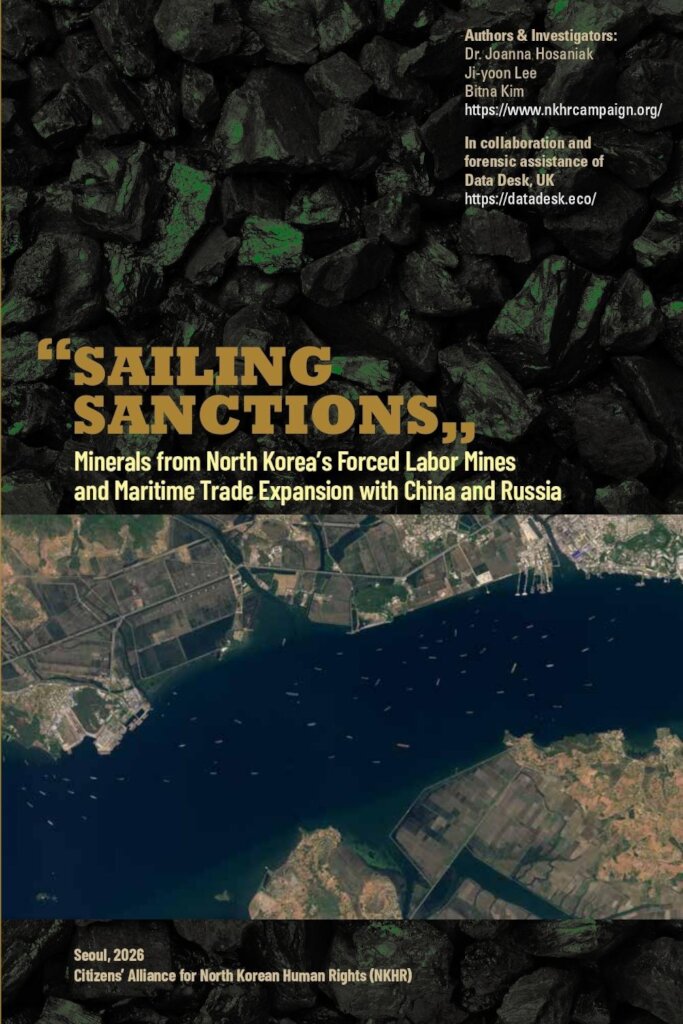
In June 2026, NKHR released its latest investigative report, “Sailing Sanctions: Minerals from North Korea’s Forced Labor Mines and Maritime Trade Expansion with China and Russia,” exposing how forced labor, maritime trade, and military financing are connected through an international network that sanctions have failed to stop. Our year-long investigation, together with expert maritime analysis from Data Desk in the UK, tracked 47 vessels and included testimony from 22 witnesses to uncover how North Korea’s coal and mineral trade continues to expand.
The scale of this trade is difficult to ignore. Vessel detections at North Korea’s five major ports increased from 783 in 2019 to 3,756 in 2025. At Nampo port alone, North Korea’s largest oil and coal cargo terminal, more than 3,000 vessel detections were recorded in 2025. Behind these ships are minerals such as coal, iron ore, and titanium, much of which is produced through forced labor.
For the people working in these mines, there is no freedom to refuse. Soldiers can be assigned to mines under military orders to generate foreign currency. Political prisoners are forced to work in mines located near political prison camps, under conditions that amount to severe human rights violations. Descendants of South Korean prisoners of war (POWs) have also been forced into labor in these mining areas because of their hereditary classification by the North Korean regime.
The money generated from this labor does not simply remain inside North Korea. Our investigation found that export proceeds are managed through financial structures in China, allowing money to move outside the international banking system. These revenues are connected to North Korea’s military and weapons programs, while the same trade networks allow sanctioned vessels to continue operating.
This is what makes the system so difficult to see. On paper, a ship is simply carrying minerals. A financial transaction may appear to be an ordinary payment. A company may see only a supplier or trading partner. But all of this could be a system built on forced labor, sanctions evasion, and the exploitation of people. People who have no choice in where or how they work.
Our investigation identified 47 vessels involved in North Korean mineral trade. Twenty-seven were already covered by international sanctions, while 20 had not yet been sanctioned. We cross-checked vessel-tracking data with open-source ownership and sanctions information to identify and expose connections that would otherwise remain hidden.
Still, documenting these networks is only the first step. Companies, governments, and financial institutions need to understand how their supply chains and business relationships may be connected to forced labor and sanctions risks. They need to investigate their connections and take responsibility for what happens beyond what is immediately visible.
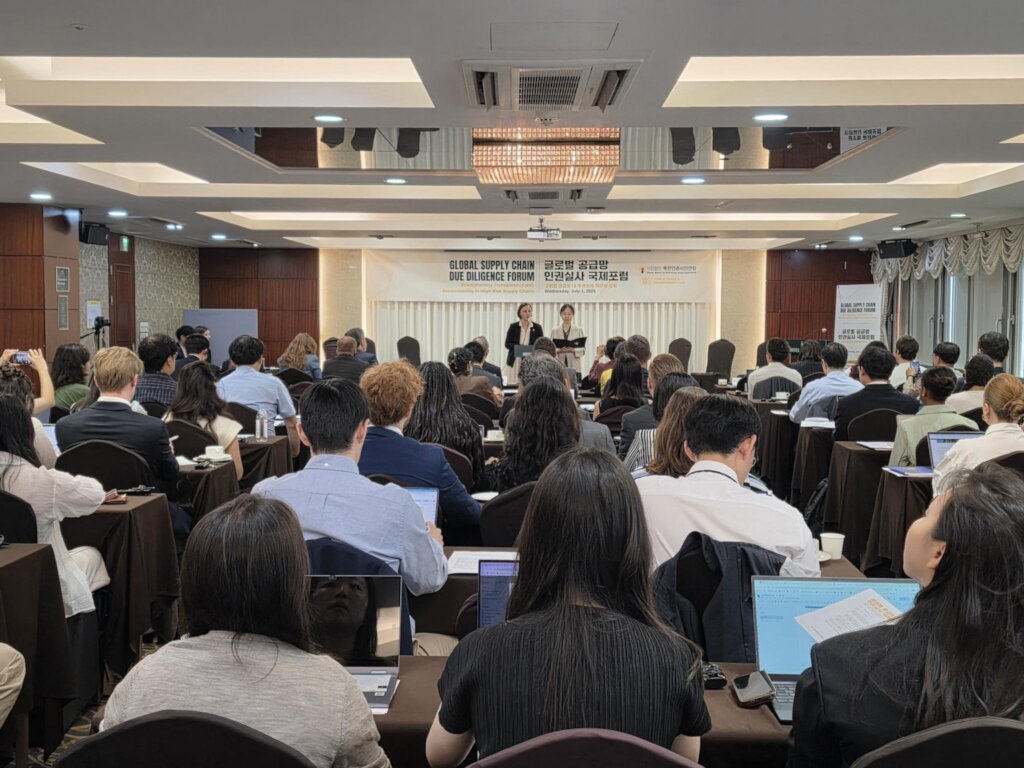
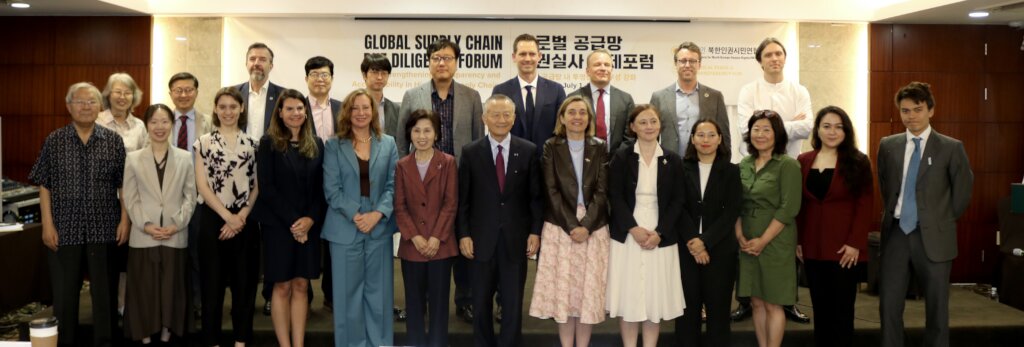
That is why, shortly after having released our “Sailing Sanctions” report, NKHR organized the “Global Supply Chain Due Diligence Forum: Strengthening Transparency and Accountability in High-Risk Supply Chains” in Seoul on July 1, 2026. The Forum brought together approximately 100 stakeholders from diverse sectors, including diplomatic missions, international organizations, government and public agencies, civil society and human rights organizations, media, academia and research institutes, the legal community, and business associations to discuss how governments and businesses can identify and address forced labor, human rights abuses, and sanctions risks hidden within global supply chains.
The Forum allowed us to bring the evidence from our investigations directly into discussions with the people who can help address these risks. International experts also shared insights into financial and intermediary networks connected to North Korean trade, the risks surrounding continued trade in Russian fossil fuels, and forced labor and labor rights abuses in Chinese supply chains. These discussions were followed by policy exchanges on how governments, businesses, and civil society can strengthen due diligence, transparency, and accountability in high-risk supply chains.
In addition, and in commemoration of our 30th anniversary, we officially announced the launch of a new initiative, the Ethical Trade & Transparency Hub. Grounded in NKHR’s 30 years of investigations, documentation, and advocacy, the Hub will serve as an evidence-based platform for governments, businesses, lawmakers, and civil society to better understand and address risks embedded in high-risk supply chains. It will analyze how forced labor and state-linked human rights abuses intersect with sanctions evasion, opaque trade and financial structures, transnational illicit financing, armed conflict, and war crimes, while supporting efforts to strengthen transparency, due diligence, visibility, and accountability. Moving forward, NKHR will continue to foster stakeholder cooperation and policy dialogue to advance responsible supply chain practices, victim-centered justice, and accountability.
All of this continues to be possible only because of donors like you.
Your support allows us to conduct long-term investigations, speak with witnesses and survivors, analyze complex trade and shipping data, and bring evidence to the people who have the ability to respond. It allows us to uncover systems that are deliberately difficult to see and expose the connections that keep forced labor and exploitation going.
Ultimately, this work is about the people trapped within these systems. People who are forced to work, denied their freedom, and have no way to challenge the system exploiting them.
Thank you for standing with them.
Links:
Project reports on GlobalGiving are posted directly to globalgiving.org by Project Leaders as they are completed, generally every 3-4 months. To protect the integrity of these documents, GlobalGiving does not alter them; therefore you may find some language or formatting issues.
If you donate to this project or have donated to this project, you can receive an email when this project posts a report. You can also subscribe for reports without donating.



Support this important cause by creating a personalized fundraising page.
Start a Fundraiser