By Anuradha Gupta | Deputy CEO of Gavi, the Vaccine Alliance
Immunisation as the gateway to health: why women hold the key in Pakistan
This post originally appeared on Gavi’s blog, Vaccineswork. Author Anuradha Gupta is Deputy CEO of Gavi, the Vaccine Alliance.
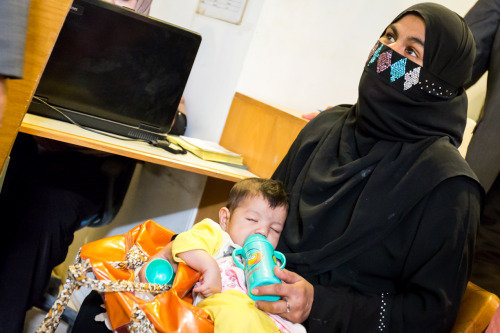
Her name was Nusarat. She was young and petite with gleaming, hopeful eyes – the only thing I could see from behind her veil. She had a four-month-old baby on her lap whom she had brought in to be vaccinated. She told me she was 22 years old, got married at 20 and had two children in quick succession. As she was not happy with the situation, she had now decided to start family planning. When I asked what contraception she used, she blushed and said “we are doing something”.
She also told me that her first child was not vaccinated until she, on a friend’s advice, came to get a tetanus shot during her second pregnancy. Only then was she informed about child vaccination and its benefits. It was clear that Nusarat would not talk about these personal issues unless it was to a woman who seemed friendly and supportive.
Several young mothers like Nusarat were waiting patiently and silently for their turn at the crowded immunisation site in a large slum in Lahore. The male vaccinator was concentrating on giving shots to the children, somewhat mechanically. Still, it was rewarding to see children receiving protection against life-threatening diseases. Child mortality rates remain high in Pakistan – more than 1,000 children die every day before celebrating their fifth birthday, and vaccine-preventable diseases account for half of these deaths (pneumonia causes 27% of child deaths and diarrhoea another 20%, with measles and meningitis also claiming many young lives).
It was hard to argue with the vaccinator’s single-minded focus on injecting vaccines. The site was cramped, most women were inhibited in communicating with him and he had to simultaneously vaccinate and fill in the details of each child in the register on his table. Concentrating on the task at hand, he did not encourage any conversation.
But the scene left me with several questions. Does the fact that Pakistan only has male vaccinators inhibit coverage? Do some women find approaching a male vaccinator a barrier that is difficult to cross and therefore decide not to take their children to be vaccinated? Are precious opportunities for integration with other health services being lost unnecessarily?
In most countries supported by Gavi, it is customary to have female frontline health workers. Often they do not only vaccinate children but also take the opportunity to talk to mothers about a range of maternal and child health issues. Even though we would all like to see fathers more involved in childhood immunisation, in reality it is still almost always mothers who bring their children to vaccination sessions.
Understandably, it is easier for women to have a conversation with a female health worker around issues of contraception or breastfeeding. In a cultural setting like Pakistan, in particular, where women may be diffident and constrained in their communication with unfamiliar men, not having female vaccinators could be a serious missed opportunity for delivering immunisation together with other reproductive, maternal and child health services.
There is increasing recognition that immunisation can be the gateway to a range of other health services. Vaccination can be leveraged to bundle services and generate broader awareness, not just around reproductive, maternal and child health but also issues like sanitation, nutrition and hygiene.
During my previous visits to Laos and the Democratic Republic of Congo, I saw efforts in this direction. Another example is my own country, India, which has repositioned immunisation days as Village Health, Sanitation and Nutrition Days. The aim is to mobilise the country’s 150,000 female frontline health workers to use outreach immunisation sessions more effectively to the benefit of mothers, children and communities.
Pakistan has already started training its Lady Health Workers to provide immunisation, replacing the current model of male-only vaccinators. This could be a turning point for expanding immunisation coverage through better communication and trust-building with mothers. Immunisation sessions could then finally be used to their full potential.
Project reports on GlobalGiving are posted directly to globalgiving.org by Project Leaders as they are completed, generally every 3-4 months. To protect the integrity of these documents, GlobalGiving does not alter them; therefore you may find some language or formatting issues.
If you donate to this project or have donated to this project, you can receive an email when this project posts a report. You can also subscribe for reports without donating.