The Need:
In recent months Portland has reported a rise in some of the most detrimental indicators impacting youth.
- The number of gang-related incidents reported in 2012 was the highest on record in over a decade (an increase of 281% since 2006).
- In the state of Oregon, during 2011, students who were eligible for free/reduced-price school lunch (an indicator of low family income) had an average reading score that was 26 points lower than students from higher income families who were not eligible for the program. Oregon was one of only seven states nationally reporting a widening of the gap between scores of low-income students and higher income students in 2011 compared to their respective scores in 2003.
- In the last decade, schools in the Portland area have seen a 14% increase of low income students.
- 56.1% of total students enrolled in Portland’s schools qualified for Free and Reduced Lunch programs during 2012-2013.
- In the last decade, schools in the Portland area have seen a 15% increase of students of color. In Multnomah County, the disparity of academic failure is sharply contrasted among children of color verses their counterparts:
- While 79% of White students met or exceeded 3rd grade reading benchmarks in 2012, only 50% of Black/African American students and 46% of Latino students met the 3rd grade reading benchmark.
- While 72% of White students met or exceeded 8th grade math benchmarks, only 41% of Black/African American students and 46% of Latino students met the 8th grade math benchmark.
- Childhood poverty now impacts more than 1 in 4 youth in Multnomah County (26.1%).
As these issues of disparity in the Portland area have risen to all-time highs, more families – especially low-income families – have come to rely upon the services offered by the BGCP. In the last decade alone, the number of youth served by the BGCP has increased, 342% and to meet the needs of this growing population the number of Boys & Girls Club site locations in the Portland area has increased 160%. Today, across the majority of our current fourteen site locations, as many as 80% to 90% of BGCP members qualify for Free and Reduced Lunch programs, 30% higher than what is reported across Portland’s local schools—low income youth are in tremendous need of the services we provide.
However, BGCP is poised to significantly impact the lives of these youth who need us most; we know our Clubs make a difference. With proven programs spanning six Clubhouses and eight afterschool extension sites, the BGCP offer trained professional staff and experience that has delivered decades of hope and opportunity for youth, enabling them to reach their full potential as productive, caring and responsible adults.
- 57% of Club alumni claim the Club saved their life
- 90% of Club alumni graduate from high school
- 51% state the Club helped them achieve a higher level of education than thought possible
- 62% cite they became more committed to their education
- 45% say the Club was critical to their graduation from high school
- 33% say they would not have gone to college without the Club
- 33% were first in their family to attend college
- 28% state that without the Cub, they would have dropped out of school
Our Strategy
Any adverse experience in a child’s life can have a dramatic impact on their ability to succeed in school. Efforts by schools during the school day, and afterschool academic and mentoring programs, such as those offered by the BGCP, can help mitigate these influences and lead to increased academic success for children.
The Boys & Girls Clubs of Portland predominantly serve youth from low-income families and neighborhoods with increased disparity. Among the population of youth served by BGCP there are several major factors undermining grade-level reading proficiency development.
· Too many children from low-income families lack early interactions that foster linguistic development, including verbal interactions with their parents, being read to, and access to books in their home, compared with children from middle-income families.
· Over the past decade, almost 38 percent of the nation’s fourth graders, and at least 60 percent of fourth-grade children growing up in poverty, fail to meet basic literacy standards.
· Low-income children are less likely than middle-income children to participate in high-quality early childhood and pre-kindergarten programs that prepare children to succeed in school. This readiness gap becomes an achievement gap when children enter school, and this gap persists over the students’ school experience.
· Research shows that low-income children fall behind during the summer by as much as two months of reading achievement—while their middle-income peers make slight gains.
· Too many children are distracted by childhood hunger and food insecurity, housing insecurity, and family mobility. Almost 1 in 4 American children (Nearly 70% of total BGCP Club members) struggle with hunger and food insecurity (not knowing when the next meal will come).
· Young children exposed to family violence, parental depression, and abuse and neglect are considerably more likely to experience problems that interfere with learning.
Providing early literacy intervention is critical to impacting the academic success of youth who demonstrate signs of struggling in the areas of reading and writing. Without aggressive and innovative approaches to prevent and remediate reading difficulties, a bleak future awaits many of these children as they transition into adulthood.
• 50% of American adults are unable to read an eighth-grade-level book.
· 60% of America’s prison inmates are illiterate and 85% of all juvenile offenders have reading problems.
· Longitudinal studies show that among children who struggle with reading in the third grade, 74% remain struggling readers in the ninth grade.
· It is estimated that the cost of illiteracy to business and the taxpayer is $20 billion per year.
“If educators want to shrink the number of students who drop out of high school each year, they must greatly increase the number who can read proficiently by the time they're in fourth grade. Ralph Smith, executive vice president of the Annie E. Casey Foundation, says that for students who aren't proficient in reading by the time they enter the fourth grade, it's "pretty hard for them to catch up on anything."
According to research by the National Institute of Health, it is possible to project with better than 80% accuracy that a 3rd grader will later drop out of school based on reading skills which are below grade level, or due to having to repeat a grade. In the Portland metro area, poverty is the single greatest risk factor impacting a child’s school preparedness, and once enrolled there remain a number of factors that impede their success: 1) only 40% of students living in poverty graduate; 2) students of minority are five times more likely to drop out; and 3) youth from single parent homes are almost twice as likely to drop out. These contributing factors are the reality for the majority of BGCP’s Club members.
The goal of the Boys & Girls Clubs of Portland is to ensure that all children receive the supplemental support needed during their out of school time to develop strong reading and writing skills. The importance of providing academic mentoring programs for the youth of the BGCP is critical to our members’ future success. The Boys & Girls Club is uniquely positioned to make a difference in the lives of youth who, if solely viewed through the lens of statistical data, characterize the number of youth who drop out of school annually, or fail to meet their grade level benchmarks, or become involved in negative social pressures. We cannot sit by and watch these children fall prey to becoming another local statistic.
Project Impact:
Since 2006 the Boys & Girls Clubs of Portland have provided Targeted Literacy Intervention programs to an average of 240 elementary aged youth across six site locations. This project focuses on the needs of members struggling to attain grade level reading benchmarks. Among youth who participated at the six site locations during the 2012-2013 program year, participants demonstrated the following outcomes:
- 1st grade participants demonstrated reading proficiency gains of 90%
- 2nd grade participants demonstrated reading proficiency gains of 56%
- 3rd grade participants demonstrated reading proficiency gains of 43%
- 4th grade participants demonstrated reading proficiency gains of 33%
- 5th grade participants demonstrated reading proficiency gains of 14%
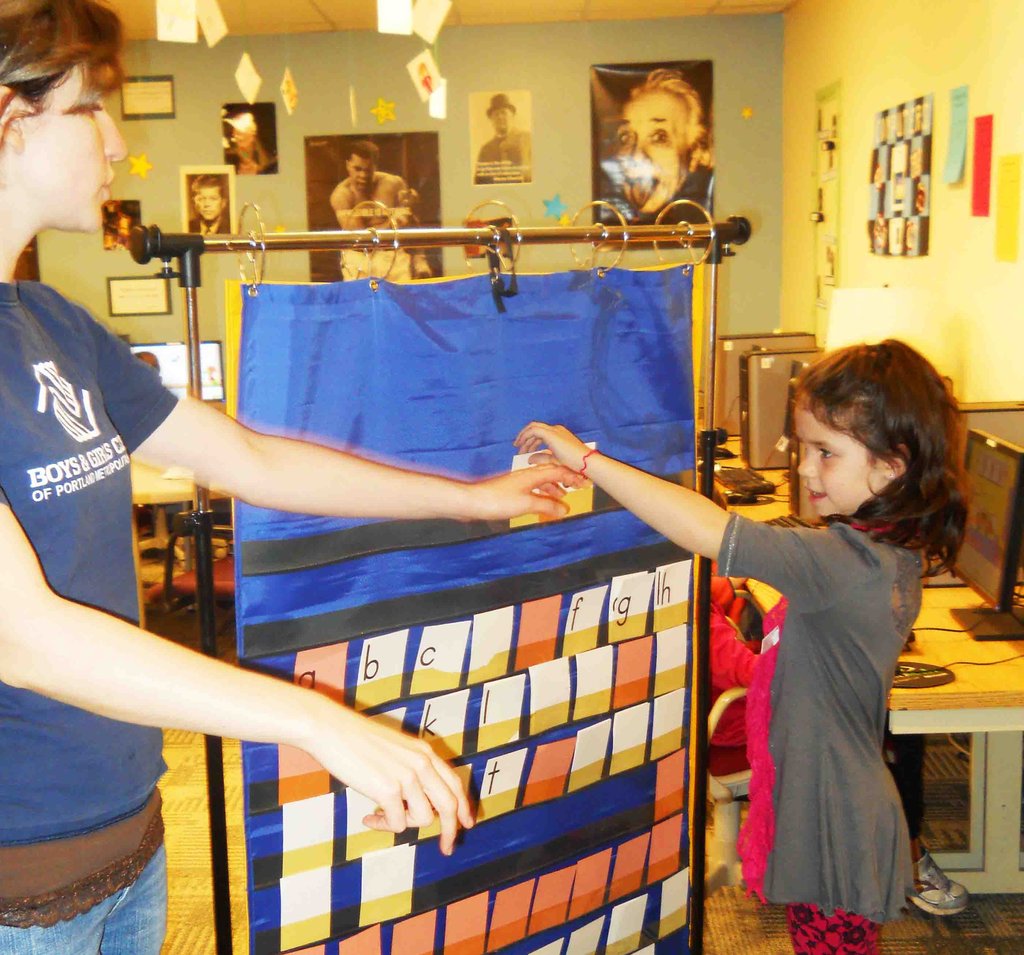
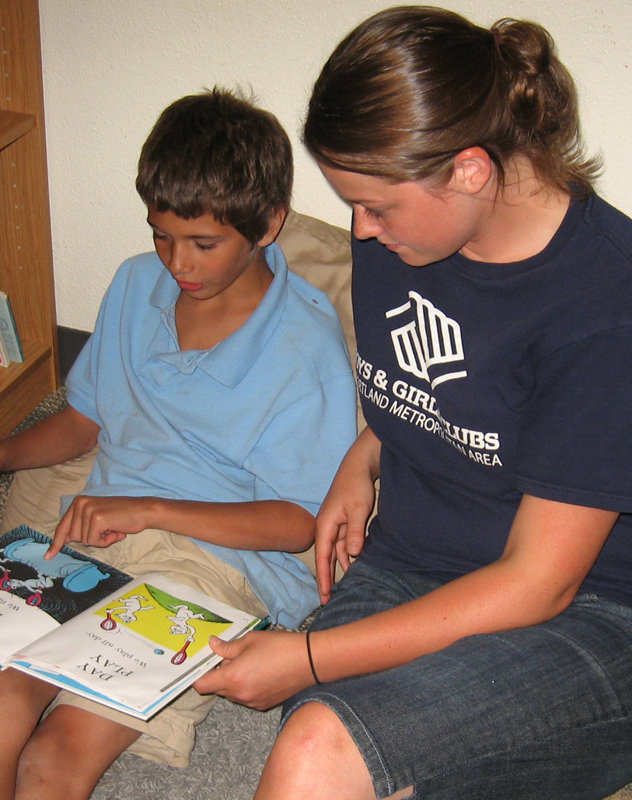
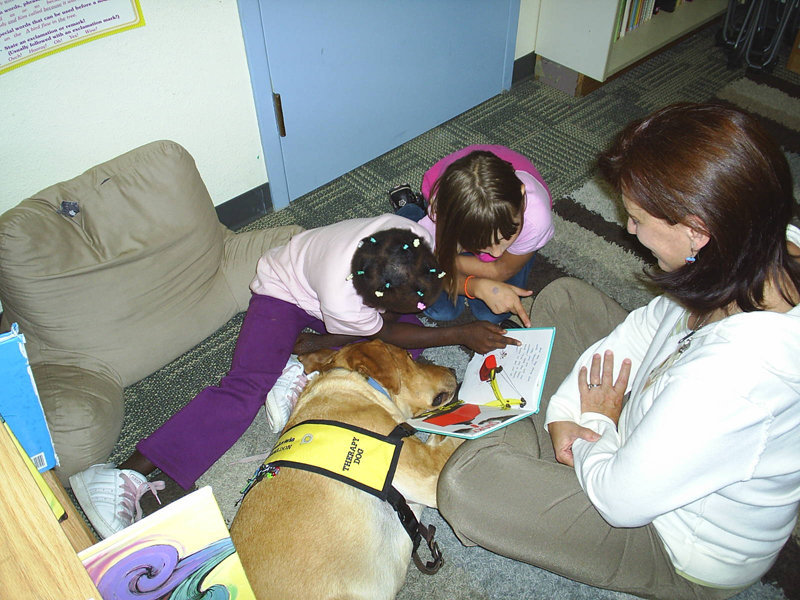
The Literacy Centers are open during the afterschool hours between 2:30 pm to 8:00 pm. Youth participating in the small group sessions receive teacher led and individualized instruction during the hour long session, while they spend the remainder of their Club day engaging in other character building and fun activities. The Centers also provide access to computer programs that are designed to engage youth in the areas of reading progression.
To evaluate and ensure the efficacy of these programs, BGCP has developed many local, state, and national partnerships which have provided their support to development, implementation and ongoing success . These partners represent some of the finest minds in the area of research and the education of youth. Some of these partners include: Dr. Edward Kame'enui, the first U.S. Commissioner on Special Education Research and current Dean Knight professor of Education and head of the Center on Teaching and Learning from the University of Oregon; the Slingerland Institute (Bellevue, WA); Dr. G. Reid Lyon, Executive Vice President for Research and Evaluation at Higher Ed Holdings; Dr. Robert Brooks, Harvard Medical School; Dr. Guinevere Eden, Georgetown University (President of International Dyslexia Association); Dr. Nancy Rovai, the Reading & Dyslexia Center of the Desert (Palm Desert, CA); the Prentice School (Santa Ana, CA); Maryanne Wolf, Director of Center for Reading and Language Research, Tufts University; and Charles Schwab Learning Centers.
“I heard my child read out loud for the first time. It was amazing. She was so far behind and I couldn’t afford the reading programs she needed. The Boys & Girls Club of Portland Literacy Intervention program changed our lives.”
- Sue, BGCP Parent
The evidence related to outcomes of the Targeted Literacy Intervention Programs is clear and has demonstrated not only a great need among the low-income youth who are served by these programs, but their impact upon the healthy learning development of youth who are recognized as struggling readers.
For the past seven years, the positive effects in the lives of youth participating in the literacy programs have been demonstrated through numerous measurable outcomes, such as those previously shared. However, the impact upon the lives of youth members extends well beyond educational achievements. Discovering success through the Targeted Literacy Intervention program is tied such areas as: increased self-confidence, improved work habits and concentration skills, improved social interaction with peers, family and mentors, reduced risky behaviors, and improved school attendance.
Through support of such sources as private foundations, corporations and caring individuals, the program has continued with great success. To ensure the continued effectiveness of the Targeted Literacy Intervention Program BGCP is committed to ensuring ongoing program development and improvements, through:
- Staff development and certification trainings
- Monitoring and coaching of staff
- Collection and analysis of data demonstrating participant achievements
- BGCP's Targeted Literacy Intervention Programs
![Share on Twitter]()
![Share on Facebook]()