By Caleb Probst | Education Manager
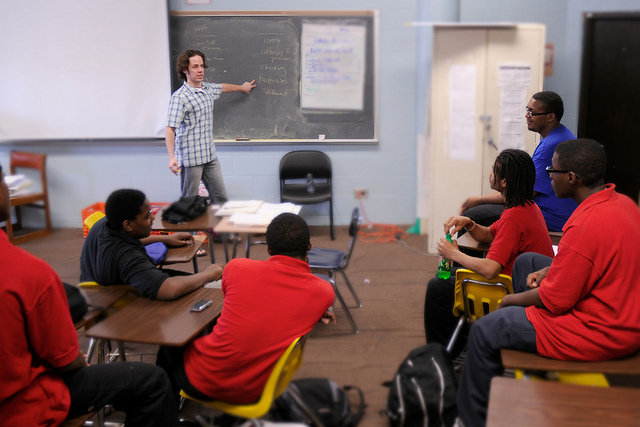
The Chicago Alliance Against Sexual Exploitation began engaging young men in conversations about reducing demand for commercial sexual exploitation through its four-session curriculum, Empowering Young Men to End Sexual Exploitation (EYM), in the 2009-2010 school year. At the beginning of the 2012-2013 school year, CAASE expanded its prevention education efforts to include young women and began facilitating Empowering Young Women to End Sexual Exploitation (EYW) as well. Like EYM, EYW engages students in conversations about demand reduction through critical examination of harmful gender norms and a culture that glorifies the objectification and commodification of sexuality, specifically female sexuality. Historically CAASE has facilitated its companion programs in classrooms that have been segregated by sex. While CAASE acknowledges that this facilitation model reinforces a gender-binary, many students have found discussing sensitive topics of gender and sexual violence easier in male- and female-only spaces. Additionally, many schools segregate their health classes and advisory classes by sex for similar reasons, and as a result CAASE has been able to easily partner with these types of classes.
In the 2016-2017 school year, CAASE began facilitating its four-session curriculum in a wider variety of classes, including social studies, civics, and gender studies classes – all of which are gender-integrated. CAASE modified its facilitation model slightly by co-facilitating the curriculum with one male-identifying facilitator and one female-identifying facilitator. This is the only difference from the sex-segregated programs. The inclusive curriculum is called Empowering Youth to End Sexual Exploitation (EY). CAASE facilitated enough EYM, EYW, and EY classes in the 2017-2018 school year to make comparisons between the three different versions. The pre- and post-surveys suggest that all students improved across all surveyed areas, and the results do not suggest noticeable differences between facilitation models. As such, CAASE will continue to leave the decision to implement its Empowering programs in single-sex or gender-integrated settings to individual schools.
CAASE facilitated the Empowering programs in eight Chicago high schools, and taught an entire grade level in each school. CAASE facilitated EYM at Lake View High School, Urban Prep Englewood, and Northshore Academy. The total number of male participants from these schools was 306, and 211 completed the program and both the pre- and post-tests. CAASE facilitated EYW at Lake View High School and Northshore Academy. The total number of participants from these schools was 192, and 73 completed the program and both the pre- and post-tests. CAASE facilitated EY at Hancock College Prep, Instituto Health Science Career Academy, Perspectives IIT, Perspective Leadership Academy, and Perspectives School of Technology. The total number of participants from these schools was 645, and 326 completed the program and both the pre- and post-tests. Students who did not complete the program were absent for at least one of the four sessions. The total number of participants in CAASE’s four-session curricula was 1,143 – a 22% increase from the previous year. In addition to the eight schools who received the four-session program, an additional nine schools received single-session workshops on topics like consent, gender in media, and sex trafficking. The total number of students who participated in these workshops was 3,407.
Outcomes
CAASE measures changes in knowledge, attitudes, and intended behaviors of students who complete the Empowering programs using pre- and post-surveys with 10 identical questions. The first eight questions are measured using a 5-point Likert scale, while the final two are free response questions. The student outcomes across all survey questions were overwhelmingly positive – regardless of whether the student went through EY, EYM, or EYW.
Summary of Likert-survey Questions –
Students reported being less likely to use these words to describe a girl after completing an Empowering program. In written reflections, over 95% of students wrote that these words are harmful because they “offend all women,” “diminish their humanity,” and “can lead to bullying” or “can lead to harmful things that are even worse.”
Students reported being more likely to call someone out for using sexist and derogatory language after completing one of CAASE’s Empowering programs. While all students demonstrated improvement in this question, students in EYW demonstrated the largest change – increasing an average of 0.74 points, on a 5-point scale.
Strip clubs represent a major gateway into the illicit sectors of the sex industry, and it is common for men who purchase sex from prostituted people to say that their first experience with paid sex occurred in a strip club[2]. This is one reason that CAASE is pleased to report that students are more likely to discourage a friend from patronizing a strip club after completing a CAASE program. Students who completed EY showed an average point increase of 0.86. Male-identifying students in the co-ed program showed an increase of 1.06 points, compared to just 0.33 of their counterparts in the male-only program. One possible explanation for this difference may be that male students in EY had the opportunity to hear the opinions and experiences of their female classmates, and as such were more likely to see strip clubs as objectifying and harmful to women.
Strip club patronage is connected not only to increased demand for the commercial sex industry, but also has negative impacts on the safety of women. Nearly every woman working in a strip club has been physically or sexually assaulted while working[3]. All students indicated that they would be more likely to refrain from patronizing a strip club after completing their program. As one young man wrote in a reflection, “from now on I don’t want to go to a strip club for any future milestones.” When examining the responses of just young men, those in EY showed a larger average increase – 0.97 compared to 0.62. However, a smaller percentage of young men in EYM indicated a strong desire to go in the first place – 21% compared to 39%.
Men who purchase sex often indicate that they seek out sex acts seen in pornography[4], and men who view pornography are more likely tolerate sexual aggression and rape[5]. While all students increased the degree to which they believed pornography posed a problem by nearly half a point, young women considered pornography more problematic than did young men. The average post-survey response scores for female students in EY and for students in EYW were 4.27 and 4.51, respectively. The same scores for male students in EY and for students in EYM were 3.18 and 3.26, respectively.
Students showed only minor, albeit positive, shifts in their attitudes around this question, because most students started the program already strongly agreeing with the statement. The group that showed the largest average point increase was EYM students, who were also the only group of students whose average starting point was below 4.
One objective of the Empowering programs is for students to demonstrate increased empathy for people exploited in the sex industry. One way that students demonstrate empathy for prostituted people is by acknowledging that prostitution is not “easy money,” and is an incredibly difficult situation to exit for myriad reasons. Students indicated disagreeing more strongly with this statement after completing the programs and in response to the open-ended question, “Why does prostitution exist?” there was an 81% decrease in the students who responded “easy money.”
Again students showed only minor shifts in their answers to this question, because students overwhelmingly indicated that they would tell a friend to absolutely refrain from this behavior. In the pre-tests, no female student indicated that she would condone this activity. For young men that number was just 15, and dropped to 5 in the post.
Summary of Free-response –
At its most basic level, the commercial sex industry exists because some people are capable of perceiving the bodies of other people as objects they can purchase. Words like “slut” and “thot,” as well as degrading media imagery contribute to the objectification of women in society. Being able to explain objectification and why it is harmful is a key first step in standing against sexual exploitation. Less than half of students were able to correctly explain objectification before participating in the Empowering curricula, but afterwards 92% could.
There are of course many reasons why the commercial sex industry exists, and without information to counter the overriding social narrative many people explain the existence of prostitution in ways that tend to focus on the situations of the individuals being sold. It is less common, and perhaps more important, that people understand that this is a demand-driven and exploitative industry.CAASE facilitators found this societal trend to hold true in student responses in the pre-surveys. The most common responses alluded to the variety of challenging circumstances experienced by people in sex trade, followed next by responses that suggested prostitution is “easy money.” In the post-surveys however, the most common responses identified buyers or traffickers as the reason prostitution exists – an almost three-fold increase in students who considered the problem to be one of demand.
Final thoughts
When discussing the impact of Empowering Young Men, Empowering Young Women, and Empowering Youth in the 2017-2018 school year, it is hard to remove #MeToo from the conversation. While CAASE does not have empirical data to measure the effects that this sudden shift in the national conversation had on classroom discussions, there certainly seems to have been a change. In previous years, students seemed far more inclined to disbelieve women and exonerate men, but this year students seemed more willing to grapple with the difficulties and nuances that exist within the countless narratives of sexual harm. Beneath the surface of every story of sexual violation – harassment, assault, or exploitation – is the absence of consent. Sometimes the word “no” is ignored, other times the word is never uttered, and students rarely have the opportunity to have a safe and informed discussion about why “no” can be both hard to say and hard to hear. CAASE is an organization seeking to eliminate all forms of sexual harm, and the student discussions this year revealed the need to incorporate a more explicit conversation about consent into the curricula. In 2018-2019, CAASE will add an additional session on consent to its Empowering programs that will move the conversation beyond “no means no” and into an exploration of what “yes” really looks like.
[1] Acronym meaning: That Hoe Out There, or That Hoe Over There
[2] Durchslag, Rachel and Samir Goswami (2008). Deconstructing the Demand for Prostitution. Chicago Alliance Against Sexual Exploitation. May, 2008.
[3] Hopsopple, Kelly (1998). Strip Club Testimony. The Freedom and Justice Center for Prostitution Resources: A Program of Volunteers of American, Minnesota.
[4] ibid.
[5] Wright, P., Tokunaga, R. S., & Kraus, A. (2015). A Meta-Analysis Of Pornography Consumption And Actual Acts Of Sexual Aggression In General Population Studies. Journal Of Communication, 66(1), 183-205.
Project reports on GlobalGiving are posted directly to globalgiving.org by Project Leaders as they are completed, generally every 3-4 months. To protect the integrity of these documents, GlobalGiving does not alter them; therefore you may find some language or formatting issues.
If you donate to this project or have donated to this project, you can receive an email when this project posts a report. You can also subscribe for reports without donating.