By Thallis Victor Cruz | Donor Relations Analyst
Key Projects and Strategic Priorities for 2026
In 2026, we pursue four major institutional objectives:
Key Achievements to Date by Todos Pela Educação Anchored in Educação Já! (Education Now)
1. Launch of Educação Já States
In April, we launched Educação Já States, an initiative designed to support candidates for state governor in developing education policy proposals for the 2026 elections. The platform provides access to state-by-state overviews featuring new data for each of Brazil's 26 states and the Federal District.
The materials focus on access, educational pathways, and learning outcomes, while offering a comprehensive picture of the progress made and the main challenges faced by each state education system — issues that should be prioritized by the next state administrations.
We also published the document Contributions to Basic Education, which serves as a resource to support the development of government plans and strengthen effective public education policies.
This initiative is particularly important because an analysis of education data across Brazil's states shows that no state ensures that more than 10% of students achieve adequate learning in both Portuguese and Mathematics by the end of basic education, highlighting the urgent need for stronger state-level education policies.
2. Educação Já Annual Meeting 2026
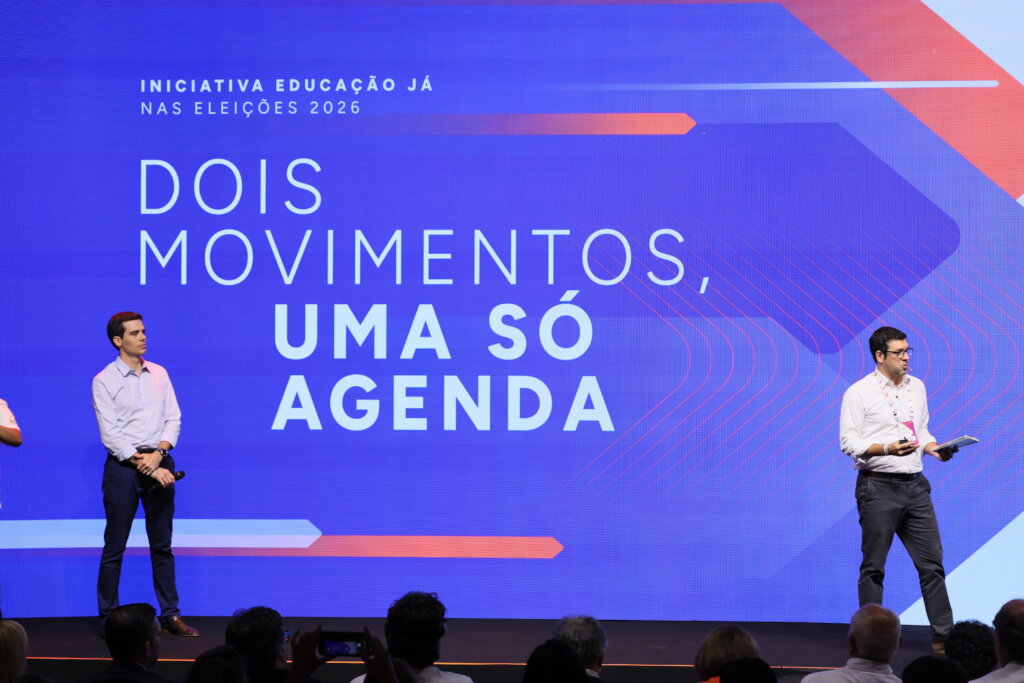
On April 14, Todos Pela Educação held the 2026 Educação Já Annual Meeting. This year's event was particularly significant, reinforcing the importance of placing basic education at the center of public debate and making it a top priority for the upcoming electoral cycle and the next administrations.
Key topics included the National Education Plan (PNE), the modernization of curriculum and assessment policies, federal governance, the National Education System (SNE), and contemporary challenges affecting schools, such as the impact of social media use among children and adolescents.
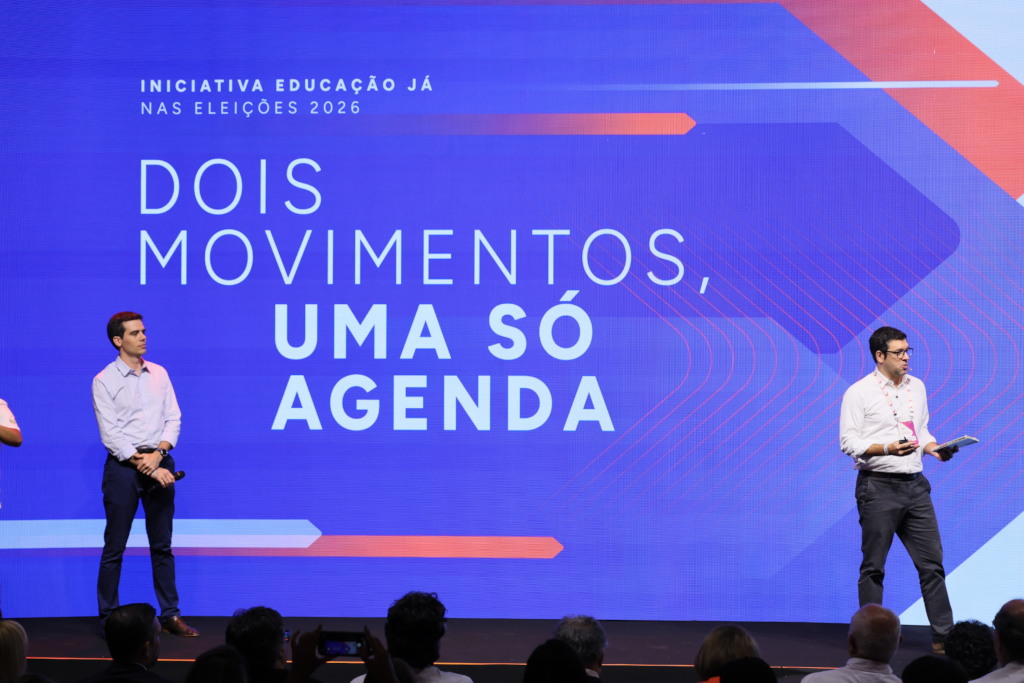
The event also brought together public leaders, education experts, teachers, and representatives from civil society and the private sector. It also marked the launch of the publication Two Movements, One Shared Agenda, developed collaboratively by education experts, lawmakers from different political parties and across the political spectrum, public officials, and civil society organizations.
3. Leadership Development Program for Education Administrators
In May, we held another session of the second edition of the Leadership Development Program for Education Administrators.
As highlighted in the previous report, this year's program continues to focus on fostering the exchange of experiences and practical solutions to the challenges faced by education systems. In addition, the 2026 edition maintains its central theme of implementation, providing a space for participants to share best practices for implementing education policies at the municipal level.
The program is delivered in partnership with the Institute of Advanced Studies (IEA) at the University of São Paulo (USP) through the Sérgio Henrique Ferreira Chair, which is responsible for certifying participants.
4. Launch of the Research Grant Call
To foster research and encourage the use of the Educational Inclusion Index (IIE), Todos Pela Educação, in partnership with Instituto Natura and B3 Social, launched a research grant call aimed at advancing studies on educational inclusion in Brazil.
Committed to promoting diversity, the call welcomed researchers from all regions of the country. Applications were open to individuals or research teams, including undergraduate and graduate students, academic researchers, and professionals from both the public and private sectors.
Applications were accepted from April 2 to May 8, with funding awarded to up to six proposals across two research tracks:
1) Applied Research – Studies using the IIE as a primary or complementary tool to investigate educational inequalities, public policies, and broader social issues, such as health, employment, and poverty.
2) Methodological Innovation – Projects focused on improving the technical aspects of the index, including automating calculations and integrating new data sources.
5. Initial Teacher Education: A New Round of Focused Advocacy
Todos Pela Educação has long advocated for high-quality initial teacher education. As a result of our sustained advocacy efforts, important progress has been made in limiting fully online teacher education programs. Drawing on evidence-based research, we have consistently argued that 100% online teacher preparation compromises the quality of teachers entering the classroom.
In May 2024, the Ministry of Education (MEC) prohibited fully online undergraduate teacher education programs and established that at least 50% of coursework should be delivered in person.
However, in February 2026, this issue faced a setback. The National Education Council (CNE) introduced a proposal to reduce the minimum in-person requirement from 50% to 40%, with support from the Ministry of Education.
One of the central recommendations in Todos Pela Educação's analysis is that teacher education programs should maintain at least 50% of their coursework in person. This recommendation recognizes that essential practical experiences required for effective teaching cannot be adequately developed through online instruction alone.
In April, the Ministry of Education released the results of the ENADE Licenciaturas, which revealed concerning outcomes: only 20% of future teachers achieved an adequate level of proficiency. In presenting the results, the Ministry grouped students classified as both "basic" and "adequate" into a single category of individuals considered prepared to enter the classroom.
To reinforce our advocacy, Todos Pela Educação published a technical note highlighting the positive aspects of the CNE proposal while emphasizing why maintaining substantial in-person instruction is essential to ensuring the quality of initial teacher education.
We also engaged extensively with the media to bring greater visibility to the issue and promote informed public debate. In parallel, Todos Pela Educação expanded its digital advocacy by translating the evidence into accessible, evidence-based communications designed to engage broader audiences through social media.
In June, Todos Pela Educação published a new technical note to contribute to the public consultation launched by the National Education Council (CNE).
The publication supports maintaining the requirement that at least 50% of undergraduate teacher education coursework be delivered in person, as well as 20% of coursework through synchronous, instructor-mediated activities, arguing that these elements strengthen teacher learning, pedagogical support, and the integration of theory and practice.
The technical note also highlights as a major advancement the proposed reorganization of supervised teaching internships, including an earlier start in teacher education programs, stronger collaboration between universities and Basic Education schools, and better integration between internships and the curriculum.
Overall, the document expresses support for the proposal under public consultation while offering recommendations to further strengthen the quality of initial teacher education and support the implementation of Brazil's new National Curriculum Guidelines for teacher preparation.
During May and June, Todos Pela Educação also intensified its direct engagement with members of the National Education Council (CNE) and key stakeholders involved in the debate. During the same period, the organization provided technical support for public position statements issued by leading education organizations, including Atricon, CNTE, Consed, FNP, FPME, Uncme, Undime, and UNE.
On June 23, following a vote by the National Education Council, Brazil approved a new regulatory framework for initial teacher education. The decision preserved important advances, including the requirement that at least 50% of coursework in teacher education programs be delivered in person, preventing a rollback from an earlier proposal that would have reduced this requirement to 30%. At the same time, the outcome fell short of the unprecedented mobilization calling for more ambitious reforms to strengthen teacher preparation and professional development.
While representing meaningful progress, the final framework does not fully address other critical challenges necessary to improve the quality of initial teacher education, such as expanding practical learning experiences, strengthening interaction between teacher candidates and faculty, and ensuring consistent pedagogical support throughout undergraduate training. As Todos Pela Educação has consistently emphasized, valuing the teaching profession requires a comprehensive and coordinated set of teacher policies, with high-quality initial teacher education serving as a foundational element for improving student learning outcomes.
7. Todos Pela Educação's Position on Homeschooling
Federal Bill No. 1,338/2022, currently under consideration in the Brazilian Senate, seeks to regulate homeschooling in Brazil and has reignited public debate over whether home education can replace formal schooling for children and adolescents.
The discussion centers on several key questions:
Todos Pela Educação opposes the broad regulation of homeschooling in Brazil. The Brazilian Constitution establishes that education should promote the full development of individuals, prepare them for citizenship, and qualify them for the workforce. In our view, homeschooling cannot fully achieve these objectives.
By limiting children's and adolescents' daily interactions to a narrower family environment, homeschooling reduces opportunities to engage with diverse perspectives, ideas, values, and social realities, weakening essential dimensions of education such as respect for diversity, social development, and emotional learning.
Schools are far more than places for academic instruction. They provide an irreplaceable environment for learning while also ensuring access to school meals, social protection, and opportunities to develop a broad range of cognitive and socio-emotional skills. For these reasons, formal schooling cannot be replaced by home education.
Beyond its implications for children's development, there is also a question of public policy priorities. Brazil continues to face significant challenges in learning outcomes, educational inequality, and student retention. Directing public financial, technical, and administrative resources toward regulating and overseeing a model with limited reach would divert attention from more urgent education priorities.
Should the legislative debate move forward, Todos Pela Educação believes that homeschooling, if permitted, should be restricted to exceptional and duly justified circumstances, subject to public oversight and limited to cases in which regular school attendance is demonstrably impossible. It should not be recognized as a standard alternative to in-person schooling.
8. Continuing Teacher Professional Development in the Legal Amazon
The Center for Applied Studies on Teaching and Learning Practices (Ceapea), part of Todos Pela Educação, in partnership with Lepes (Laboratory for Social Economics and Education Studies and Research) and the Inter-American Development Bank (IDB), published the study "Institutional Conditions for the Provision of Continuing Teacher Professional Development." The research evaluates the State Education Plans of the nine states that make up Brazil's Legal Amazon.
The study found that all nine states recognize continuing teacher professional development as a priority and guarantee this right within their legal and policy frameworks. However, significant challenges remain, including the lack of clearly defined institutional responsibilities, limited coordination mechanisms across education agencies, and insufficient conditions to enable teachers to participate effectively in professional development activities.
With the approval of Brazil's new National Education Plan (PNE) and the ongoing revision of state and municipal education plans, the study provides evidence to help reposition continuing professional development as a comprehensive state policy, rather than simply a collection of training courses. Strengthening the institutional conditions that support teacher development is essential for enhancing the teaching profession and expanding learning opportunities for students across Brazil.
Links:
Project reports on GlobalGiving are posted directly to globalgiving.org by Project Leaders as they are completed, generally every 3-4 months. To protect the integrity of these documents, GlobalGiving does not alter them; therefore you may find some language or formatting issues.
If you donate to this project or have donated to this project, you can receive an email when this project posts a report. You can also subscribe for reports without donating.



Support this important cause by creating a personalized fundraising page.
Start a Fundraiser