By MSF Staff | MSF-USA
Bangui, the capital of the Central African Republic, has been convulsed by violence for weeks, but most of the city’s hospitals are no longer functioning. Doctors Without Borders/Médecins Sans Frontières (MSF) runs the only trauma unit in the city, at Community Hospital, where staff have treated more than 800 patients—most with bullet or knife wounds—since fighting broke out in early December. Here, project coordinator Jessie Gaffric, who manages MSF’s operations at Community, describes the situation:
“Last November, we had already identified a significant need for surgical care and had begun working [at Community] on December 2. No one suspected then that the situation would explode three days later.
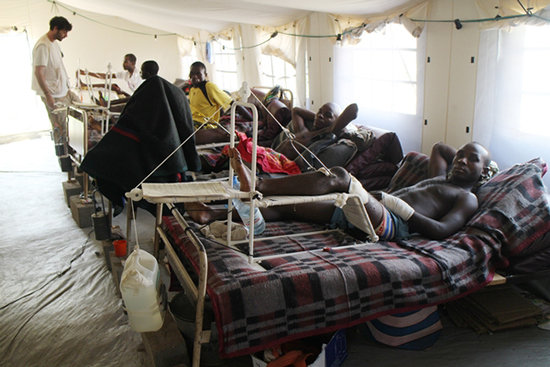
“That day, we received 120 wounded patients and another 60 the following day. We were submerged. We had to manage the situation under extremely difficult conditions. It was chaos. Because the hospital did not have enough room, we set up tents next to the building to house patients who needed post-operative care. Over time and as the emergency continued, we improved the patient pathway, management of the emergency department and the quality of care.”
“On January 11, following the resignation of former president Mr. Djotodia, we received more than fifty patients referred by other MSF health centers located in Bangui or in IDP camps in the town.
“One man came by ambulance. He had been shot in the foot and tried to treat his injury himself. The infection was so severe that his foot had to be amputated. Another had had a motorcycle accident. A third had knife wounds. Patients stream in every day and every case is different. On average, 20 wounded people come to the hospital every day, with the flow peaking on certain days.
“Our primary challenges have to do with insecurity and time management, specifically because we must leave the hospital no later 6 pm, when curfew begins. Nine expatriates and approximately 50 Central African staff work in this facility. Of those, some are living in the displaced persons camps. They cannot come to work when fighting occurs or must even stay and sleep in the hospital. What is also striking is the severity of the wounds, whether from a knife or machete. They attest to the level of violence and its relentlessness.”
MSF has managed both of the Community Hospital’s two operating rooms until now. The International Committee of the Red Cross (ICRC) recently took over one of them. Ultimately, the ICRC is expected to assume responsibility for the entire surgical department and MSF is preparing to work in another hospital in the city.
Bangui, the capital of the Central African Republic, has been convulsed by violence for weeks, but most of the city’s hospitals are no longer functioning. Doctors Without Borders/Médecins Sans Frontières (MSF) runs the only trauma unit in the city, at Community Hospital, where staff have treated more than 800 patients—most with bullet or knife wounds—since fighting broke out in early December. Here, project coordinator Jessie Gaffric, who manages MSF’s operations at Community, describes the situation:
“Last November, we had already identified a significant need for surgical care and had begun working [at Community] on December 2. No one suspected then that the situation would explode three days later.
“That day, we received 120 wounded patients and another 60 the following day. We were submerged. We had to manage the situation under extremely difficult conditions. It was chaos. Because the hospital did not have enough room, we set up tents next to the building to house patients who needed post-operative care. Over time and as the emergency continued, we improved the patient pathway, management of the emergency department and the quality of care.”
“On January 11, following the resignation of former president Mr. Djotodia, we received more than fifty patients referred by other MSF health centers located in Bangui or in IDP camps in the town.
“One man came by ambulance. He had been shot in the foot and tried to treat his injury himself. The infection was so severe that his foot had to be amputated. Another had had a motorcycle accident. A third had knife wounds. Patients stream in every day and every case is different. On average, 20 wounded people come to the hospital every day, with the flow peaking on certain days.
“Our primary challenges have to do with insecurity and time management, specifically because we must leave the hospital no later 6 pm, when curfew begins. Nine expatriates and approximately 50 Central African staff work in this facility. Of those, some are living in the displaced persons camps. They cannot come to work when fighting occurs or must even stay and sleep in the hospital. What is also striking is the severity of the wounds, whether from a knife or machete. They attest to the level of violence and its relentlessness.”
MSF has managed both of the Community Hospital’s two operating rooms until now. The International Committee of the Red Cross (ICRC) recently took over one of them. Ultimately, the ICRC is expected to assume responsibility for the entire surgical department and MSF is preparing to work in another hospital in the city.
- See more at: http://www.doctorswithoutborders.org/news/article.cfm?id=7268&cat=voice-from-the-field#sthash.65TT61ZG.dpufProject reports on GlobalGiving are posted directly to globalgiving.org by Project Leaders as they are completed, generally every 3-4 months. To protect the integrity of these documents, GlobalGiving does not alter them; therefore you may find some language or formatting issues.
If you donate to this project or have donated to this project, you can receive an email when this project posts a report. You can also subscribe for reports without donating.