By Susan Berta | Orca Network Director, CPSMMSN Coordinator
Orca Network's Central Puget Sound Marine Mammal Stranding Network, as well as our Whale Sighting Network, have been busy all year assisting NOAA Fisheries, researchers, and other regional Stranding Networks in tracking emaciated gray whales throughout the Salish Sea, and being on call for live or dead stranded gray whales in our stranding region (Island, Skagit and N. Snohomish counties) and beyond.
Beginning last year, we started to see signs that the gray whale population was not doing well. On our annual trip to San Ignacio Lagoon in March 2018, there were fewer gray whales in the mating/birthing lagoons, and fewer calves being born. In North Puget Sound, where we help monitor a small population of gray whales known as the "Sounders" or North Puget Sound Grays, we had several "new" whales show up in the spring of 2018, to feed on ghost shrimp along with the 10 - 12 regulars who come into North Puget Sound each March - May. That has happened in the past, but usually during years where the food supplies up north in the Bering Sea summer feeding grounds is sparse. What was even more unusual was that several of these new gray whales didn't leave North Puget Sound when the "Sounders" left in late spring - and one of them was still in the area feeding when the Sounders returned in the spring of 2019! This was something Cascadia Research had never seen before in their 30+ years of research, nor had we, in our 20+ years of tracking the gray whales in Puget Sound.
Spring of 2019 also brought in more "new" whales to North Puget Sound, and many emaciated gray whales who wandered into the inland waters in search of food, often turning south into Puget Sound waters, some of them dying there. As of this date, we still have at least one gray whale remaining in the area, feeding off the northwest shores of Whidbey Island, months after the others have headed north. On our March 2019 trip to San Ignacio Lagoon in Baja we also observed more "skinny" gray whales, and fewer mom/calf pairs - and according to NOAA Fisheries, 50-55% of the free-ranging whales observed in the birthing and mating lagoons in Mexico this winter were reported as “skinny” compared to the annual average of 10-12% “skinny” whales normally seen. Fortunately the mother whales we did see with calves, looked healthy and well fed.
On May 29, 2019, NOAA Fisheries declared an "Unusual Mortality Event" gray whales (warning - this website contains photos of deceased gray whales, but is the only site with complete and constantly updated info. about this issue) - at that time a total of 147 dead whales had been reported, with ~73 dead whales in Mexico, 69 whales in the U.S. (37 in CA; 3 in OR; 24 in WA, 5 in AK), and 5 whales in British Columbia, Canada. For the U.S., the historical 18-year 5-month average (Jan-May) is 14.8 whales for the four states for this same time-period.
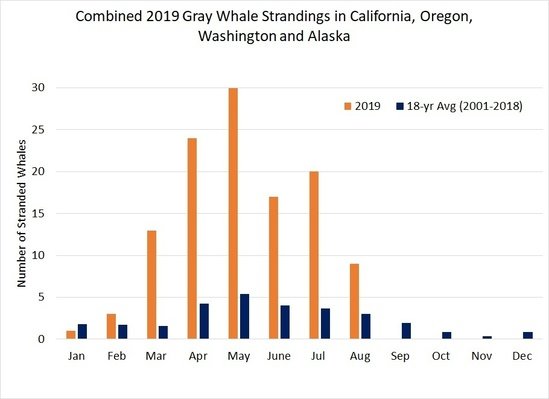
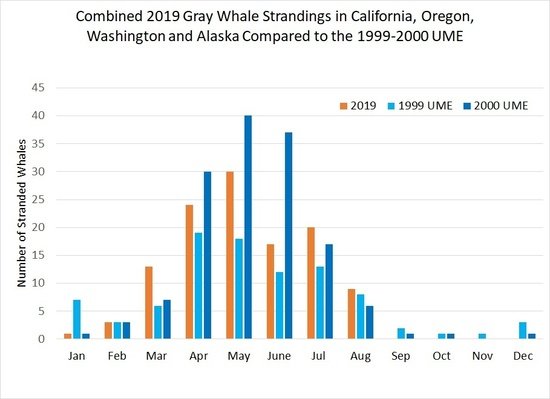
As of Sept. 5, 2019, the numbers total 208, with 81 in Mexico; 117 in the US (37 in CA; 6 in OR; 34 in WA; 40 in AK); and 10 in Canada. See NOAA Fisheries chart below for comparison by month to the 18 year average number of gray whale strandings.
Common findings include emaciation in both dead and live free-ranging whales, but the investigation continues with a research team who is examining reports and lab results from the stranded whales who are in fresh enough condition to be necropsied and samples tested. Declaring an Unusual Mortality Event (or UME), brings more focus and resources to help the investigation, including significant expertise of a Working Group and an Investigative Team, and assistance from stranding network partners, including volunteer organizations such as CPSMMSN, to respond to gray whale strandings. The UME also triggers the development of a response plan and makes available additional resources to respond to further strandings.
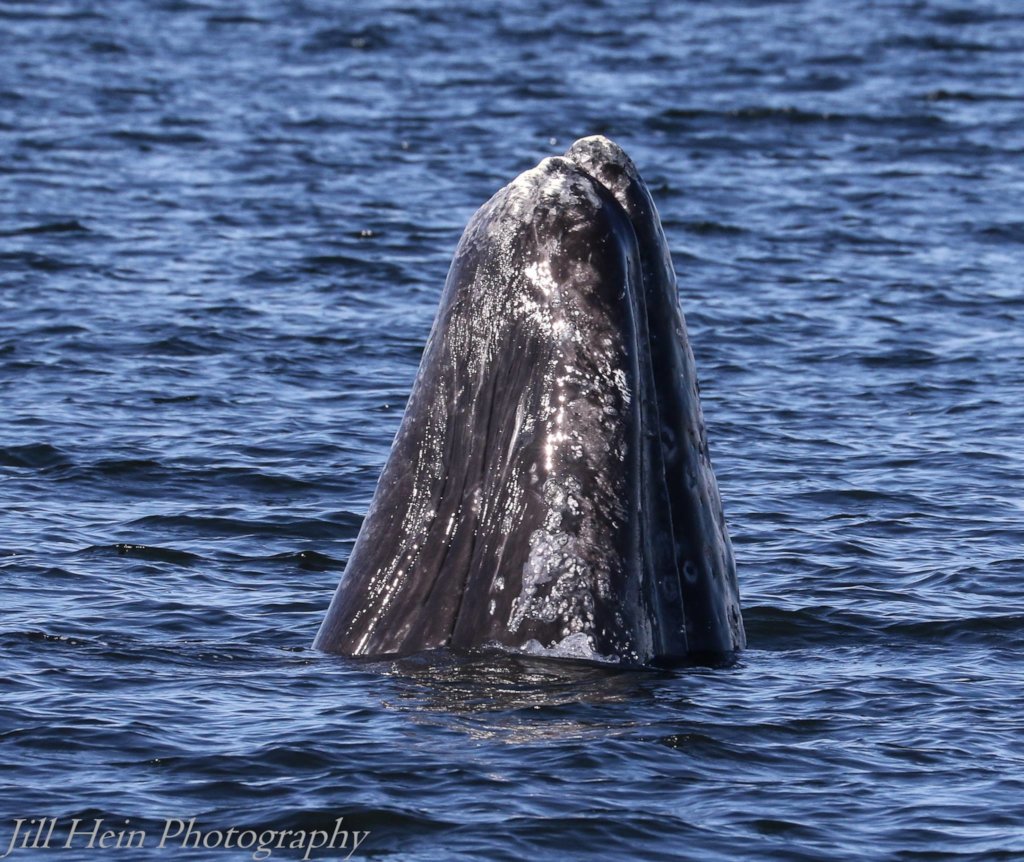
We have not had any gray whale strandings in our region as of yet this year, but one stranded in Everett, WA, just beyond our region, and another who stranded in Seattle was towed to Whidbey Island for necropsy by Cascadia Research and WA Dept. of Fish and Wildlife. CPSMMSN members observed the necropsy, and a team of our volunteers was allowed to collect baleen for educational purposes, and one of the pectoral fins for display at our Langley Whale Center. Once decomposed, cleaned up and re-articulated, the pec fin will show 1) how LARGE gray whale pec fins are, and 2) how very similar they are to our own human hands. Each spring we observe gray whales feeding on ghost shrimp in our mudflats, so we often see one pec fin extended way above the water as they lie on their side to scoop and suck up the shrimp-filled mud.
The last gray whale UME took place in 1999/2000, and coincidentally one of the grays who stranded on Whidbey Island is what got our current CPSMMSN started 20 years ago! A group of us responded to volunteer when this whale stranded, and we decided to retrieve the entire skeleton and re-articulate it - and that whale, "Rosie" is still on display at the Coupeville Wharf on Whidbey Island, complete with the baleen installed in the upper jaws, and has educated tens of thousands of visitors to Coupeville about the size, history, and grace of our gray whales.
As you can see from the last chart below, which compares the current UME to the one that occurred in 1999/2000, we are likely going to see further strandings in the year ahead, and stranding networks such as CPSMMSN are gearing up to be prepared for an increase in the number of gray whale strandings, which is made more difficult given many Stranding Networks (like ours) do not receive any federal or state funds to support the work we do, so support from donors like YOU are very much appreciated!
Thanks so very much for your interest and support ~
Links:
Project reports on GlobalGiving are posted directly to globalgiving.org by Project Leaders as they are completed, generally every 3-4 months. To protect the integrity of these documents, GlobalGiving does not alter them; therefore you may find some language or formatting issues.
If you donate to this project or have donated to this project, you can receive an email when this project posts a report. You can also subscribe for reports without donating.