By Yana Zolotovitskaya, Olga Lavut | Olga Yushina
VARYA
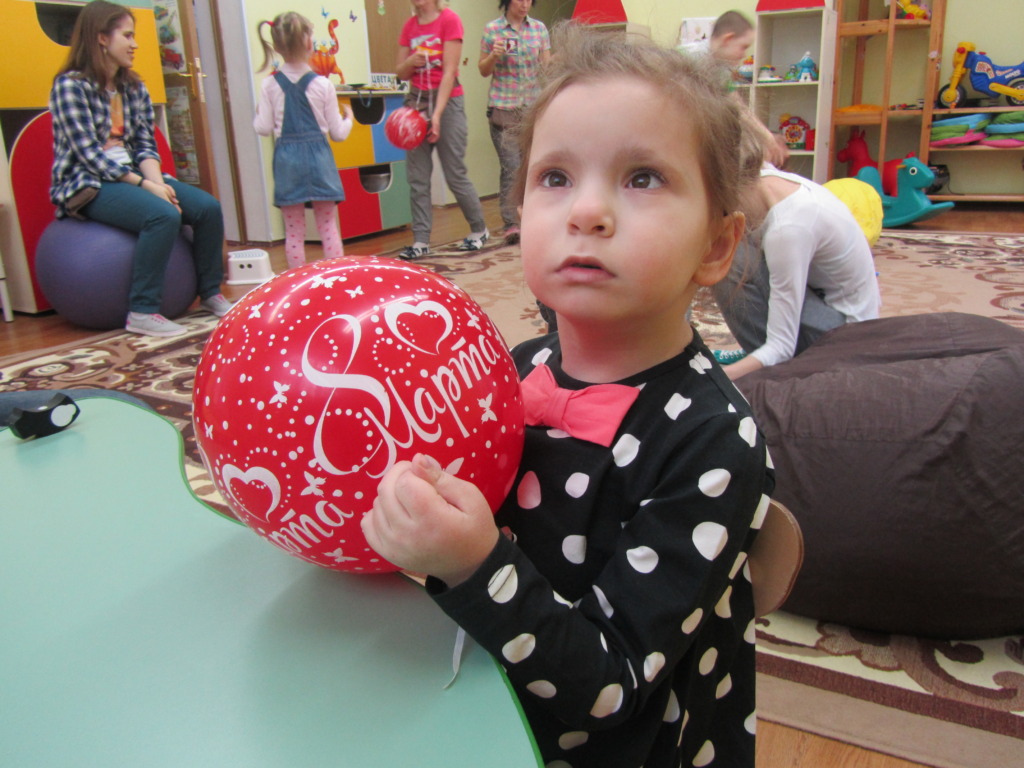
The teachers and tutors have many nicknames for Varvara – or Varya – including “Baby Bear” and “Varenik”, which means “Dumpling” in Russian. Varya has CP, an organic disorder of the brain and the central nervous system. When she was born, the doctors’ verdict was unanimous – Varya will never learn anything or be able to take care of herself. The medical system suggested that the mother give up her daughter to the state, as it always did in such situations. Varya’s mother Masha, however, decided otherwise, and took Varvara home from the hospital. Of course, she believed in herself and in her little girl. She is a single mother, and she calls Varya “the girl who fell from the sky”. From the very first day, Masha has been working hard, doing all kinds of activities and exercises with Varya. She teaches her every little thing, and brings her to clinics for expensive rehabilitative treatments.
When in 2014 we first opened the preschool group of our project, Masha and Varya were the first on our list of prospective students. Masha travels across half the town on public transportation to bring Varya to the preschool. They live in one of the residential neighborhoods on the outskirts of Moscow, in a tiny apartment. But there is nothing Masha can’t do when it comes to her Varenik.
When Varya first started attending our preschool, she could walk, she responded when her name was called, and she was able to carry out a simple command with support. She wasn’t able to talk – she just made very loud noises that resembled the growling of a baby bear. Varya was a large three-year-old and grew fast, which makes motor abilitation more complicated for children with similar disorders. Everyone immediately started calling Varya “our baby bear” – for her voice, for her wobbly gait, for being so tall, and for how insistent she was in achieving her goals.
When Varya first joined our project, we developed individual programs to teach her the basic self-care skills and to introduce alternative communication methods. We also created behavioral protocols for socialization, along with physical therapy and speech therapy programs.
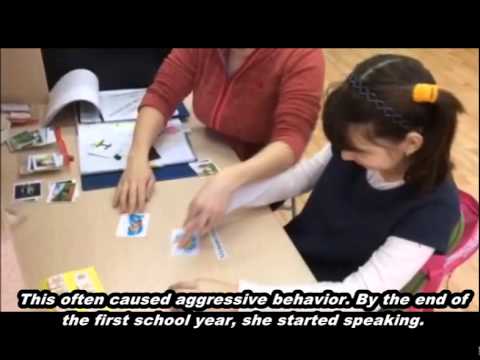
After three years in our project, Varvara has learned to respond well to her name, to follow verbal instructions for activities at the desk, to use a fork and spoon, to drink from a cup, and to ride a scooter. It took two years to teach her to use the PECS, a form of augmentative and alternative communication. Varya has bad sight, and at first, it was very hard for her to distinguish the images on PECS cards. Our experts had to try a few different strategies and approaches to teach her to tell the cards from each other and to connect the images on them with real objects. Today, Varya is able to go very far – even distances that are very significant for her – to tell an adult what she wants and to ask for help. A speech therapist taught Varya to rhythmically sing out vowels, to pronounce many different syllables, and, most importantly, to say the word “Mom”.
In another year, Varvara will start first grade together with “regular” kids. There is a long school journey ahead of her, and she will definitely learn many new, useful skills. We do not doubt that.
Project reports on GlobalGiving are posted directly to globalgiving.org by Project Leaders as they are completed, generally every 3-4 months. To protect the integrity of these documents, GlobalGiving does not alter them; therefore you may find some language or formatting issues.
If you donate to this project or have donated to this project, you can receive an email when this project posts a report. You can also subscribe for reports without donating.