By International Bridges to Justice | International Bridges to Justice
2013 QUATERLY REPORT: FIGHTING ILLEGAL JUVENILE DETENTION IN BURUNDI
During the last three months, International Bridges to Justice (IBJ) has continued to assist children in conflict with the law, in the provinces of Bujumbura, Mairie, Bujumbura Rural, Mwaro and Cibitoke.
The roundtable discussions, organized by IBJ, focused on juvenile justice relevant innovations that have been brought about by the new Criminal Procedure Code. As a consequence of these discussions, it was noticed that there has been better implementation of Article 166 of the Code which mandates the defense of juveniles by a qualified lawyer. A notable example of the impact of IBJ’s work is the case of Bernard, 17, who was accused of rape. As per the law in Burundi, a person is considered to be a ‘juvenile’ if he/she is under 18 years of age. In Bernard’s case, the Court of Bujumbura, Rural refused to proceed with the matter since the 17 year old boy was not represented by a lawyer. The judges postponed the case to another date, and in the meantime, IBJ was called upon to assist in the matter. The network of juvenile legal aid providers in Bujumbura, ‘Coordination de l’assistance judiciaire des mineurs en conflits avec la loi’ refers many criminal cases to IBJ. One of its members has said about IBJ – ‘IBJ lawyers have proven their competencies in assisting children accused of crimes’.
Besides Bujumbura, Mairie and Bujumbura Rural, IBJ lawyers also assisted juveniles in the provinces of Mwaro and Cibitoke. These are two of the seven provinces in Burundi which do not have prisons situated within their geographical limits. This situation creates a unique problem for juvenile detainees. Since they are detained in prisons remotely situated from the competent court, their trials are not conducted in a timely manner. To overcome this challenge, itinerant hearings of the courts are organized to expedite the case of juveniles detained in these remote prisons. In the provinces of Cibitoke and Mwaro, transportation of Magistrates is supported by the Belgian Technical Cooperation.
One of the cases that IBJ has dealt, within these past three months, is a case of robbery wherein three children and two adult men have been jointly accused.
In this case, the two accused adults were not in detention; one of them had been released by the police, while the second had escaped from prison. What is shocking to note is that the case has been pending for a long time due to the absence of the two co-accused adults and, for this entire period, the three juveniles were detained in prison.
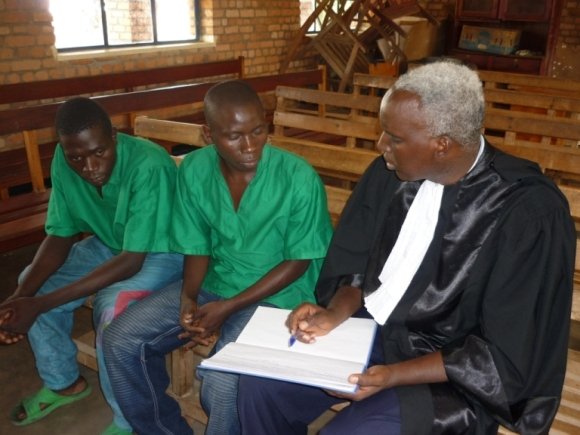
IBJ petitioned for the case to either be re-heard, or in the alternative, for the three juveniles to be released until the two co-accused adults are apprehended and brought before the court. Eventually, the Court decided to re-start the trial and Jean Claude Barakamfitiye represented the three juveniles on behalf of IBJ.
It is worth noting that significant improvements with relation to juvenile justice have been made by the new law on criminal procedure. The Code of Criminal Procedure now obliges trials involving children to be conducted in the presence of a lawyer or any other person skilled in juvenile justice matters. It also mandates that any interrogation of a child must be done in the presence of a lawyer or any other skilled person as directed by the court.
In the matter dealt with by Jean Claude Barakamfitiye, the children had not been interrogated in the presence of a lawyer. The defense demonstrated many irregularities in the evidence against the three children, which were to be considered by the Court. The defense argued that these children had been involved in the crime by adults who had, surprisingly, been released. The children stated before the Court that, “We had been promised payment for transporting these items. But we did not know that they were stolen goods”. This raised many doubts about the role of these children in the robbery. The prosecution argued that, from the confession of the children made to the police, it was evident that they had committed the crime. Eventually the prosecutor sought a sentence of 8 years of imprisonment for the three young children. Subsequently, the three boys were sentenced to 2 years of imprisonment.
For the year 2014, IBJ thinks it is necessary to organize trainings on criminal justice for juveniles since it has come to light that children are being prosecuted in an illegal manner. In the above mentioned case, the court was sensitive to the accused juveniles and agreed to conduct the trial in-camera. However, the prosecutor sought punishment of imprisonment of 8 years for the children although, according to the new criminal code of procedure, the maximum sentence against a child in conflict with the law may not exceed 4 years.
In total, IBJ has taken up thirteen cases in these past three months, and in January 2014, six other cases have been referred to IBJ via the network of the juvenile legal aid.
Project reports on GlobalGiving are posted directly to globalgiving.org by Project Leaders as they are completed, generally every 3-4 months. To protect the integrity of these documents, GlobalGiving does not alter them; therefore you may find some language or formatting issues.
If you donate to this project or have donated to this project, you can receive an email when this project posts a report. You can also subscribe for reports without donating.










