Project Report
| Jun 2, 2026
Beekeeping Protective Gear & Implementation of Apiary Hygiene Practices
![]()
Executive Summary
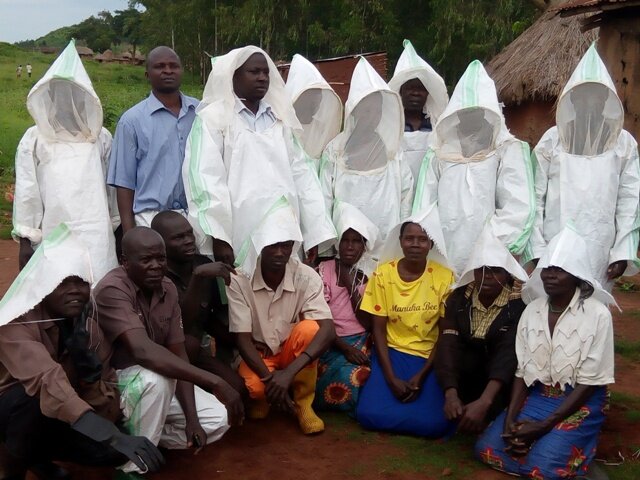
This project aimed to enhance the safety and productivity of local beekeeping operations by training community members to manufacture their own protective gear using affordable, locally sourced materials. A total of 18 participants (11 female, 7 male) were trained in crafting bee suits and veils from maize flour sacks, denim, wire mesh, and mosquito nets. Additionally, the project established standardized protocols for the regular cleaning of hives and the overall apiary to reduce disease, pests, and stress on bee colonies. The initiative successfully reduced barriers to entry (cost) while promoting sustainable, self-reliant beekeeping practices.
Background & Rationale
Commercial beekeeping protective gear is often expensive and unavailable in remote areas. Consequently, many local beekeepers risk injury, leading to reduced hive management and honey production. Furthermore, poor hygiene in hives and the apiary environment contributes to the spread of foulbrood, wax moth infestations, and other colony-threatening conditions. This project addressed both challenges by combining hands-on training in gear fabrication with education on essential apiary cleaning routines.
Project Objectives
- Objective 1: To train 18 local beekeepers (with a focus on gender inclusion) in the fabrication of functional bee veils, suits, gloves, and boot seals.
- Objective 2: To produce durable, low-cost protective gear using materials such as maize flour sacks, denim, wire mesh, and recycled mosquito nets.
- Objective 3: To establish and implement a standard operating procedure (SOP) for the regular cleaning of individual hives and the entire apiary.
- Objective 4: To reduce bee sting incidents and improve hive manipulation confidence among participants.
Methodology & Training Approach
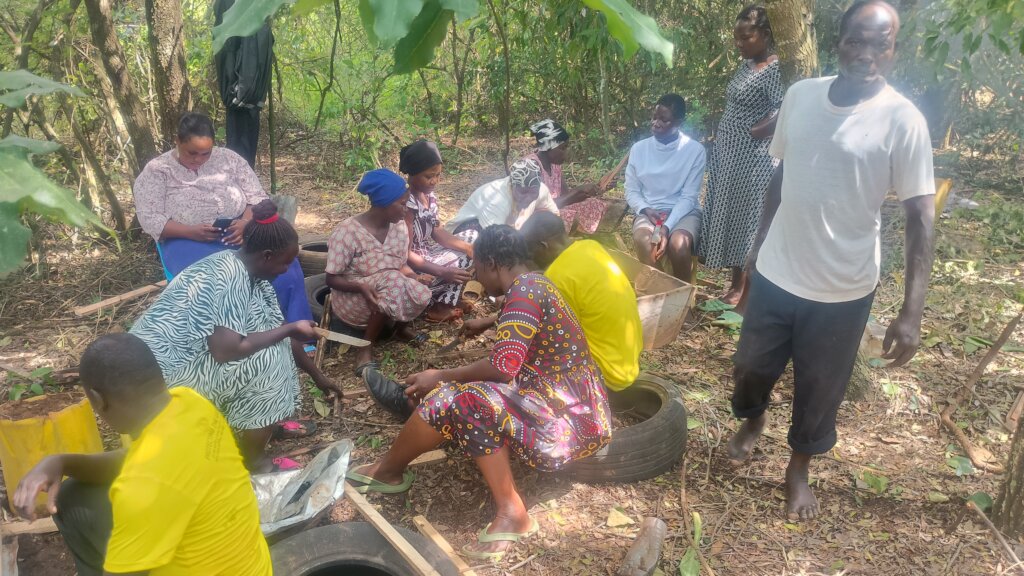
The training was delivered by "Webtrained" facilitators through a combination of demonstration, hands-on crafting sessions, and field-based cleaning drills.
Participant Demographics
- Total Participants: 18
- Female: 11
- Male: 7
Material Sourcing
All materials were locally procured to ensure affordability and replicability:
- Fabric: Clean maize flour sacks, heavy denim, thick cotton.
- Mesh: Old mosquito nets, fine wire mesh.
- Fasteners: Elastic bands, heavy-duty Velcro, drawstring cords.
- Headwear: Wide-brimmed cowboy or sun hats.
- Footwear: Sturdy, high, closed-toe boots (participants provided their own).
Fabrication Process for Protective Gear
Participants were guided through the step-by-step assembly of four essential gear components.
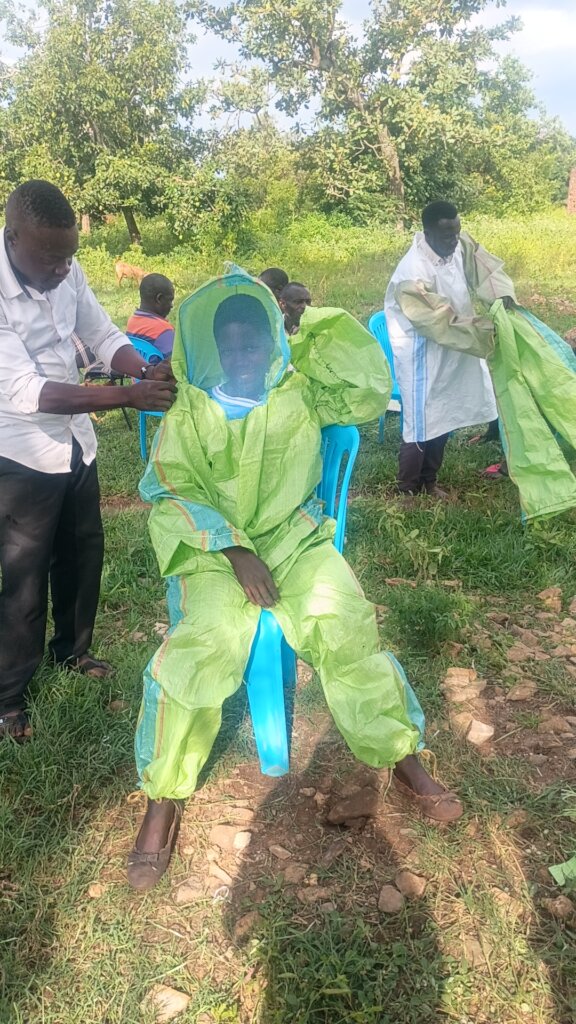
5.1 The Bee Veil (Face & Neck Protection)
- Step 1 – Frame: Each participant selected a wide-brimmed hat to keep the mesh away from the face.
- Step 2 – Mesh: They cut a piece of mosquito net or wire mesh large enough to wrap around the hat brim and extend past the shoulders.
- Step 3 – Assembly: The top edge of the mesh was sewn securely to the outer rim of the hat brim.
- Step 4 – Seal: An elastic band or drawstring was attached to the bottom hem of the mesh, allowing it to be pulled snug against the chest and neck, blocking bee entry.
5.2 The Bee Suit (Body Protection)
- Material Selection: Participants used light-colored, tightly woven fabric (maize flour sacks or denim) because light, smooth colors help keep bees calm.
- Construction: Long-sleeved coveralls were created. Where one-piece coveralls were unavailable, a thick long-sleeved shirt was stitched to sturdy trousers at the waist.
- Sealing Openings:
- Wrist cuffs: Elastic bands or heavy-duty Velcro were sewn in to seal tightly over gloves.
- Ankle cuffs: The same method was applied to seal over boots.
- All loose buttons, holes, and gaps were eliminated.
5.3 Gloves & Boots
- Gloves: Participants used standard cotton or leather gardening gloves. To extend protection, long fabric sleeves with elastic at the top were stitched to the glove cuffs, covering the forearms.
- Footwear: Participants wore sturdy, high, closed-toe boots. Pant legs were tucked inside the boots, and additional elastic bands were applied over the ankles to block crawling bees.
6. Cleaning Protocols for Hives & the Apiary
In addition to gear making, participants were trained in systematic cleaning procedures to maintain colony health.
Cleaning Individual Hives (During inspections & post-harvest)
- Preparation: Don all protective gear. Use a smoker to calm bees.
- Removal of Debris: Gently scrape away propolis, wax moth webs, and burr comb from hive walls, frames, and the bottom board using a hive tool.
- Frame Inspection: Remove any dark, brittle brood combs (older than 3 years) as they can harbor disease spores.
- Bottom Board Cleaning: Scrape and remove all fallen debris, dead bees, and wax pieces. In top-bar hives, replace the dirty bottom board liner if available.
- Entrance Maintenance: Clear the hive entrance of dead bees, leaves, and debris to ensure proper ventilation.
- Disinfection (Low-tech method): Use a solar wax melter or leave scraped hive parts in direct sunlight for 24-48 hours. A 1:10 bleach solution (1 part bleach to 10 parts water) can be used sparingly on empty, bee-free equipment, followed by thorough rinsing and air-drying.
Cleaning the Entire Apiary (Site Hygiene)
- Weed & Grass Control: Keep the area in front of hives mowed or cleared to reduce hiding spots for small hive beetles and to allow bees clear flight paths.
- Remove Attractants: Eliminate old comb scraps, spilled honey, or propolis left on the ground, as these attract ants, wasps, and robber bees.
- Water Source Management: Ensure the nearest water source is clean (add a handful of straw or pebbles to prevent drowning) and located away from where visitors walk to minimize stings.
- Equipment Storage: Store unused frames, supers, and tools in a clean, dry, sealed container or bee-proof shed to prevent wax moth and rodent infestation.
- Cull Old Equipment: Burn or deeply bury any woodenware from colonies that died of suspected American Foulbrood (AFB) to prevent spore spread.
Outcomes & Achievements
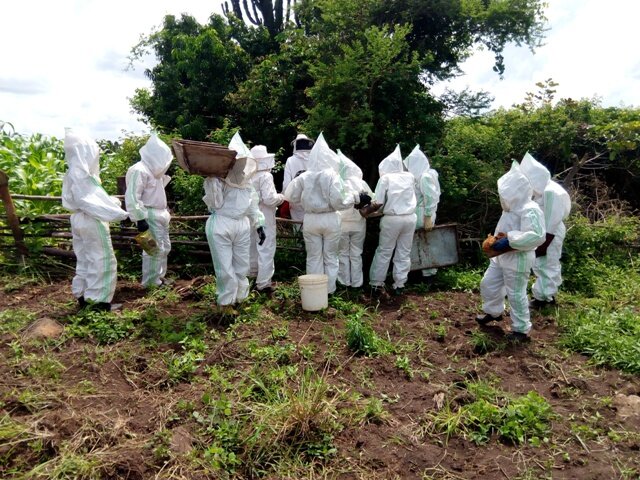
Gear Production: All 18 participants successfully fabricated a complete set of protective gear (veil, suit, gloves, boot seals).
Cost Savings: Average cost of locally made gear was 80% less than commercial imported equivalents.
Safety: 100% of participants reported increased confidence when handling hives, with zero major stings during the post-training hive cleaning exercises.
Hygiene: 15 of 18 apiaries implemented the recommended cleaning schedule within one month of training.
Gender Inclusion: 61% female participation enabled women to safely engage in beekeeping, a role traditionally dominated by men in the region.
Challenges & Mitigation
- Challenge: Durability of maize flour sacks compared to denim.
- Mitigation: Participants were advised to use double layers of sack fabric for high-wear areas (knees, elbows). Denim was recommended for long-term use.
- Challenge: Reduced visibility through mosquito net mesh in low light.
- Mitigation: Recommended using lighter-colored netting or wire mesh for better visibility. Advised performing hive inspections during bright daylight hours.
- Challenge: Difficulty cleaning deep inside box hives.
- Mitigation: Introduced a simple angled scraper tool made from a bent metal rod to reach corners.
Recommendations
- Establish a Community Gear Hub: Set up a small workshop where future members can borrow stitching tools and buy discounted materials (elastic, netting) in bulk.
- Quarterly Refresher Training: Conduct a 2-hour refresher session every 3 months on both gear repair and apiary cleaning checklists.
- Integrate Solar Wax Melting: Introduce a simple solar wax melter to the apiary cleaning station to automatically clean and recycle old wax comb scraped during hive cleaning.
- Document Local Adaptations: Encourage participants to document any modifications to the gear designs (e.g., adding ventilation slits behind denim patches) for sharing with other local beekeeping groups
Conclusion
The project successfully demonstrated that effective beekeeping protective gear can be manufactured locally using affordable, accessible materials like maize flour sacks, denim, and mosquito nets. The training of 18 participants (11 female, 7 male) not only improved safety but also empowered the community to take ownership of their beekeeping operations. When combined with the disciplined cleaning of hives and the apiary, these low-cost interventions significantly reduce disease pressure and bee defensiveness, leading to more productive and sustainable apiculture. This model is highly replicable in other resource-limited beekeeping communities.
![]()
![]()
![Share on Twitter]()
![Share on Facebook]()