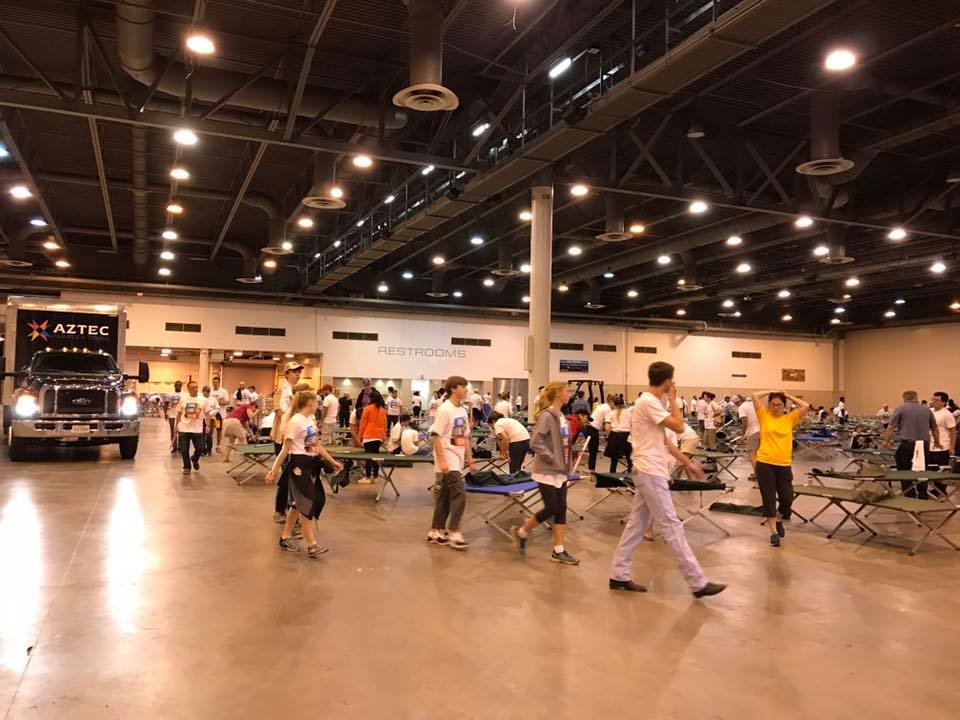
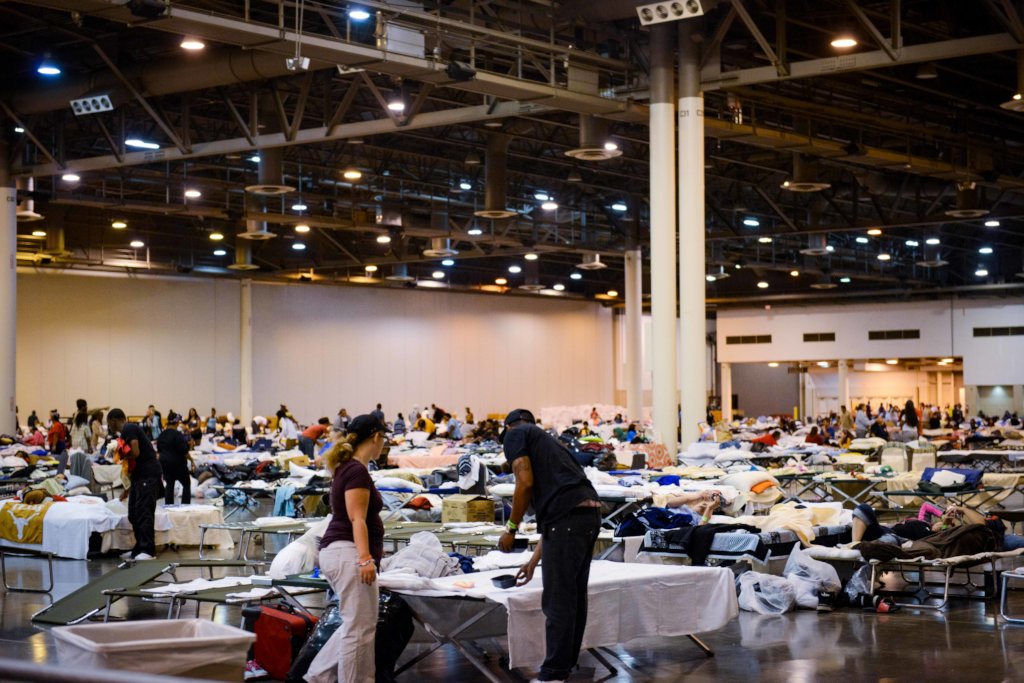
![Volunteers assemble cots before the shelter opens.]()
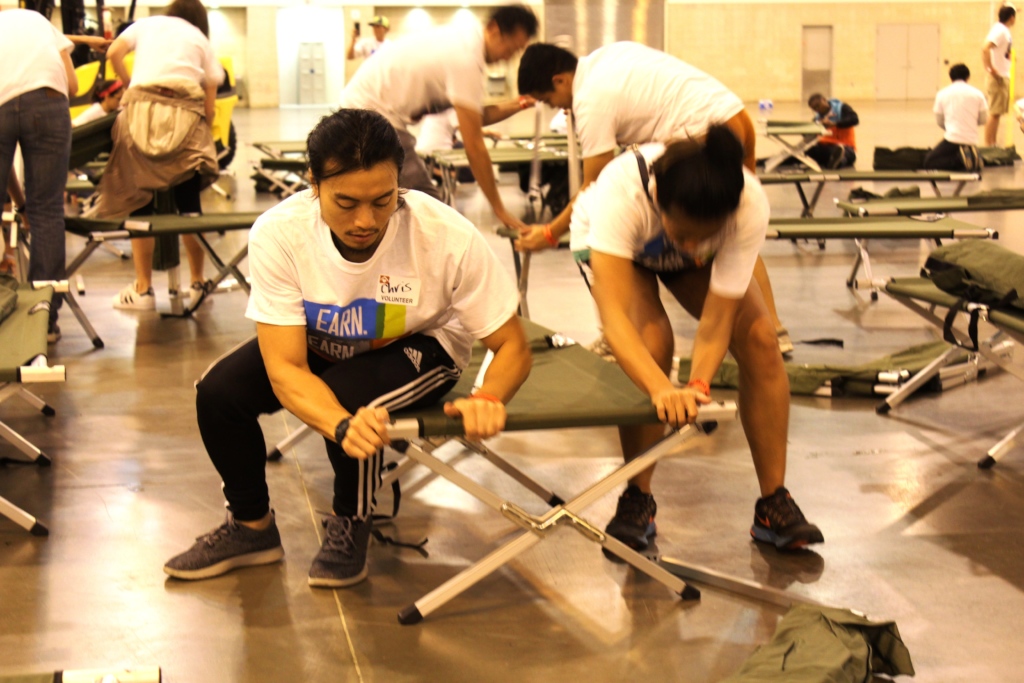
Volunteers assemble cots before the shelter opens.
Thank you for your generous support of BakerRipley and the Houston region's recovery from Hurricane Harvey. It's hard to believe that it's already been three months since Harvey struck the Gulf Coast. In the intervening time, our agency has been hard at work implementing a disaster recovery program whose goal is to alleviate human suffering caused by Harvey by guiding our neighbors and communities through a process that leads them to pre-disaster stability as quickly as possible.
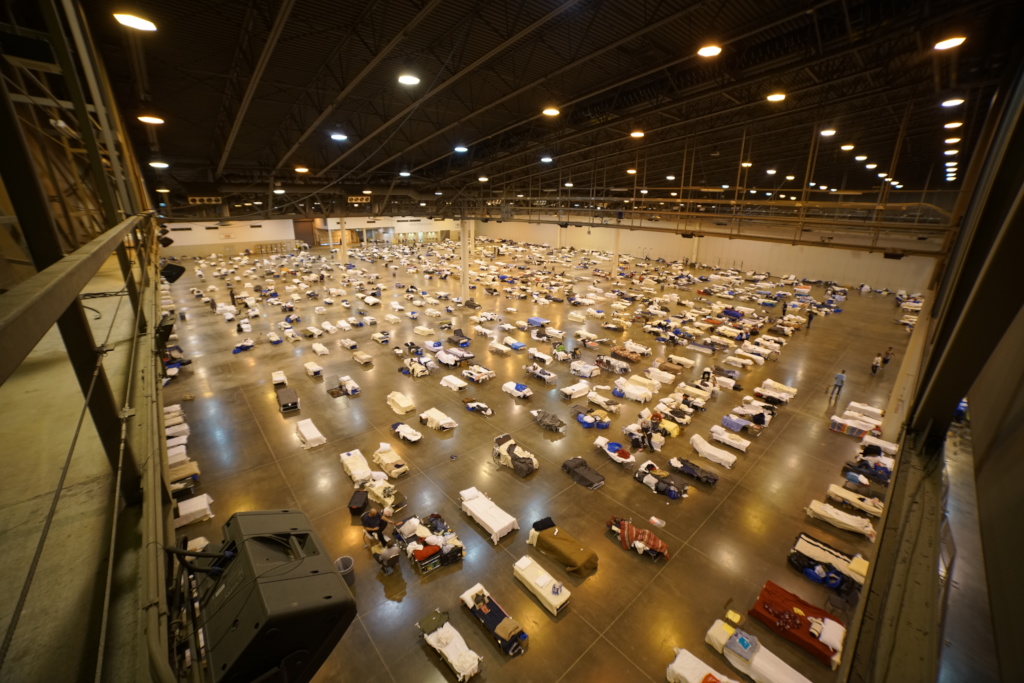
In the immediate aftermath of Hurricane Harvey, BakerRipley operated an emergency shelter at Houston’s NRG Center for Houston-area individuals and families displaced by the storm. We opened this shelter at the request of Harris County Judge Ed Emmett, and from August 29 to September 23, 2017, we welcomed more than 7,500 guests to a safe environment where individuals and families had a place to sleep; received food, clothing and shoes, and other basic necessities; accessed medical care; and obtained guidance on how to file insurance claims and access other resources.
With our shelter closed, BakerRipley has now transitioned into supporting the Houston region’s medium- and long-term recovery from Hurricane Harvey. Beginning in September 2017, we have leveraged our agency’s community centers and partnerships to establish distribution centers in five neighborhoods across Greater Houston:
- East Aldine (in unincorporated Harris County near Bush Intercontinental Airport),
- The East End (just east of downtown Houston),
- Greater Hobby (in southeast Houston near Hobby Airport),
- Gulfton/Sharpstown (in southwest Houston), and
- Pasadena (a city in southeast Harris County)
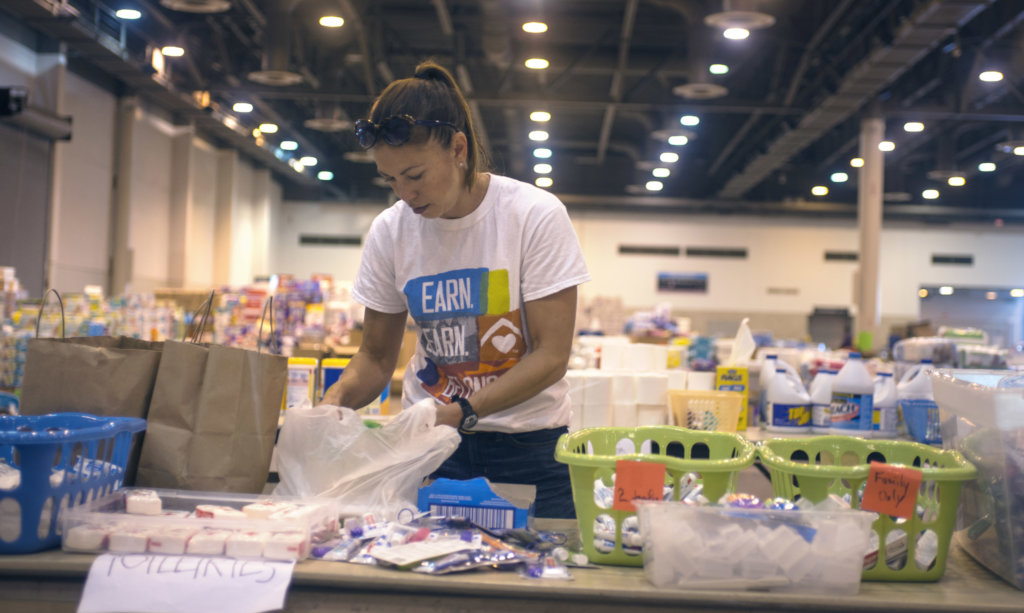
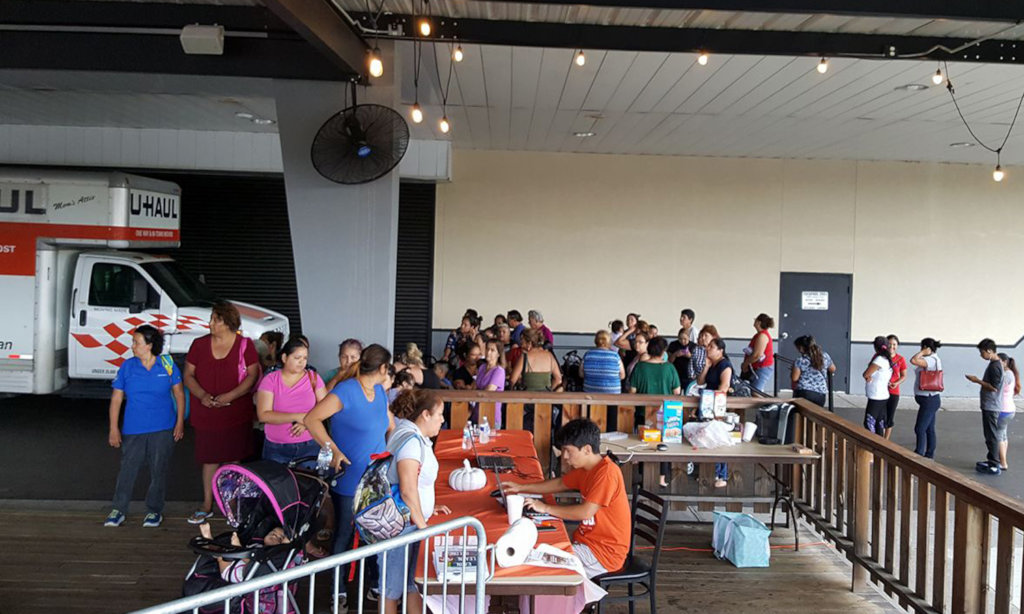
BakerRipley has deep community ties in each of these communities, and our centers are recognized as safe places for community members to gather, obtain information and seek help. As our neighbors continue to recover from Hurricane Harvey, these distribution sites provide hygiene kits, clothes, food, and cleaning supplies as well as information and referrals. Through November 15, 2017, we have made 8,851 basic needs distributions.
In January 2018, we will transition these distribution sites into “Restoration Centers.” We are currently finalizing our program plans and strategy for this next phase, but our work will be a collaborative and co-led effort with the City of Houston along with public, private, and non-profit partners to deliver unified and holistic recovery services at the neighborhood level, tailored to the particular needs of each community, and informed by data on status and progress.
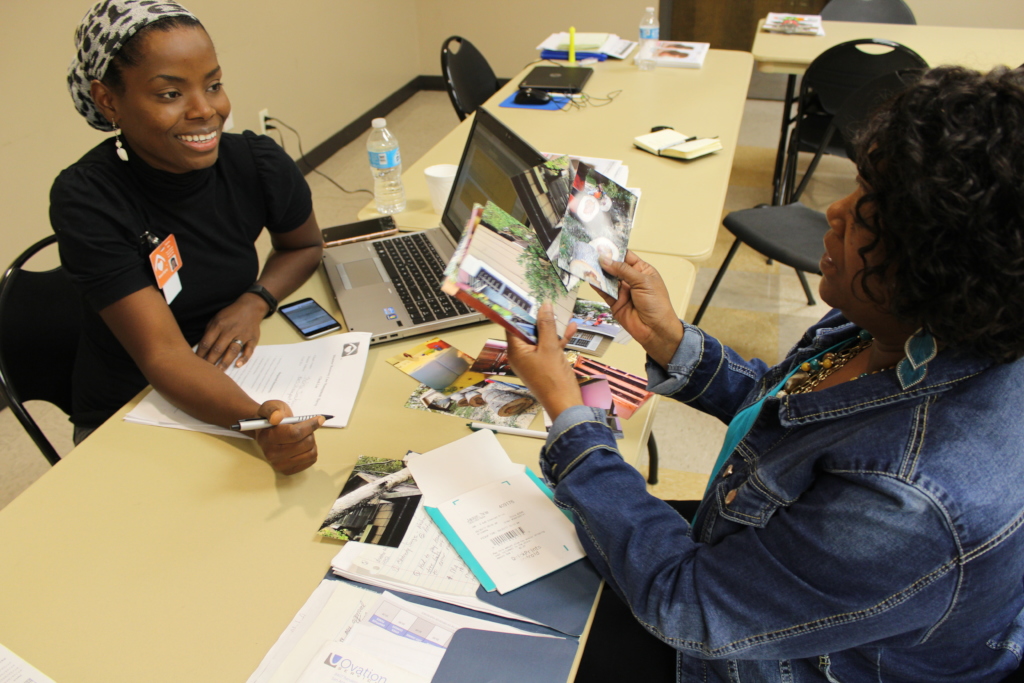
One of BakerRipley’s greatest strengths in disaster recovery is Disaster Case Management (DCM), through which we work with individuals and families to connect families impacted by Hurricane Harvey to resources and services needed to stabilize and adjust to their “new normal.” The main components of our DCM work include assessment, triage, and recovery planning, and ongoing monitoring and advocacy.
BakerRipley “Service Connectors” and clients develop a recovery plan that outlines specific goals and action steps needed to move toward recovery, such as obtaining home repairs, replacing lost items, or securing permanent housing. Plans include connections to recovery services, be it BakerRipley-provided or external. Our Service Connectors focus on individuals’ or families’ strengths, support systems, connections and aspirations – a unique approach to case management that not only achieves client case management collaborative goals, but builds self-esteem and enables our case managers to develop the most successful plan of action. Service Connectors maintain regular contact with clients for support and coaching and to update plans as needed. The intensity and duration of this ongoing case management varies by client.
BakerRipley projects to serve 3,500 cases per month (based on a 35:1 ratio of cases to managers when at capacity with 100 FTE Service Connectors on staff). Through November 15, we have opened 1,178 cases – with 1,104 cases still active and 74 closed – serving 2,861 individuals thus far. There remains great need, though – more than 3,800 individuals are waiting to be assigned, well above the capacity we have with current funding levels.
Financial assistance is available to families to address disaster-related gaps that remain after all other resources have been exhausted. While some families/individuals need one-time help, others need more ongoing support depending on their pre-disaster status. Our Service Connectors screen requests and using these funds in a manner that supports the recovery process. Financial assistance is available for unmet needs such as work-related expenses (uniforms, shoes, etc.), medical expenses (replacement of medical equipment, dentures, eyeglasses, emergency medical bills, mental health support, transportation expenses (necessary car repairs), and other requests considered on a case-by-case basis.
BakerRipley also has extensive experience in helping our neighbors find suitable short- and long-term housing, experience gained following Tropical Storm Allison (2001), Hurricane Katrina (2005), Hurricane Ike (2008) and the recent Memorial Day (2015) and Tax Day (2016) floods. Our services include 1) placement of families into multi-family units; 2) placement of individuals /families into hotels; and 3) supporting miscellaneous expenses related to relocation (i.e. moving costs, rental deposits, mortgage payments, security deposits, and appliances purchases). We have existing partnerships with apartment and hotel owners across the region who are willing to provide apartments and hotels to individuals and families participating in our disaster case management services. Thus far, 156 of our DCM clients have received financial assistance (averaging $1,116 per case). More than three-quarters of the financial assistance we have provided thus far has been for housing.
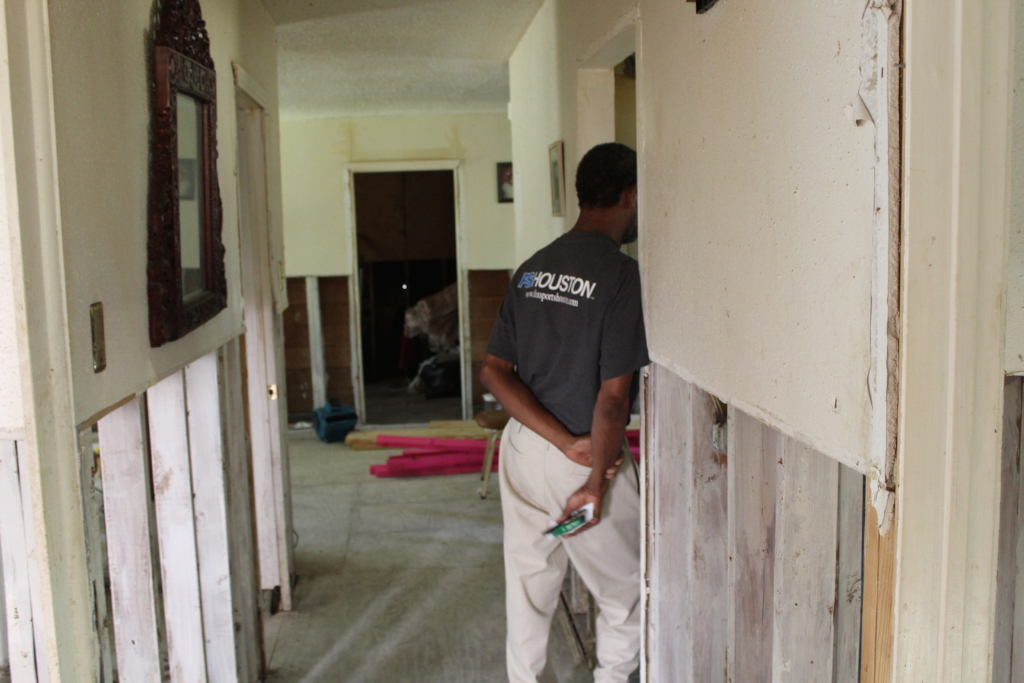
Finally, BakerRipley provides Home Restoration services – the fundamental goal of which is to make a home safe, sanitary, and secure for a family’s or individuals’ return. Our services includedata collection so that homes in need of clean-up are identified, conducting initial assessments of damage, deploying muck and gut clean-up crews, and coordinating critical home repairs. We offer three options for residents to access home repairs:
- Homeowner Self-Managed Projects: for those who can self-manage the repair process, we help homeowners assess damage and estimate costs, and coordinate payments to vendors for supplies and labor for the homeowner to oversee the completion of repairs.
- BakerRipley-Managed Projects: for vulnerable clients and those unable to oversee the work of a contractor, BakerRipley has a network of quality, pre-screened contractors, adjusters, and inspectors under contract to complete the home repair process.
- Volunteer-Managed Projects: BakerRipley coordinates with self-managed volunteer groups to conduct muck-and-gut clean-up and rebuilding projects. Most recently, we hosted a team from Barrington, Illinois which work on four homes in November 2017.
BakerRipley is committed to providing Disaster Case Management through the end of 2018, and we look forward to keeping you updated -- both with top-level numbers demonstrating the aggregate impact of your contribution as well as with stories of the impact you are making on Houston individuals and families. Thank you again for your support!
![Aerial view of a dormitory area in our shelter.]()
Aerial view of a dormitory area in our shelter.
![A guest looks for a book at the shelter's library.]()
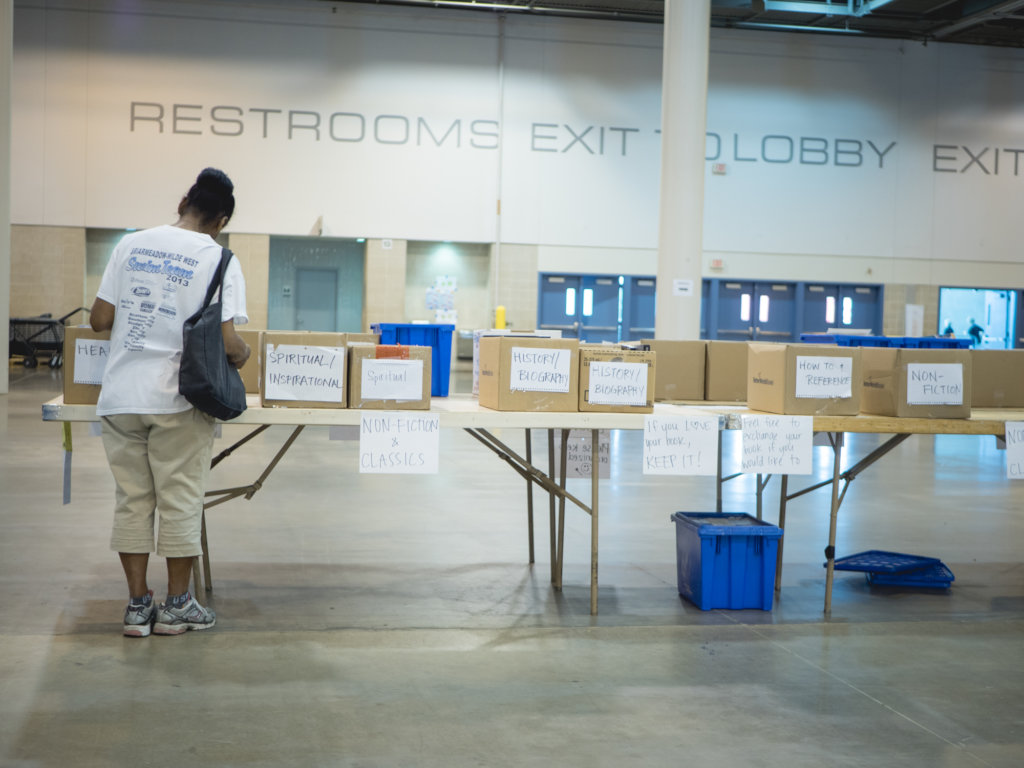
A guest looks for a book at the shelter's library.
![East Aldine residents access basic needs items.]()
East Aldine residents access basic needs items.
![A service connector reviews photos with a neighbor]()
A service connector reviews photos with a neighbor
![Homeowner during a visit assessing his gutted home]()
Homeowner during a visit assessing his gutted home
Links:
![Share on Twitter]()
![Share on Facebook]()