By ASPCA | Project Leader
It had been four years since Steven and Jacqueline Berry and their family lost their Siberian Husky, Missy, to old age. But when Steven saw a media segment about the Clear the Shelters adoption event at the ASPCA on August 18, he knew the time was right to bring a new canine companion into their home.
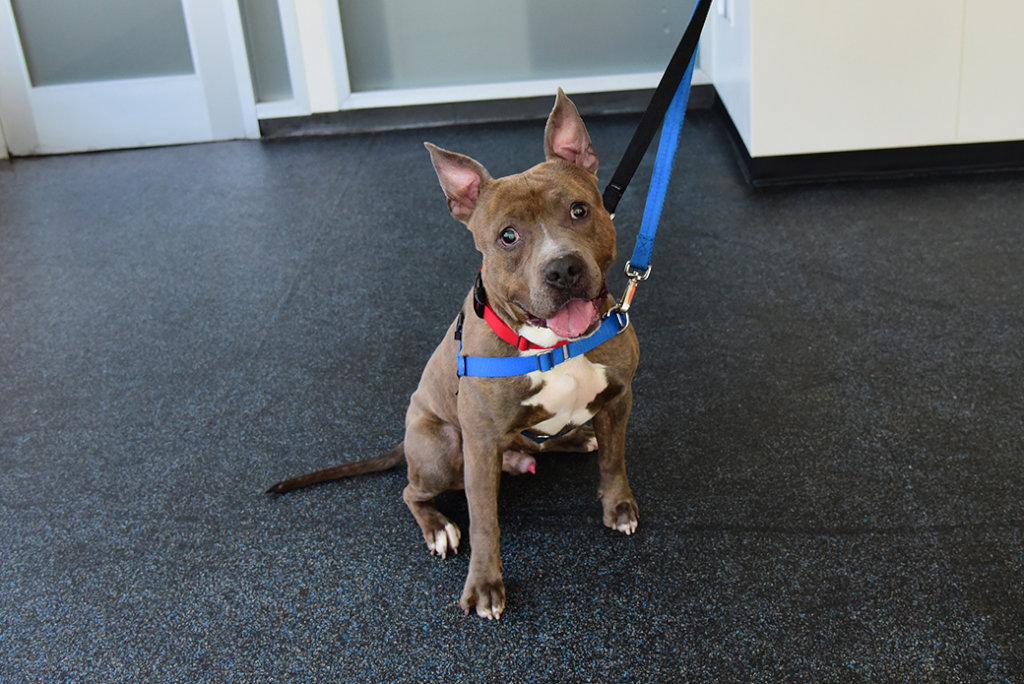
By the time Steven and his family arrived at the ASPCA Adoption Center that same Saturday afternoon, only one dog was left for adoption: a blind, two-year-old pit bull named Jah.
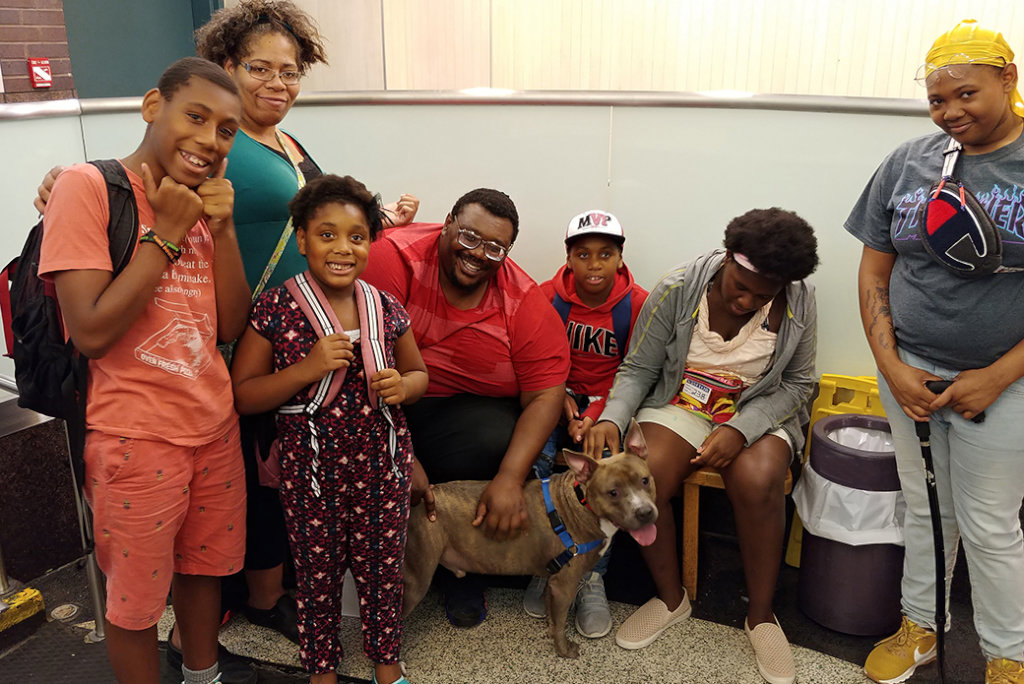
They hesitated at first, but all misgivings quickly disappeared when Steven saw how Jah interacted with his four children, girls Heavenly and Janey, boys Caillou and Elijah, ages seven to 13, and Steve’s sister, Shanear.
“He came right up to us like he had known us for years,” recalls Steven, whose wife and sister were also present. “The kids were petting him, touching him, rubbing his stomach. He even rolled over.”
“I remember thinking, ‘This is the perfect home for Jah,’” says Stephen Cameron, Admission and Foster Programs Coordinator at the Adoption Center, who processed Jah’s adoption. “They asked all the right questions and were very excited about him. It was an amazing moment, so full of life and love.”
It only took Jah a few days to adjust to his new home, despite his blindness.
“He learned the layout of our house quickly,” says Steven. “The way he moves around now, you wouldn’t know he has a vision problem.”
Jah first showed up on the ASPCA’s radar when Lisa Kisiel, Community Engagement Case Manager, and Dr. Jasmine Bruno, Community Medicine veterinarian, visited his previous owner to provide food, vaccines and a microchip for Jah.
“Jah approached us by smelling us,” Lisa recalls. “So we suspected he was blind.”
An ophthalmic assessment at the ASPCA Animal Hospital confirmed Jah’s blindness as well as progressive retinal degeneration, an inherited disease, in both eyes.
When Jah’s owner transitioned to living in a homeless shelter, he was forced to relinquish Jah to the ASPCA.
“He did everything he could to keep Jah,” recalls Katherine Good, Community Engagement Coordinator and the lead on Jah’s case. “But his situation wasn’t sustainable.”
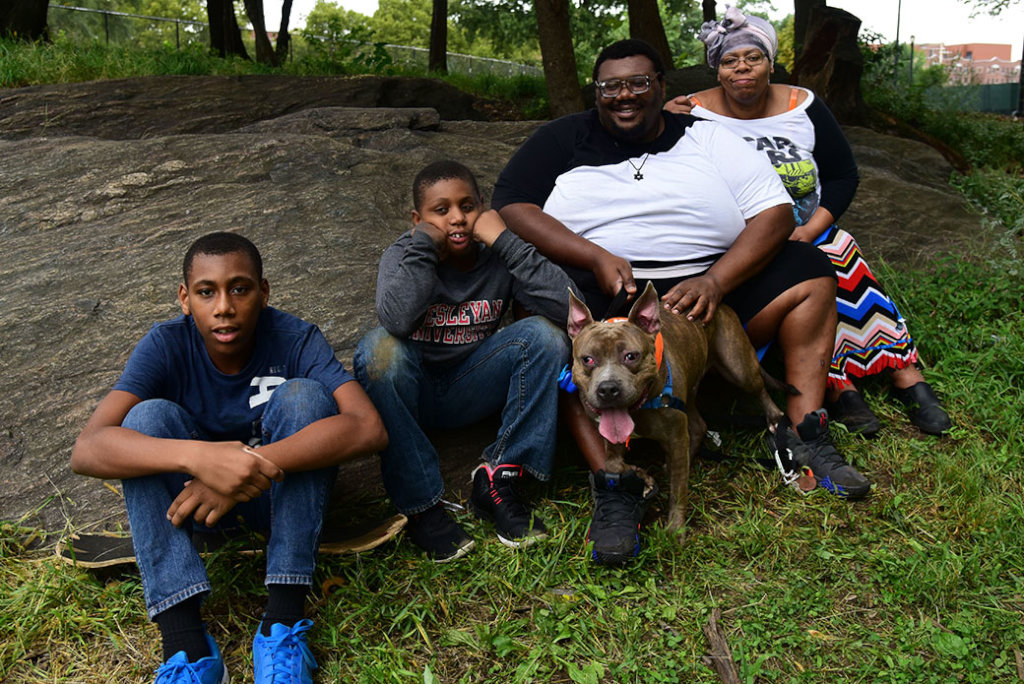
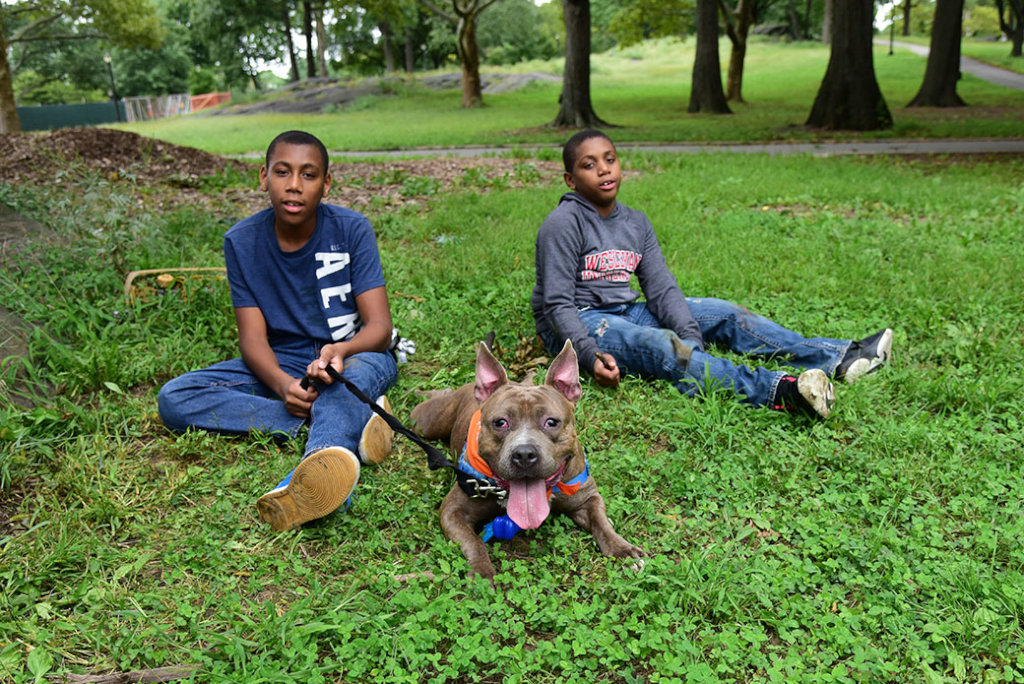
In his new home, Jah’s disability requires some cautious measures. Steven and his family make sure Jah’s environment is always safe and they use a harness to guide him on outdoor walks at nearby Crotona Park in the Bronx.
“His sense of smell is 100 percent,” reports Steven. “Even though his sight is gone, you really can’t tell he’s blind. He even darts for the front door when it’s time to go out.”
“Jah is proof that an animal who is irreversibly blind can have an excellent quality of life and be a loving companion,” says Dr. Felicia Magnaterra, a veterinarian at the Adoption Center who oversaw Jah’s care.
Jah gets a number of walks during the day, and the outings benefit the family as well as their new pet.
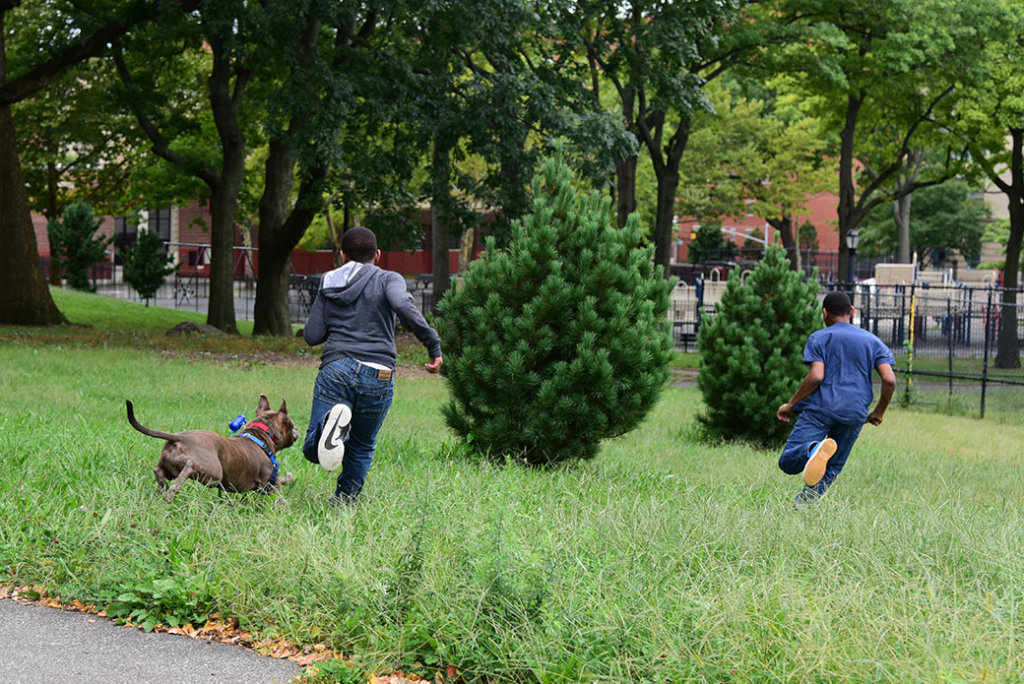
“Jah gets me walking more, and in general, our whole family is more active now,” Steven says. “He’s fun to play and run with,” adds Caillou.
“It’s refreshing to see a family who just accepts Jah the way he is,” says Katherine. “I couldn’t have imagined a better turnaround for him. He was loved before, but now he has ten times the attention, stimulation and entertainment.”
Jah may have been the only available dog at the shelter the day Steven and his family walked in, but they don’t see it that way. “Jah was the last one left,” Steven says. “So I guess it was just meant to be.”
Jah’s story is just one example of how for every shelter dog, there is a match waiting to take them home. No matter their shape, size or age, there is someone for everyone. This month, as we celebrate Adopt a Shelter Dog Month, we hope that you will get involved to help more dogs like Jah find loving homes through our #FindYourFido campaign!
Project reports on GlobalGiving are posted directly to globalgiving.org by Project Leaders as they are completed, generally every 3-4 months. To protect the integrity of these documents, GlobalGiving does not alter them; therefore you may find some language or formatting issues.
If you donate to this project or have donated to this project, you can receive an email when this project posts a report. You can also subscribe for reports without donating.