By Fergus Knight | Partnerships Manager
Machine Learning for Good: introducing a new course from Apps for Good
This year we have a brand new machine learning course available, developed in partnership with SAP.
The world young people are facing is increasingly volatile, uncertain, and complex. All around us, there’s a growing awareness of both the positive and negative consequences of emerging technologies like machine learning. By gaining hands-on experience and applying machine learning technologies for good, students can gain new skills and be empowered to harness the opportunities of the digital age.
Machine learning is becoming an increasingly important part of life with technology. While there are some great tools that exist to teach machine learning concepts, there is currently a lack of accessible resources to teach the subject in key stage 3. To address this gap and help teachers get ahead, we have created a machine learning course alongside subject experts.
What is machine learning?
For simplicity’s sake, we’ll describe machine learning as a system where – rather than a computer programmer deciding the best way to sort, organise, classify or use information – a computer program develops its own set of instructions based on information that users feed it. Machine learning algorithms are all around us. They’re powering customer service chatbots, making personalised recommendations for us on Netflix, and helping our iPhones to identify the phrase ‘Hey Siri’.
Machine learning is a topic of interest for many at the moment, as people are understandably excited to unleash the potential of this technology. Recent advances have rapidly improved the performance of machine learning algorithms, within just a few years they have become much more capable. Machines can now learn at a mind-blowing pace and can handle growing amounts of data in shortening amounts of time. Concepts like face detection and image recognition may have been around for a while, but information can now be processed very quickly and at enormous volumes.
Machine learning is also being applied in innovative areas, like predicting which medication could be used to fight cancer. Of course, there is a current debate about potential ethical issues with the application of machine learning. For instance, if you’re training a driverless car, is it more important to protect passengers than pedestrians? When making a decision in an emergency, is it more important to save young people or old people? It is important for students to explore these implications of emerging technologies, as well as be aware of how this technology is impacting on them personally.
When students are able to consider ethical questions as they directly apply new technologies to create solutions for real-world problems they care about, they are gaining new skills as well as nuanced perspectives as future creators of tech for good. By becoming fluent and confident with new technologies like machine learning, students gain important skills as innovators, problem solvers, and creators. They are preparing to tackle the problems of the future, very likely tackling problems we’re not even aware of yet. With machine learning skills in their repertoire, students will be able to solve bigger and bigger problems faster and faster.
Chatbots for good
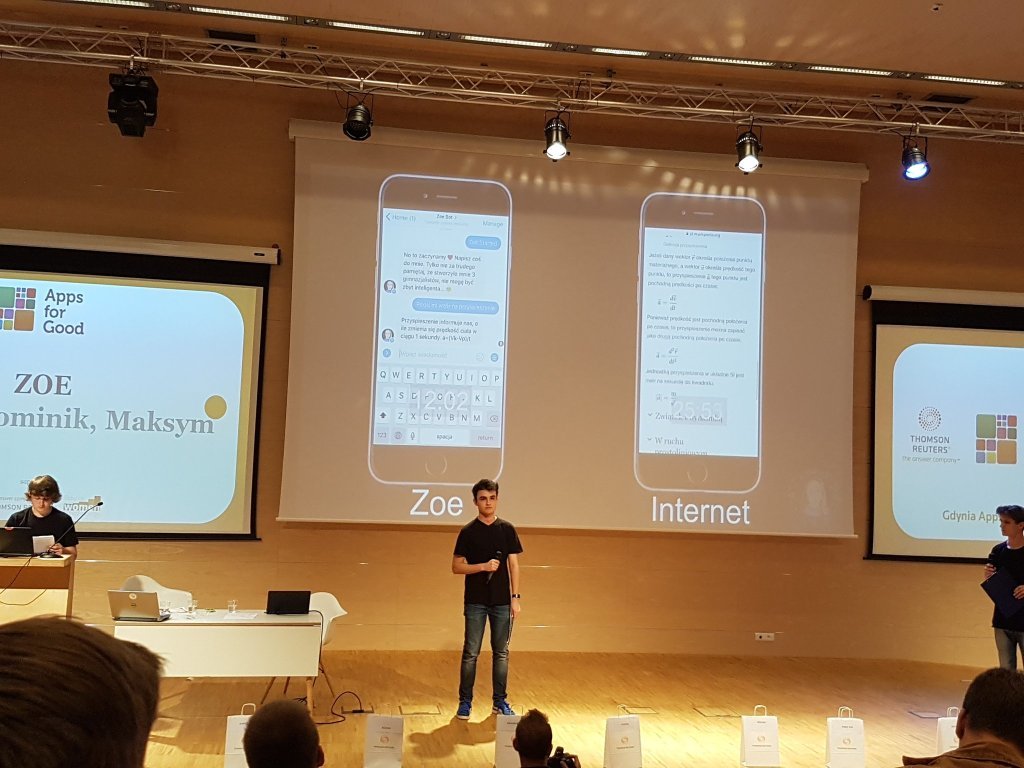
The ZOE bot is an example of Apps for Good students creating machine learning solutions for problems they care about. ZOE is a Facebook messenger chatbot that helps Polish students revise for physics classes. ZOE was trained with all the physics notes the student creators had collected together. Since winning at our Poland showcase in 2017, the students have continued to refine and promote ZOE. AfGTeamZoe Dominik, Adrian and Maksym of Team ZOE, pitching their chatbot idea to a panel of judges the second annual Apps for Good final in Gdynia, Poland. Closing the digital skills gap By exploring machine learning, students are also preparing for the newest jobs in the technology market. Nearly every technology company is considering how machine learning can transform business, and these companies are on the lookout for skilled professionals to help them. With the current skills gap, there aren’t enough people to fill these roles.
Students exposed to machine learning concepts are gaining a head start when it comes to future employability, gaining the technical skills to help them succeed in this changing professional landscape. Let’s look briefly, for instance, at SAP, the market leader in enterprise software. We have partnered with SAP for the past five years, and most recently collaborated with them to create a new machine learning course for teachers. As an organisation, SAP often incorporates machine learning solutions into their products. They place a lot of importance on developing future technology talent and closing the digital skills gap.
Through learning about machine learning, including the benefits and ethical issues, we can empower students all across the UK to unlock their confidence, skills, and talent, and to see the difference they can make both in their own lives and the communities around them using emerging new technologies for good. If you asked us, when armed with these tools, the future is looking pretty bright in the hands of these young tech-minded change makers.
Project reports on GlobalGiving are posted directly to globalgiving.org by Project Leaders as they are completed, generally every 3-4 months. To protect the integrity of these documents, GlobalGiving does not alter them; therefore you may find some language or formatting issues.
If you donate to this project or have donated to this project, you can receive an email when this project posts a report. You can also subscribe for reports without donating.