By Jyoti Patil | Secretory (Executive Head)
BACKGROUND
Upholding the vision of holistic personality development in a joyful environment, Aarohi Bal Sansar(ABS), a middle-level school, was started in the year 1994. ABS is a vibrant learning space which is sensitively designed, nurturing children through quality education using an appropriate curriculum, creative teaching methodologies and sufficient infrastructural resources. ABS today is a model school, providing education which is sensitive to the changing aspirations of the people from the rural and remote parts of the Kumaon hills in Uttarakhand, Northern India.
SUMMARY
Basic education is a critical part of rural development, devoid of which one cannot expect to bridge the rural-urban divide. The Indian National Curriculum Framework is designed for the masses and unless contextualised to the local and rural realities cannot be relevant for large population constituting the rural India.
In a country as vast and as diverse as India can a standard national curriculum framework be sufficient? The rural-urban learning variance is ever increasing, with a bulk of the so-called educated mass we are churning out every year being unemployable, unskilled and unadoptable. They are misfits in the true sense of the word where they often lack even the basic skills for survival. Rural children struggle with a syllabus they cannot relate to. Their context, their realties and point of references are much different than that of their urban counter parts. The medium of instruction is in a language which is not their mother tongue.
The contextualisation of teaching and learning using immediate environmental experiences of the children offers encouraging options to make education more relevant for the rural children. Natural resource management practices can be used as media for contextualisation and enable learners to cope more effectively with the general subject matter, whilst contributing to the skills formation process at the same time. Examples from different parts of the world show that teachers can use natural resources as a learning aid in various subjects and topics as this provides real life examples from the local environment and gives a practical touch to theory.
Agriculture is the most important aspect of rural life. Using agricultural and natural resources as a medium for contextualising the curriculum could, therefore, provide an avenue through which children can have repeated experiences to develop their cognitive, physical and social skills.
PROGRAMME OVERVIEW
This year we have 167 students from 14 villages. Thirty-one new students joined ABS in this term. Of the total students 85 are girls and 82 are boys.
We continue maintaining a healthy student-teacher ratio of 9:1. There are 18 teachers, with 2 teachers for the pre-primary section and 16 teachers teaching in the primary and the upper primary sections.
ABS has a beautiful combination of academics as well as co-curricular activities. Arts, Crafts, Music, sports are given equal importance along with the academics. Life skill programme further prepares them for the challenges of the modern world.
SCHOOL FARM PROJECT
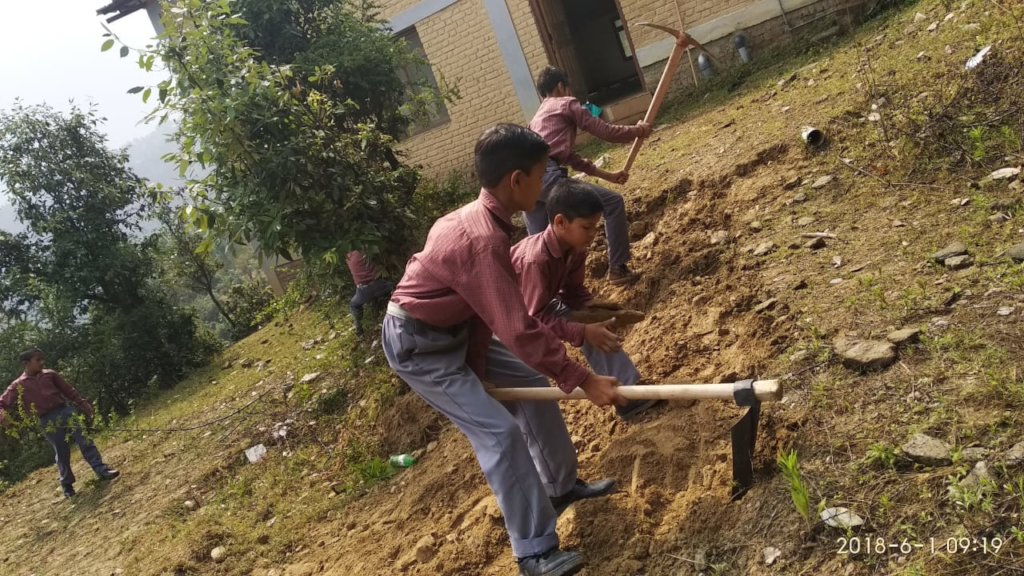
School Farm Project was initiated in this term with the aim of contextualising education to farming and ecology to make education relevant for the students from the rural areas. The levelling of the land (20 ft x 30 ft) is complete. A compost pit of length 15 ft, breadth 6 ft and depth 1.5 ft has been dug entirely by the students. Compost required for the plants in the greenhouse will be created in this pit. The design of the greenhouse is also complete. Tools for the project were purchased in the middle of the May.
Apart from contributing to the construction work of the greenhouse, students were shown the design of the greenhouse and they built a model replica using it. Through the process, the children learnt about dimensions and measurements. Students were also taught the English names of the tools and their uses. Tools were then labelled in English. They also have been taught about the budget estimation.
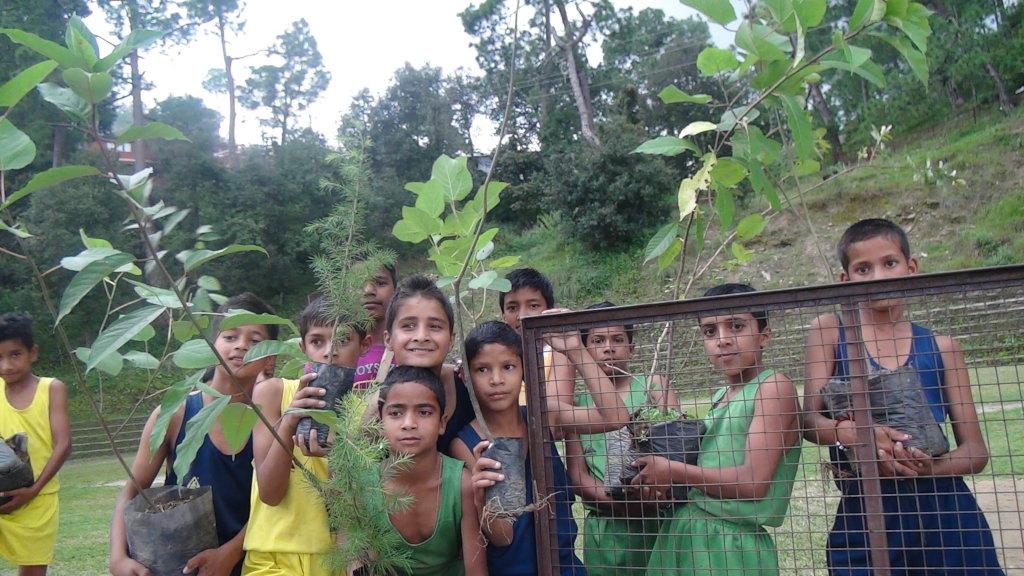
6th-grade students did a survey in their villages to figure out which vegetables could be grown in which months and to find out how long would they take to grow. Then students collected seeds and put them in pits filled with compost. The pots were also labeled.
Students have been divided into teams and each team is made responsible for recording various details of the project. They are taught how to use Excel and PPT to enter data and make presentations. By the end of the project, students would be making a presentation.
Funds are required for the construction of the green house.
Project reports on GlobalGiving are posted directly to globalgiving.org by Project Leaders as they are completed, generally every 3-4 months. To protect the integrity of these documents, GlobalGiving does not alter them; therefore you may find some language or formatting issues.
If you donate to this project or have donated to this project, you can receive an email when this project posts a report. You can also subscribe for reports without donating.