We HWF with beneficiaries from the primary schools in Kenya (Nyanza Province Girls) thank you for your continuing support that has ensured that a majority percentage of girls are being enrolled in schools thanks to the support gained from GLOBAL GIVING.
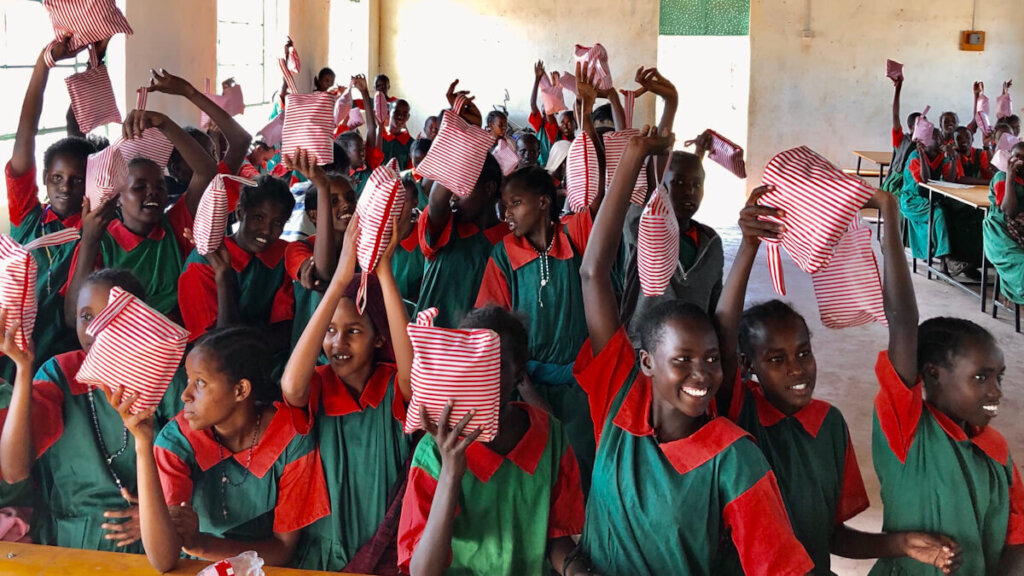
During the past 5 months HWF has embarked on activities aimed at ensuring that the girl child is kept at school.One of the major steps taken to ensure the continuity of girls in school was the distribution of Sanitary towels in 2 schools in Manga District, Nyanza Province in Kenya.The lack of proper sanitation for the girls pupils in primary schools acts as a reason for lower enrolment of girls students in schools with some of them absconding classes due to lack of sanitary towels.
The sanitary towels was distributed to 3 Primary schools to children aged 13 onwards and these were of standard 7 and 8 ( Kenya Curricular of classes in Primary education) .The schools that benefited from these towels were as follows:-
1. Rianyabwanga Primary school - 168 girls benefited 2. Kiangoso Primary School - 72 girls benefited 3.Bitundugusu Primary School - 80 girls benefited
Due to the large number of girls in school in the regions, it was not possible to supply the sanitary towels to 9 other schools in the region that had students who lack the basic sanitary needs.HWF assured their school heads that through donor community and GLOBAL GIVING initiative , more students in the remaining 9 schools will be provided with sanitary towels and training facilities to ensure that more than 2000 Kenyan girls learn comfortably and competitively.
With the continuing support from Globalgiving and wellwishers,HWF plans to provide sanitary needs to female students who have reached menses in 12 Primary schools in Manga District, Nyanza District,Kenya.This will inturn keep the girl child in school and further their learning environment.
What do you think on this progress of keeping Kenyan girls in school?
Our appointment with Health & Water Foundation was for 09:30hrs with the program officer, Mr. Munuve. We were warmly ushered into the office not so far from the Nairobi central business district - a well organized office with a sizable team welcomed us and got straight to business about the project.
The project was started in 2003 and its main mandate was to provide water and sanitation in Nyanza province, but later diversified to HIV/AIDS training and facilitation. They supply the rural communities with clean and safe water, build piped water harvesting equipment, latrines and dig boreholes.
According to Mr. Munuve, their method and approach in the region is very effective because of good weather and good reception from the communities, who provide support in terms of labor, food and materials. but their biggest challenge is mostly funds since they have not been able to dig any boreholes. Amongst their projects they initiated a program in the community schools called the "hand wash" to facilitate hygiene on latrines by building toilet blocks, and supplying soap and hand washing facilities.
They also provide sanitary and sanitation training to school and community girls which has stemmed up absenteeism in schools, improved performance, reduced water borne diseases and improved hygiene.
About Mr. Munuve
He is a program officer with Health and Water Foundation who joined in 2006 and since has learnt a lot in donor relations, project planning, and implementation. He is mostly driven by the fact that the organization gives back to the community and enables him interact with different people and cultures. "Our work has directly improved on individual school performance and absenteeism by reducing the number of children in these communities involved in providing water and sanitation," he said.
In addition to visiting the staff, GlobalGiving evaluations usually involve interviews with the people in the community served. However, in this case, we could not give a conclusive take on this as we were not able to talk directly to any of the beneficiaries. Furthermore, the accounts were not made available to us.
We like to know whether the community knows about the project and whether they support it.
According to Munuve, the project is supported by the community. When projects and construction is going on, the members of the community provide free labour. Stones and building bricks are also contributed. The community also offers to cook and provide lunch during when construction works are going on.
You can read a detailed report (attached below).
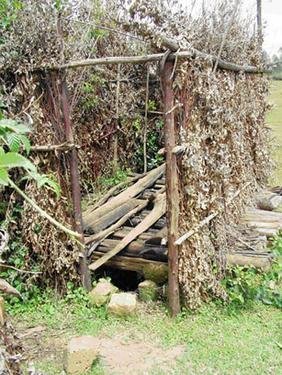
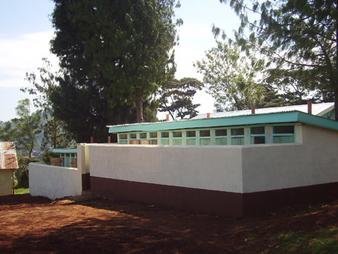
The aim of this project was to improve the hygienic and sanitation state of the school which was appalling, although the main focus of the project was the improvement of girls’ school attendance, the bad conditions of toilets also affected the boys, hence separate latrines for boys and girls were built in the school.
Funds so far received by Health and Water Foundation from donors through Global Giving have been used to provide participatory hygiene training and providing sanitary ware to girls.
Specific Benefits
So far, pupils especially girls are now spending more time in school doing class works. This has been realized because:
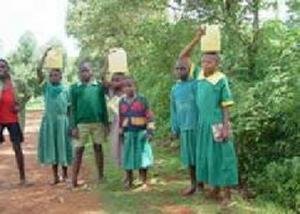
• Pupils no longer spend time outside classes fetching water for use at school. The tanks have water almost all the time • Fewer Pupils absent themselves from school due diarrhea and other diseases. These cases have reduced so far. • School Girls are now more comfortable and they are no longer tempted to skip school when they have their periods. The wash rooms provided and the training given have improved their morale and confidence in handling their menstruations • The risk of molestation and rape cases of schoolgirls has been reduced due to enhanced privacy of sanitary facilities. Girls are no longer spied on nor teased by boys when they visit the toilets/wash rooms
The following outcomes are expected to be realized in the long run.
• Higher levels of education amongst girls. • Increased empowerment for women • Reduced disease incidents due to availability of safe water and improved sanitation to children including 40 disabled ones, teachers and staff
Hygiene education and PHAST
Participatory Hygiene and Sanitation Transformation (PHAST) training was undertaken to capacity build and enable the school pupils have knowledge and skills on water, hygiene and sanitation. This training was provided by HWF staff. Hygiene education is about encouraging people to adopt good practices in order to prevent illness. The exercise was for promotion purposes and aimed at removing constrain to safe hygiene practices associated with lack of water and sanitation.
The training were done in schools (most of which hosted pupils from Internally Displaced Persons) families.At the end of the activity, the facilitators summed up the session by identifying the diseases that are caused by contaminated water and poor sanitation. The girls were informed of:
• Lack of adequate water for personal hygiene may result in increased spread of diseases such as diarrhea, dysentery, scabies, and eye diseases. • The use of adequate quantity of water leads to reduction of water-washed diseases. • Contaminated water may carry germs which cause disease such as typhoid, cholera, amoebas and hepatitis (water borne diseases) • Water is necessary for breeding of mosquitoes and bilharzias. Diseases caused by such vectors are called water related diseases. Examples of such diseases are malaria, schistosomiasis (Bilharzias) • Diseases caused by poor sanitation are known as excreta disposal related diseases.
CHAST and CTC (Child To Child) when used together encourage a child-to-child approach. The HWF staff led by water, sanitation and settlement specialist Mr. Reuben Kibegwa introduced these methods to the Schools targeting girls especially.
These methods will have important effects on the children because:
• Child to child approaches link what the children do in class with what they do out of class and at home and help children grow up into responsible adults • They give children new knowledge and skills and a better understanding of what they are doing. They also make learning more interesting and fun • They give a new look to health education in school, previously, children were taught facts about their own health, but these new methods encourage children to take health action for themselves and others- this targeted girls especially during menstrual periods. • They encourage children to work in a group, which helps them develop self-respect and a sense of worth.
Sexual Maturation, FGM and use of Sanitary Towels/Pads.
This training was conducted to the girl children from Rirumi Primary School. It also involved all female teachers and selected female parents.
Sexual Development of Girls
Girls go through five stages of development during puberty. Girls usually start to show the physical changes of puberty between the ages of 9 and 13, which is slightly sooner than boys. The female sex hormone called estrogen and other hormones cause the physical changes. Many girls are fully developed by the age of 16. Some girls will continue to develop through age 18.
The outputs were
• Sanitary towels provided for girls. • Training on general hygiene provided to the teachers. • Training on alternative initiation rites other than FGM.
Conclusion
The big program plans to cover over more 15 needy primary schools and we are continuing to source financial assistance, but faces a number of challenges. The main challenge is getting funds fast enough to cover the schools at US$ 25,000 per school. The program continues to receive urgent requests for assistance. In some schools the situation is desperate; the toilets have collapsed and schools face the prospect of being closed down on health grounds.