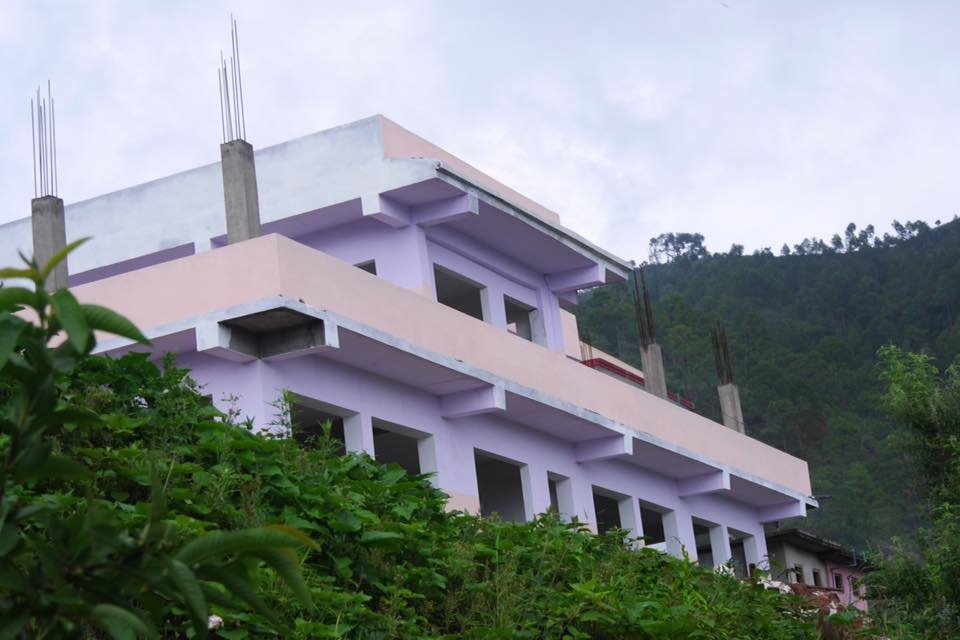
This past month 34 high school students volunteered to build a house for women at Her Farm. Previously, one volunteer from Colorado had spent two weeks putting in the foundation for the first "earth bag" house to be built in this part of Nepal. The students then spent one week and were able to finish 50% + of the house. Consisting of 4 rooms, each one 18ft by 18ft, it's a large structure that involved hundreds of hours of labor to complete. Earth bag housing is built using rice bags which are filled with dirt, stacked as you would bricks or cement blocks with barbed wire acting as mortar, then compacted with a heavy tamper. A steel and concrete ring beam around the top of the entire structure ties all the walls together for strength. It's an environmentally great way to build and provides a home that is also free from chemicals. We finished our earth bag house off with mud plaster and a metal roof. We've just to finish the floors inside the rooms and it will be ready for occupancy.


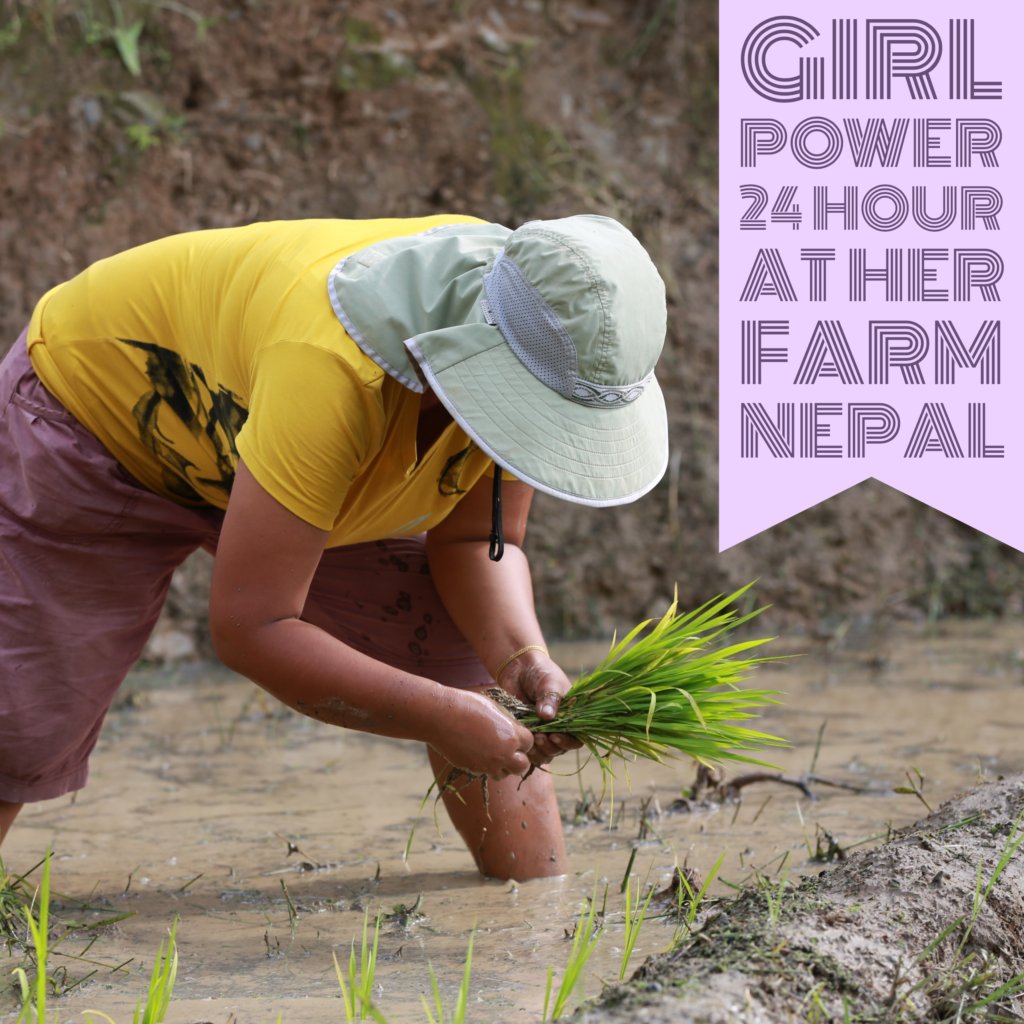
Happy to report that thanks to our Global Giving donors we're making great progress on the farm. First, we've hired a caretaker, a husband and wife we've known for several years. The husband is skilled in the building trades and is engaged right now in building an out building on the farm for livestock so we'll soon be able to move our animals to the farm. We are buying a pair of oxen to use for plowing the fields. In Nepal, people use a team of oxen and a wooden plow for their fields. With the sometimes-steep, terraced farming that's practiced and the lack of mechanized equipment in the company, oxen are the most popular choice for plow animals. We will also be adding a cow for milk and some goats as soon as the livestock building is complete, which should be by the end of December.
Another woman and her children have moved in at the farm. She's an experienced farmer, escaping a very abusive marriage and we're so happy to be able to provide her with a good home to live in and prime farmland to grow food on.
A volunteer is arriving at the farm this week to start putting a foundation in for another house on the farm. He will be there for three weeks and is optimistic he can complete the footings in that time. Then, in March our school group from Canada will return and begin construction of another house. We'll be using earth bag building for this as it's inexpensive, earthquake resistant and provides warmth in winter and cool in summer. It's also an easy material to work with for volunteers. Instead of bricks or cement blocks, rice bags are filled with compacted dirt and stacked atop each other with barbed wire in between the bags that acts as a mortar. Once finished the interior and exterior can be plastered with mud, after the local fashion, or cement, a style more popular in the cities of Nepal.The house will have 4 rooms, about 18 feet by 18 feet each. We are building a common kitchen and toilet/bath next to the house. I'll have photos of the kitchen/bath soon as it is under construction now.


Shari Davis & Ellen Currin are InTheField Travelers with GlobalGiving who are visiting our partners’ projects throughout Nepal. Their “Postcard” from their most recent visit in Nepal:
A two-hour bus ride from The Mountain Fund’s volunteer house in Kathmandu took us to the site of their women’s cooperative farming project. A few of the volunteers were participating in a home-stay program in the village, and we first dropped of their belongings, then began our two-hour hike to Mankhu Village Farm. This site contained the land and housing for their farming project, where women suffering from domestic abuse are provided safe housing and farmland for themselves and their children.
We spent the day digging and planting around 100 trees on the sloping land owned by the Mountain Fund. The organization’s local staff organized and supervised our planting efforts, explaining the trees will provide food and shade for animals, which can provide additional means of livelihood for the women.
It was HOT. We were sweaty and dirty by the time we finished. Our Nepali family made it worth the effort, fetching us fruit from trees, turning a fallen log into an amusement park ride, and leading a game of javelin with our planting equipment. It was a bit of a miracle we got any work done at all.
I only wish we could see the impact of these trees during the coming years, shading the valley of the women’s cooperative farmland, feeding the animals, and helping provide a fresh, new start for many deserving families.

Links:

Good news ! We've been trying to obtain one small parcel of land that adjoins ours and now we have. It's just 5 more ropani of land but the primary reason we sought to obtain it is that is has a house on it. It's a pretty decent, 2 story home built in the typical village style but it does give us a little more housing and that's what we so urgently needed.
We still need to construct two additional homes on the farm, bringing the total to 4 houses, in order to have capacity but this purchase brings us one step closer to meeting our goal of housing thirty.
Soon we will also be building a small greenhouse so we can get a head start on seeds and have them ready for transplanting to the fields. Few farmers go to the extra expense or work of doing this but plenty of studies at university research farms have shown that if you can start your plants in seed beds in a greenhouse the productivity of the farm can be increased. More productivity equals more food for women and children.
Thanks for your continued support of this project,
Scott

The Mankhu Village Farm for Women is open and occupied. We've moved two families, both from the "untouchable caste" into the one house we currently have at the farm. There are a total of six children living there. We have provided them with land to farm on, seed to plant so they can grow their own food and a small wage for work they are doing to repair and improve the farm, enough to sustain them until the crops come in. We have also provide the children with clothing and school supplies.
Before moving to the farm these families had no land and were basically squatting on nearby government land and living on the fringe of the village. Now they have a roof over their heads, land to farm and enough basic things to survive.
Our challenge now is to build more housing for more women and children. We have enough land for farming to support as many as 30, but not enough housing. We have women and children waiting to live on our land and farm it to sustain themselves and we will move more in as soon as we can provide a roof over there head. If you can help us to build more housing please make a donation.
To construct one house, in typical village fashion, that can house 10 more women and children we need approximately $7,000.
Links:
Project Reports on GlobalGiving are posted directly to globalgiving.org by Project Leaders as they are completed, generally every 3-4 months. To protect the integrity of these documents, GlobalGiving does not alter them; therefore you may find some language or formatting issues.
If you donate to this project or have donated to this project, you will get an e-mail when this project posts a report. You can also subscribe for reports via e-mail without donating or by subscribing to this project's RSS feed.
Albuquerque,
New Mexico,
United States
http://www.mountainfund.org