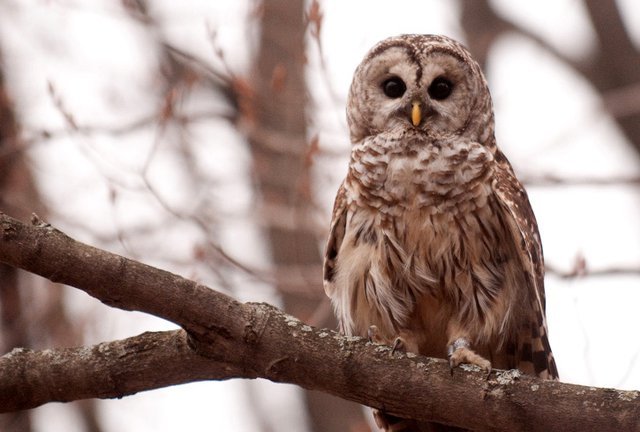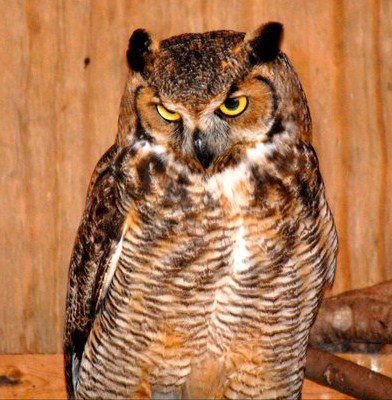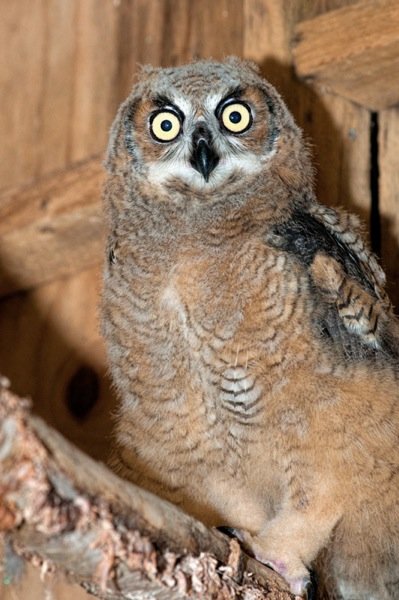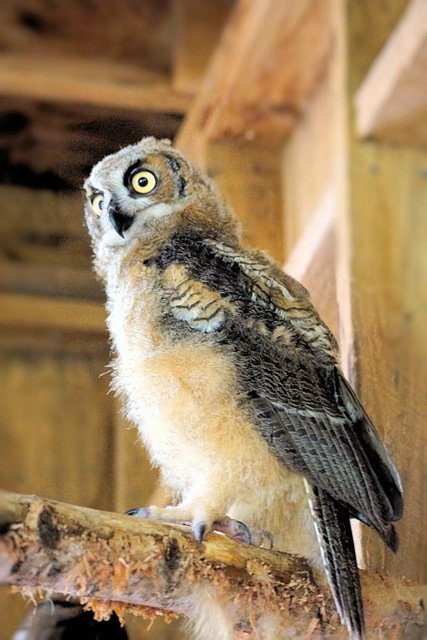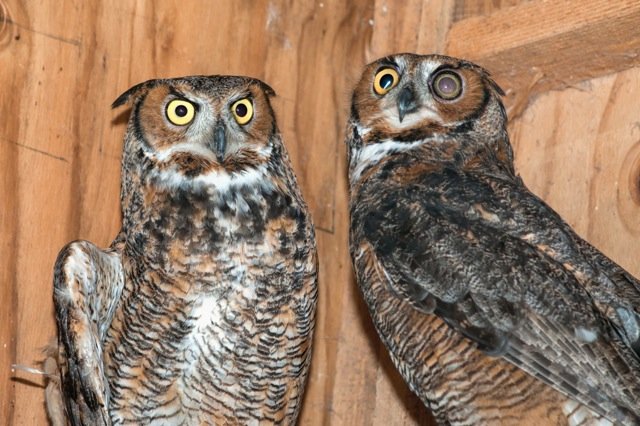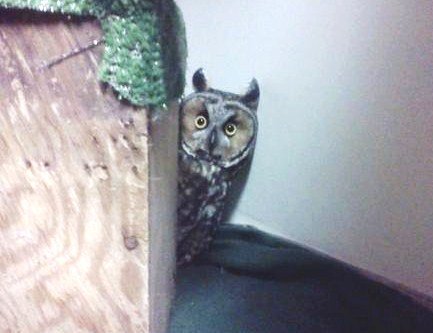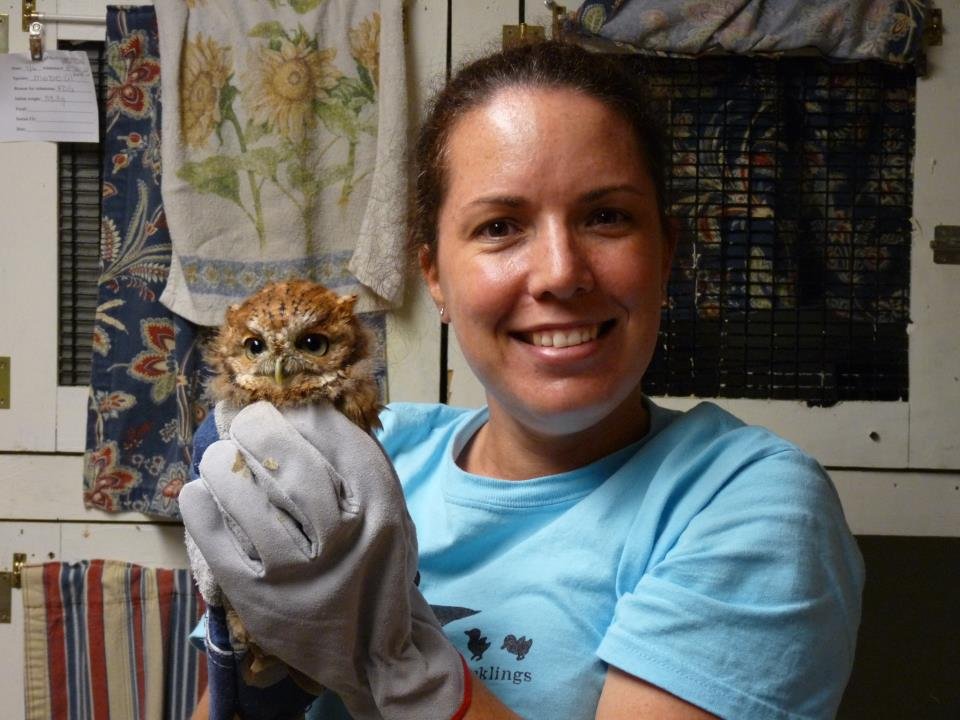
Thanks to your donations Center for Wildlife has continued our work medically treating over injured and orphaned wild owls, and continue to work toward securing funding for the next transmitter to be placed on an owl with ocular damage. In 2012 our local community brought us a total of 33 injured and orphaned owls, with fractures, head trauma, and eye trauma mainly sustained from being hit by cars. These patients represent native species and include snowy owls, barred owls, great horned owls, Eastern screech owls, and Northern saw whet owls. 20 of these owls were released back into the wild where they belong, and the rest were humanely euthanized due to extensive injuries and internal trauma. In January alone, we have admitted 10 owls, five are being cared for in the clinic, and three have already been released!
We have submitted a grant to the National Wildlife Rehabilitator's Association to help with the cost of $5,000 for two transmitters and their data transmission for the next owl patients with ocular damage. Together with your support we are hopeful that we can understand more about an owl with limited vision's ability to hunt after recovering from injuries sustained from vehicle collisions. Here's a great story about one of our owl patients that was recently released:
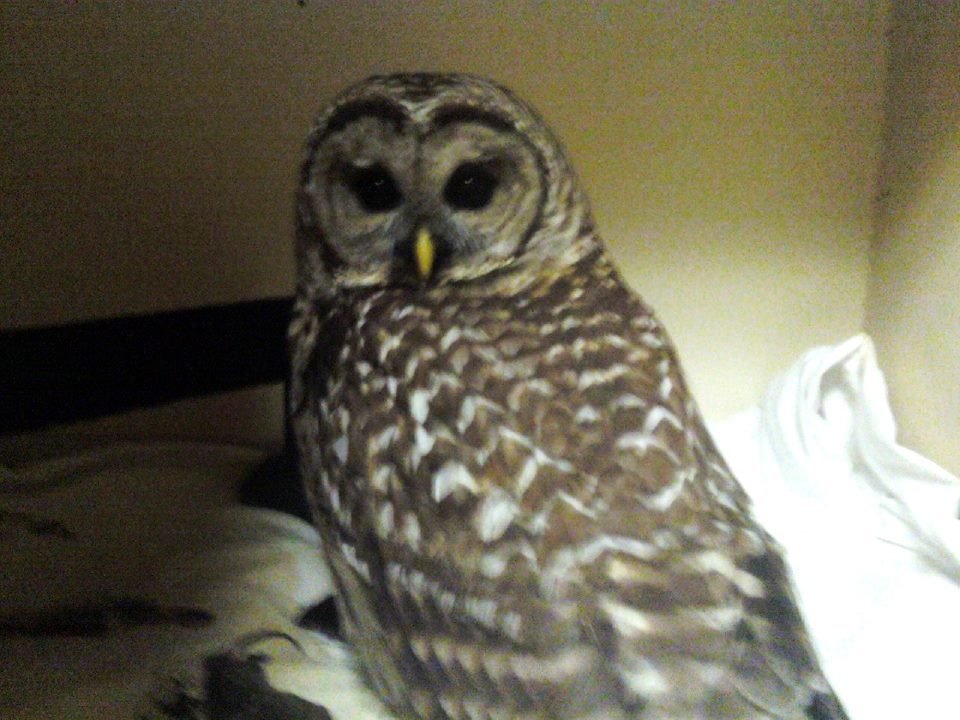
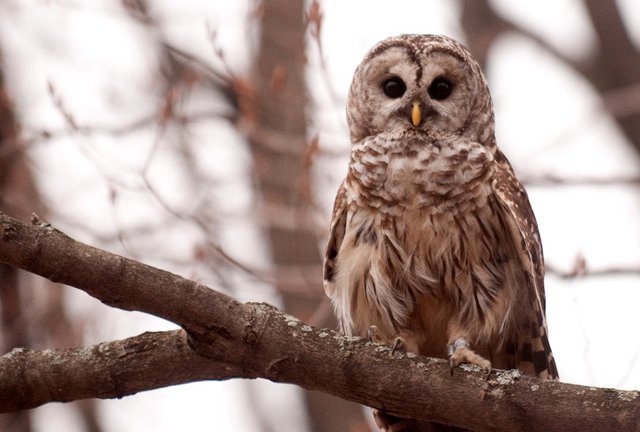
On November 21st, a local man was on his commute to work on Route 4 in Durham, NH when he noticed what looked like a bird laying face down on the side of the road. He quickly turned around, and found that it was indeed a barred owl that had just been hit by a car and was struggling to stand. Amazingly he was not the only person that wanted to help, a utilities service truck soon pulled over offering gloves or equipment to safely transport the raptor. The rescuer gently wrapped the owl in a jacket, careful to cover her head so that she would not be scared. He drove immediately to the Center for Wildlife, worrying that his patient was comfortable and not stressed, and wondering if she would be able to make it.
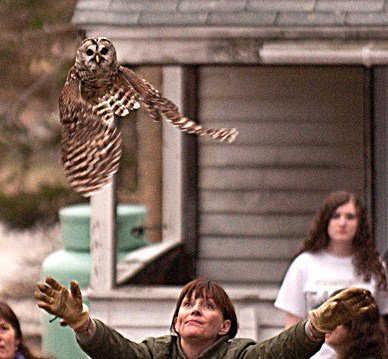
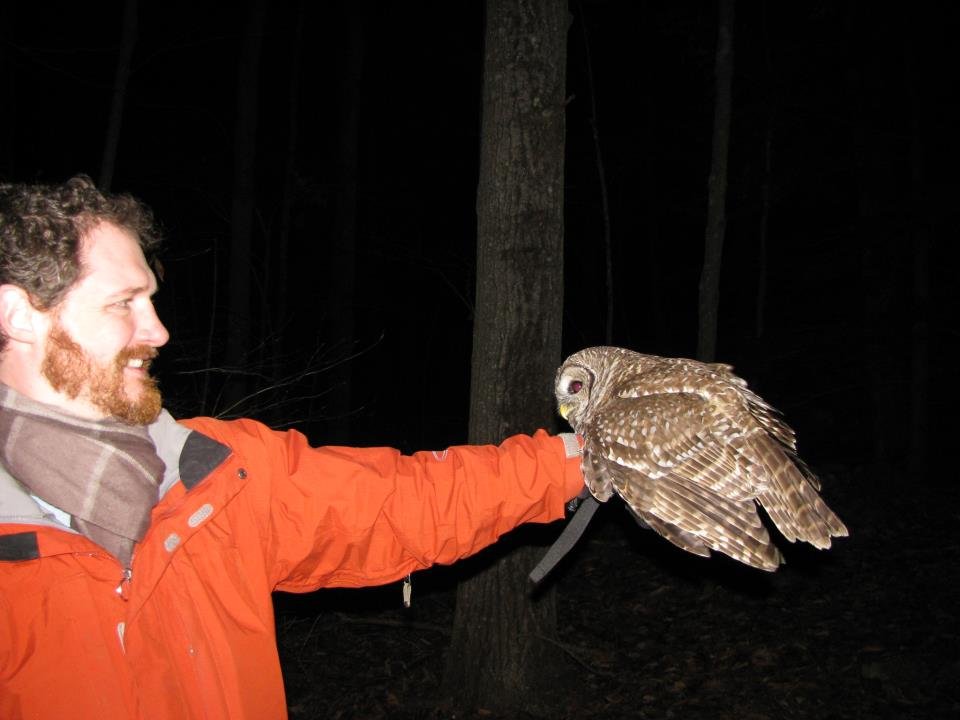
Upon examination our Wildlife Specialists and volunteer veterinarian, Dr. John Means DVM, found that she was feisty and had no fractures, but had some damage to the structures in her eyes. Incredibly, with supportive care, proper nutrition and housing, her eyes have already healed! Our veterinarian almost couldn't believe his "eyes"! The local man that rescued the owl was given the honors of the release. As the man held the bird she quietly took in her surroundings, then quickly flew to a tall pine, seemingly happy to be back home! She looked back at us, then slipped off into the woods. The rescuer shared "A big thank you to CFW Staff, volunteers, interns, and vet for rehabilitating this amazing barred owl! I feel very fortunate to have found her and had a place to bring her for the excellent care she needed after being hit on rt 4 in NH. The work you all do, and the care you give, is amazing, and I am thankful to have been able to release the owl tonight. The quality of care given at CFW, and the resilience of this barred, is evident in the quick recovery (found the day before Thanksgiving). Thank you all again!"
We hope you enjoyed the update, and are so grateful that you value our work and local wildlife, we truly could not do our work without you!
Sincerely,
-Center for Wildlife staff, patients, and wildlife ambassadors


Links:
We have been planning a new phase of this project and submitted a grant request to NWRA (National Association of Wildlife Rehabilitators) for partial sponsorship.
The project leader will be Dr. John Means, a local veterinarian and Center for Wildlife Board member.
The project abstract is as follows: Platform transmitting terminals (PTTs) will be affixed to two rehabilitated owls with unilateral ocular trauma. Their movements and survivorship will be tracked after release. The birds, a barred owl (Strix varia) and a great horned owl (Bubo virginianus), will be made available by the Center for Wildlife, in Cape Neddick, Maine. Both birds will be kept in rehabilitation until change in the visible damage to the eye (as assessed by opthalmascope) has ceased, indicating that remaining damage is permanent. Degree of ocular damage will be assessed by a veterinarian upon initial admission to Center for Wildlife, and again just prior to release. After undergoing rehabilitation, exhibiting adequate flight capability (as determined by staff rehabilitators), and demonstrating the ability to capture live prey in a large flight enclosure, the owls will be released back to the territory in which they were found. They will be tracked as long as possible, and a visual confirmation will be attempted if the birds do not move substantially for a week. If a bird dies, attempts will be made to recover the carcass, at which time radiographs and necropsy will be conducted to determine the cause of death.
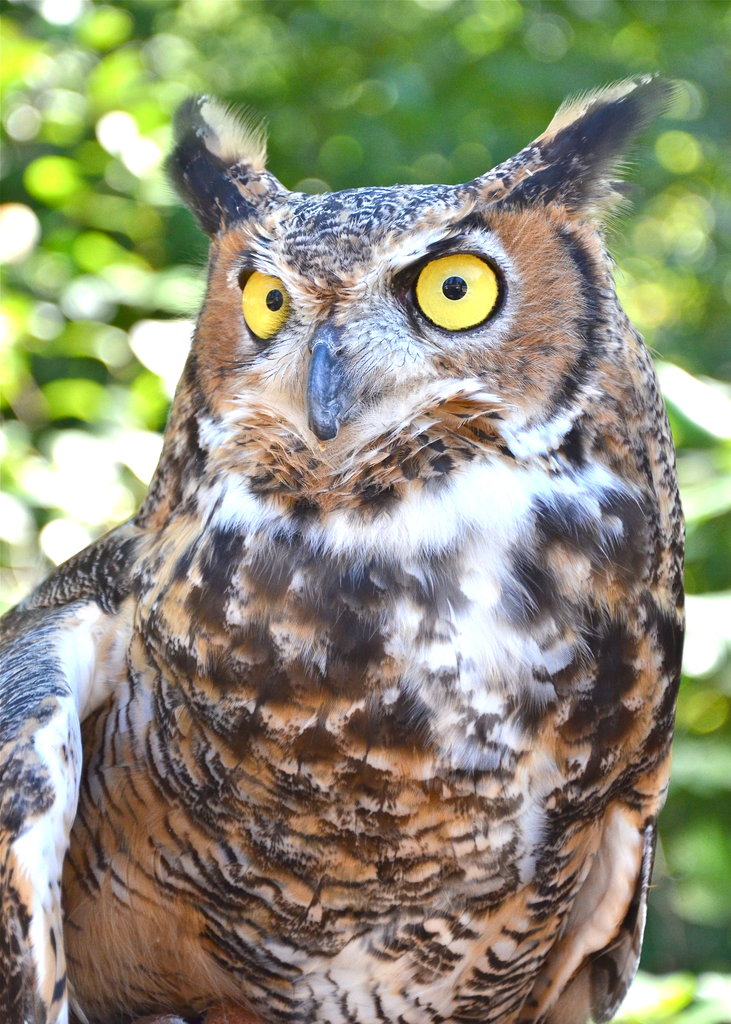
We are pleased to report that our great horned owl successfully thrived for a little over 4 months (approximately 132 days), but saddened to report that she has indeed passed away. The purpose of our study was to determine whether an owl with ocular damage could hunt well enough to take care of herself, especially during the winter season where many prey are hibernating, have migrated, or are taking cover under snow. Thanks to this study it is clear that she was able to survive for quite sometime, and based on date of recovery of her body and no satellite movements we can determine that she passed away sometime in the beginning of March. We had continued to work with Biodiversity Research Institute who offers expertise in field studies and research, and after receiving uncharacteristic satellite data determined that either the transmitter was dislodged or that she had passed away. We were able to borrow their VHF receiver and GPS equipment and track down the great horned owl. She was found on the shore in Harpswell, ME; a mainland off the coast of the islands that she had been discovered on, and travelled around for the majority of the time that we were able to track her.
Center for Wildlife staff immediately brought her remains to the New Hampshire Veterinary Diagnostics Lab, a medical partner located at the University of New Hampshire. Part of your funding made it possible to run a complete necropsy by their qualified staff, and try to determine cause of death. Cause of death could not be determined definitively, however it was noted that she had a fractured radius, and was thin. If she had been hit by a car, or suffered a fractured radius in another way, she would not have been able to hunt well enough to feed herself which could explain why she was thin.
Although of course we would have loved the great horned owl to survive for the rest of her life span, we are very encouraged by these findings. Chris Desorbo, the Wildlife Research Biologist working with us from Biodiversity Research Institute stated "It seems clear that your owl was able to survive despite the ocular injury for some time." Although we may not be able to draw definitive conclusions from one study, the data does show clearly that an owl with ocular damage has a great chance of surviving and caring for themselves for quite some time, and would not necessarily automatically starve to death upon release. This is very hopeful news for great horned owls who may have been euthanized or automatically placed in captivity for life-time care due to permanent eye trauma. There also was not much information about island dwelling owls or their movements in Maine, and this study has offered very valuable data. Center for Wildlife staff, Biodiversity Research Institute's biologists, and the general public were amazed by the great horned owl's travels over the open ocean each night. The data and maps also offer supporting data to the theory that great horned owls are dedicated to a territory and tend to hunt and live in one area.
We are so grateful to the donors toward this research project. There is little to no data or post-release studies on owls with ocular damage, or released patients at all due to no state or federal funding for wildlife medical care. Many centers including Center for Wildlife struggle each year to raise the funding to treat an increasing amount of patients, despite a decreasing amount of donations due to the economy. Because of your support, we have taken the first step to understanding the best prognosis for a great horned owl with ocular damage. We were able to recover the transmitter and it is in tact and can pay a fee to have it restored to it's full capacity and battery life (1.5 years). This means that we will be able to place the transmitter on a new patient, and continue our important research. Funding toward this project will continue to go toward the equipment, data processing, and staff time to study the next post-released owl. Thank you!!

Links:

This great horned owl is no ordinary owl in many different respects. Beyond being one of the first rehabilitated owls to be tracked post-release, she is also an island dwelling owl. Her rescuers found her at their home on Hope Island, which is one of several small islands off the coast of Portland in Casco Bay. Her rescuers called often to check on her recovery, and were one of the first lead donors to support the transmitter. They check in almost weekly to hear reports and updates from the transmitter, and have reported spotting "Hootie" (as they fondly call her) hunting around their property every so often. Thanks to your donations, we have been able to share updates and maps of the great horned owl's amazing travels over the open ocean on our website and Facebook pages. Center for Wildlife staff, volunteer, interns, and our community all look forward to the weekly updates, and are amazed that this owl with limited vision not only hunts for herself, but traverses the open ocean regularly.
As we arrived to the island when we brought her home for release, we could see that the great horned owl had chosen the perfect habitat for herself. This island and the ones surrounding it offer the perfect open habitat bordered by forest and snags for hunting, nesting, and perching. Great horned owls are dynamic hunters, with 200-300 pounds per square inch of crushing power in their talons. Amazing for a 3-5 pound bird! These birds have an extremely wide range of prey with over 250 species identified. We were hopeful that she would have a great variety of species in this healthy ecosystem, and it is certainly proving to support her!
We are so pleased to report that our great horned owl is doing well, and makes some pretty incredible journeys on almost a nightly basis! The transmitter is set to turn on for 8 hours at a time, and then off for 88 hours (3 days and 16 hours). This will allow us to retrieve readings every 3 days for the life of the battery- 1.5 years. We have been amazed to find out that this owl often travels 1-3 km in one evening around the islands surrounding Hope Island. For the past two weeks she has changed her traveling patterns, and instead of hunting on different islands around Hope, she has been staying put on a small island north of Hope called Bangs Island. This is great horned owl nesting season, and we are hopeful that she may have found a mate, and is staying put because she is busy incubating eggs in a nest. Thanks to your support we can find out more about these amazing creatures!


On December 26, 2010 Phyllis and John Cacoulidis found an injured great horned owl weak and face down in the snow near their home on Hope Island. With over 50 owls now typically admitted for the past few winters, this unfortunately is a story that many of our local rescuers are far too familiar with. The owl was boarded immediately onto their boat and brought him to Dr. Vassey in Portland, ME who in turn coordinated transport to Center for Wildlife. Center for Wildlife gladly admitted the owl whom had eye trauma, and with intensive and supportive care from staff, volunteers, and interns the owl regained full health except for perfect vision in his left eye. She worked up to our 100 foot flight enclosure and demonstrated excellent flight and potential survivability. The question that has plagued CFW staff and wildlife clinics nationwide then ensued…she was essentially blind in one eye but owls also rely on silent flight and their excellent sense of hearing for hunting and feeding themselves, so is it possible that she and other owls can survive without perfect vision? This amazing owl was the perfect candidate for our release study!
Thanks to your donations CFW was able to care for and medically treat the owl, and coordinate the first “On the Wings of Research” transmitter project. Staff were able to spend some time to draft a study, and raise initial funding for the transmitter and data collection and analysis for the life of the transmitter (approximately 1.5 years). This would allow us to track her seasonal movements, get a location for her every 4 days, and understand how well she can hunt and take care of herself in the wild with her disability. This information can then guide us to the best prognosis and care for one-eyed owls (can they be humanely released or will they starve to death?) along with understanding the best release practices- optimal timing and season for release, whether they are extremely site loyal or if they can be relocated, and much more!
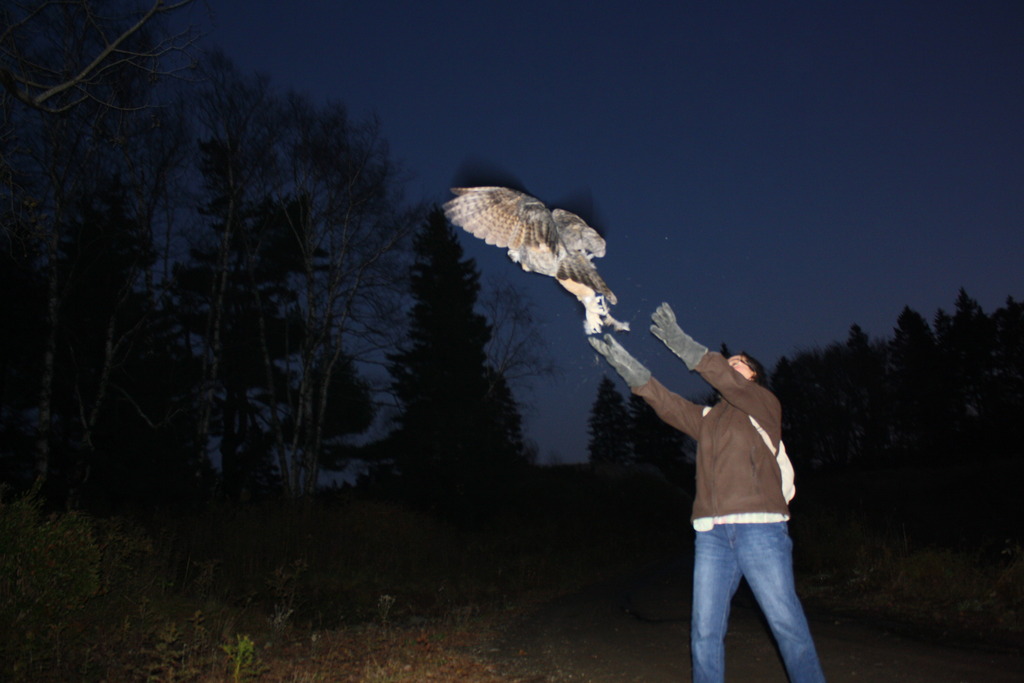
This was an exciting release for all involved. "Mrs. C" was kind enough to invite CFW staff and volunteers, Biodiversity Research Institute staff, and everyone involved in this majestic creature’s rescue and care. We loaded the owl to the boat with excitement in our stomachs, and reached the owl’s beautiful habitat. We were welcomed with cider and donuts, and all walked together to an open field that faced the woods. The release honors were given to Sheila Rogers whom had answered the "call of the wild" and gave a major gift to help make this pilot project a reality. Staff transferred the strong and large bird to Sheila, and she opened her hands and the owl soared off and perched in a near tree. We were able to watch her take in her familiar territory, and she finally flew off into the night. As our Education and Outreach Fellow observed, “there was a lot of hope coming from Hope Island that night”.
We are so grateful to all involved, and have been happily tracking her movements ever since. Without your contributions we would never have been able to pull this project, materials, and research together which will prove to be invaluable to our work along with many other wildlife medical clinics. We have been happily tracking the owl's movements along her island habitats and are so pleased to report she is alive and doing well! We have also been amazed to find out that although she is built with a woodland owl's wings, she travels over the ocean and hunts at different islands almost every night. We will continue to monitor and track her movements, and look forward to this being the first of many patients that can be tracked post-release!


Links:
Project Reports on GlobalGiving are posted directly to globalgiving.org by Project Leaders as they are completed, generally every 3-4 months. To protect the integrity of these documents, GlobalGiving does not alter them; therefore you may find some language or formatting issues.
If you donate to this project or have donated to this project, you will get an e-mail when this project posts a report. You can also subscribe for reports via e-mail without donating or by subscribing to this project's RSS feed.
Cape Neddick,
Maine,
United States
http://www.yorkcenterforwildlife.org
Cape Neddick,
ME
United States