Help Nicaragua's Poor Climb out of Poverty

 
$570
$1,430
Raised
Remaining
Apr 4, 2013

Emprenedora Technical High School Goes Green

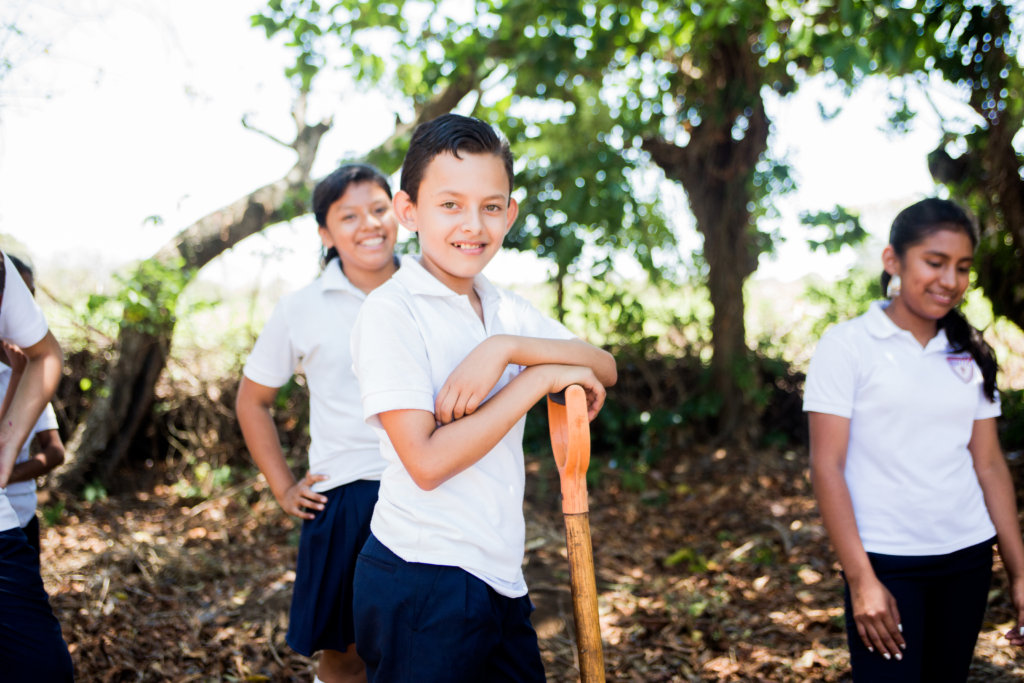
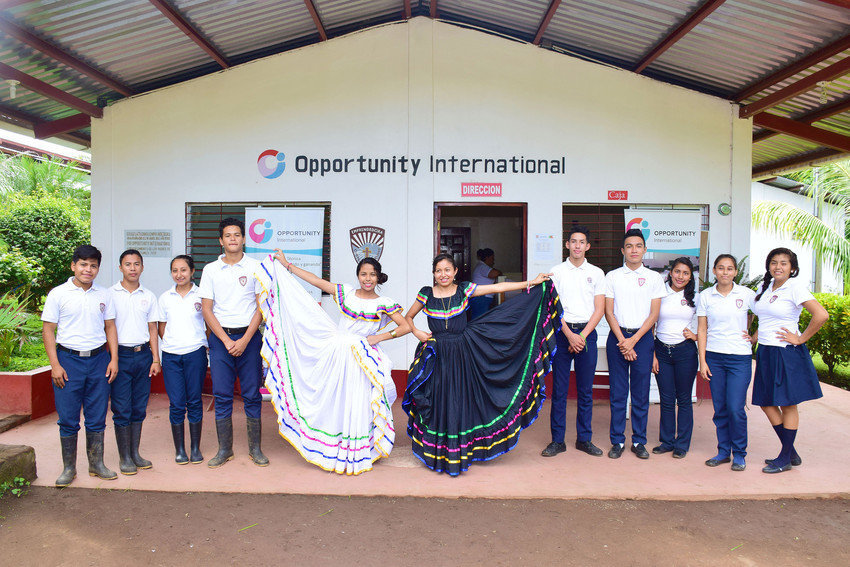
The Emprenedora Technical High School  began operations in the Spring of 2012 starting with two classes of seventh graders. The school is designed to not only meet the requirements of the Nicaraguan Ministry of Education, but also to give students a hands-on learning opportunity in skills key to the local economy including hospitality and agriculture. Typical classroom learning is augmented to include the opportunity for students to learn and practice entrepreneurial skills through multiple school businesses. When sustainable, these school businesses will help support the school. 

May kicked off Nicaragua’s first planting season of the year with full student participation planting the organic garden. Students were involved in the preparation and planting of a variety of organic vegetables that will be sold to local restaurants and provide income for the school. Working in the garden using a simple gravity drip-irrigation system (see green tank in photo) is a new experience for the students. 

Additional school highlights include:

  • Two school businesses currently operating: the chicken hatchery and the organic garden. In August, the team installed the infrastructure for bee-keeping.
  • The construction of two additional classrooms, a library and kitchen/bodega is moving forward to accommodate the growth to 120 students planned for the 2013 academic year. 
  • The Emprenedora School is utilizing the curriculum of the EARTH Institute that focuses on sustainable education models in Latin America. The curriculum augments the required national curriculum and allows the school to introduce entrepreneurial skills into the classroom as well as offer practical application in the school’s businesses. 
  • The School is able to offer several extra-curricular activities that are not commonly found in the Nicaraguan setting such as music and organized sports. The aim is to support children’s holistic development and education.

Links:

Dec 13, 2012

Building Communities

In Nicaragua, you help communities put their assets to work

The Nicaragua Community Economic Development project combines the power of financial products for microentrepreneurs with support for skill building, job creation and small business development. The community economic development approach grows income and creates jobs in Nicaragua through several community-level interventions. Opportunity develops programs that capitalize on the immense potential of Nicaraguans to become investors in their own community projects and development. Highlights from the last six months are outlined below.  

  • Farmer training and support is provided through the Agriculture program by trained agronomists to assist in improved technologies for better income as well as improved stewardship of assets and farm land.
    • To date more than 682 farmers have received training. 
    • The yucca processing plant employs 66 workers, more during peak season.
    • 300 yucca farmers increase income by selling to the processing plant.
    • Net income has increased from 20% to 47% per acre planted with assistance.
    • In 2012, clients reported yields 23% to 40% higher than the national average.
    • 787 farmers have directly benefited from the program.
  • The Emprenedora Technical High School is maintaining a100% student retention through the first school year. This is a critical indicator, as only 30% of Nicaraguan children who start school graduate, and only 10% achieve this in rural areas. The school is in its infancy, but provides an economical alternative for students and their families for a cutting edge and leading educational experience. 
    • 20 parents are actively involved as volunteers in the school’s first year of operation.
    • 58 students attended the first year of school with two classes of 7th graders.
  • Ojala and NicaWorks Artisan programs focus on supporting the development and commercialization of traditional artisans through the organization and sharing of ideas and practices as well as increasing export potential for some artisans.   
    • 15 artisans are selling their product via Ojala  as of July 2012.
    • As of July 2012, Ojala  sales are $84,490 since inception.
    • 260 clients benefited from the NicaWorks program through 2010, 303 beneficiaries were supported in 2011 and 293 benefited by the NicaWorks artisan program in 2012 to date.
  • The Community Infrastructure projects are improving living conditions, reducing costs and providing opportunities for greater community good. Significant progress to date has been achieved to confirm that the project is focused and achieving this goal. 
    • As of July 2012, 160 clients have been using green technologies including methane gas.
    • Six community projects and six church projects have been organized by communities.
    • 20 community libraries have been developed with over 10,000 books placed in the libraries.
    • 5,906 people are directly benefitting from these community projects.  
Aug 21, 2012

Artisan and Community Support in Nicaragua

The Artisan Support Program

With enhanced brand identity and World Free Trade Organization (WFTO) status, representatives of the Ojalá! entrepreneur cooperative attended a week long home décor trade show in Atlanta.  The show proved successful:

  • Over 150 stores throughout the United States now carry Ojalá!  Products.
  • Staff in Nicaragua shipped 15 cases, the largest order to-date.
  • 750 handmade items from our clients reached United States stores, representing more than $8,700 in sales and growing first quarter sales alone to $11,000.

The success driven by the Ojalá!  trade show appearance led to signing on for another trade show in July and increased sales projections for 2012 to $47,000.

The Community Infrastructure and Leadership

Your support for community-led projects promotes leadership development among adults and youth and increases quality of life and unity within Nicaraguan communities.

  • La Granadina Cooperative organizes projects that address a local issue or improve the local quality of life conditions. A recent undertaking was the La Laguna Road Repairs project which improved road conditions using community generated funding and labor. A previous effort, the La Laguna Water Project resulted in clean, affordable water to 215 households.
  • 380 Nicaraguan youths participate in Young Life, which combines discipleship and leadership training, meeting weekly and encouraging youth to get involved in the community.

The communities’ coordination resulted in the provision of affordable bus transportation for students at the cost of $.40 per student per day. This illustrates the community’s support for Community Economic Development projects, and is another example of how Nicaraguans invest their time and skills to improve life for families in their community. 

Lessons Learned in Nicaragua

  • Lending to the poor creates benefits beyond charity, while co-investing with the poor creates benefits beyond lending.
  • Conducting an asset assessment creates a baseline of data based on potential and opportunity, whereas a needs assessment creates a baseline of data based on problems and limitations.
  • Small-Medium Enterprise (SME) development in value chains allow financial intermediaries to address chronic issues of small holder farmers such as: lack of quality inputs, inconsistency in quality, lack of volume and lack of financing – while defining and developing market relationships. 
May 23, 2012

Partnering with Nicaraguan Yucca Farmers

A pungent, unfamiliar, almost rancid but still sweet, scent hit my nostrils: freshly ground yucca meets a growling grinder. Five men man the contraption: one filling the large funnel, one jamming a large stick into the funnel to feed the yucca chunks into the grinder, one scooping the pulp out of the bottom, one shoveling the pulp into a sack, and one, well, doing a great job holding the sack. I’ve eaten yucca fries and mashed yucca, but this is not a culinary operation.

Stuffed-full sacks of yucca pulp are put into a compressor that squeezes the water out. Fifty already-smashed sacks are piled in the corner, contents ready to be emptied onto large black tarps to dry in the midday sun. An acre of field behind the plant is dedicated to rows of tarp. Some rows have wood framed screens propped up to allow breeze to flow above and below the pulp to speed up drying. The air is sweeter and less musty in the field, but still tangy and fermented.

A diesel motor catches my attention as a yellow truck pulls into the gate in front of the Opportunity Nicaragua plant. Fifty young women chatting in the shade of nearby trees make their way to a tented slab of concrete at the sound of the truck. They sit on orange crates in slightly haphazard circles, waiting for young men to deliver their truckload of yucca, pulled from the ground early this morning. The women peel the yucca efficiently and skillfully, each filling their own orange crate. Opportunity International pays the women by the weight of the crate at the end of an eight-hour shift. At talk of buying a yucca peeling machine, the women protest saying they like the work. Most households in the area are multi-generational with one to two family members working part-time. These women are thrilled to have steady work for good wages. Day workers are organized into teams of five. Opportunity staff communicates hours and days with a team leader who then gathers up the team on work days.

Young men carry the crates of peeled yucca to the side yard where big blue plastic tubs of water wait encircled by more women donning white aprons. The women give the yucca a quick wash and scrub before passing them on to the five men at the grinder. It’s a very well-orchestrated operation. And it’s all designed to help 300 farmers get the best margin from their yucca harvest.

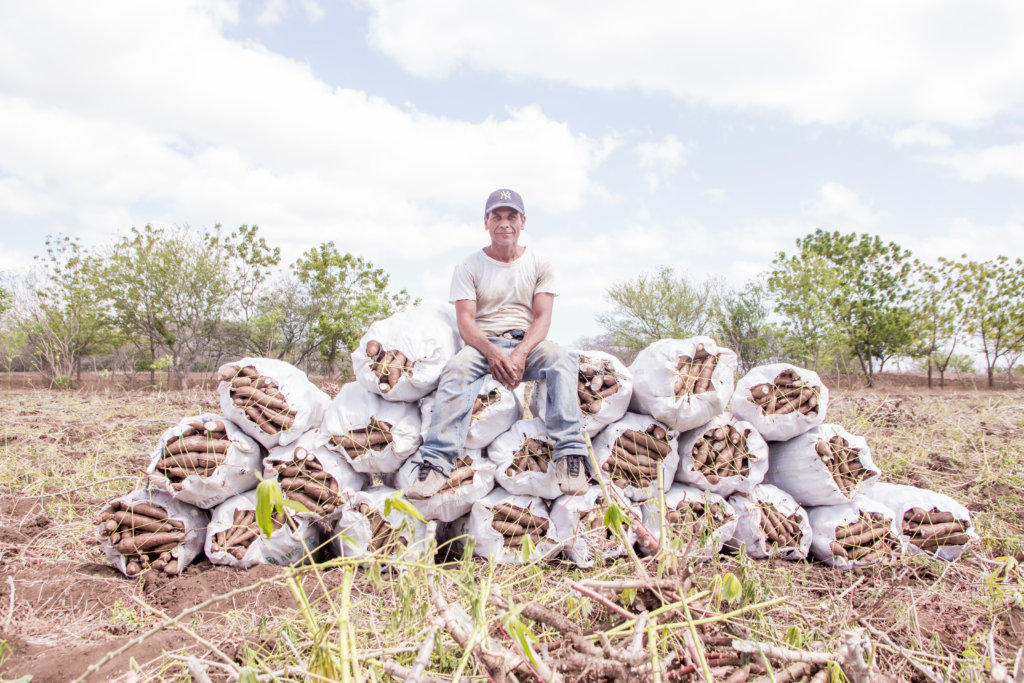
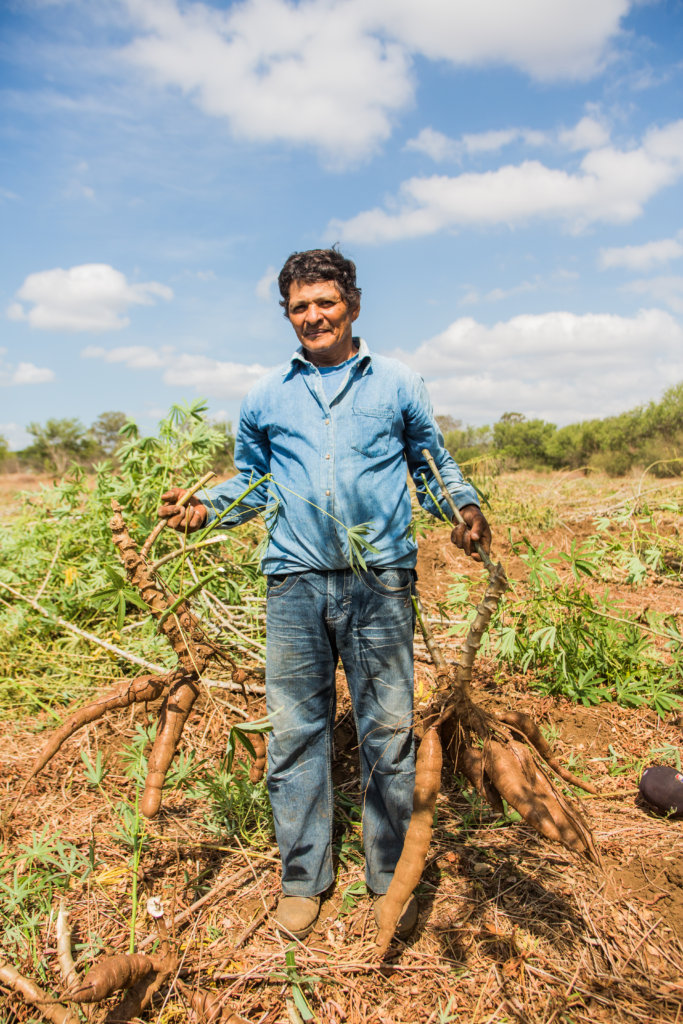
The “gold” of the yucca plant is the starch that can be derived from its ugly, brown, tubular roots. Watching 50 people take one farmer’s yucca harvest from ground to starch makes obvious the need for cooperation and mechanization. Yucca is a cranky crop. Its roots are extremely impatient and begin to rot just 24 hours after being pulled from the ground. There are a few ways to extend the life of a harvested yucca: dipping it in wax, which requires a waxing tub; keeping it cool, which requires refrigeration; or peeling, washing, grinding, pressing and drying, which requires the lengthy process described above.

Yucca also suffers from class discrimination, and class or quality can vary greatly from plant to plant, and even within a plant. A-quality yucca is suitable for wax-dipping and sale in the market. B-yucca is best suited for starch and flour processing. C-quality yucca can really only be sold for farm feed. Each quality fetches a different price. The more A yucca in a field, the more money the farmer can earn… if he can sell and deliver before it begins to rot.

Impoverished farmers living hand-to-mouth have little chance of selling A, B, or C yucca for a profit. There are too many barriers. As such, they end up as price takers in a precarious market. Enter Opportunity Nicaragua’s processing plant.

Opportunity sends out agronomists like Helen and Hawell to partner with farmers in the region. They teach techniques to increase yield, such as planting yucca seeds horizontally in softened earth rather than vertically in unturned soil. At harvest time, Helen and Hawell take a sampling of yucca from a 10-meter by 10-meter plot to assess the average quality of the harvest. Opportunity buys the farmer’s entire yield at current market price based on the assessment. An Opportunity truck arrives at the farmer’s land on the day of harvest to quickly take the yucca directly to the plant for processing. Because the farmer is able to sell his whole crop at a fair price without waste or spoiling, he increases his income significantly and can plan for the upcoming seasons.

“Successful farming is all about mitigating risk,” says David Kone, executive director of Opportunity Nicaragua. When farmers can count on a buyer and a fair price for their best yucca, they can invest in their homes and land, build savings, and send their children to school.

Carlos Polanco, an Opportunity farmer, shared how he decided to work with Opportunity. His brother’s plot of land abuts his own. Last year his brother worked with Opportunity agronomists but Carlos was skeptical. The techniques Helen and Hawell teach require more labor on the front end, so without proof of higher yields, it can be hard to convince life-long farmers to adapt their methods. But as the yucca grew it became obvious that the labor was worth it: his brother’s yucca plants were noticeably fuller. At harvest, each plant yielded two to three times more yucca that was better quality than his own. This year, Carlos is an Opportunity farmer.

Back at the processing plant, David chats with plant manager Denis Brenes. Nicaraguan-born Denis has been integral to the project’s success in the last 11 months. Last week, David and Denis received a game-changing call. Cargill in Nicaragua tested and approved Opportunity’s starch product for use in their animal feed and will buy as much starch/flour as Denis can process in 2012. With proper machinery to unlock some bottlenecks in processing—such as the sun-drying process—Opportunity will be able to buy yucca from 1,000 farmers this season.

Helping people to improve the economics around their community’s greatest assets is called Asset-Based Community Development. Opportunity Nicaragua’s pilot project is focused on improving efficiency and quality in the area’s agriculture, tourism and artisan markets to increase the income and resources of the community. The goal is to turn self-sustainable assets, like the yucca-processing plant, over to the community of farmers in the next decade.

Jan 30, 2012

Promoting Entrepreneurship for the Next Generation

Opportunity International is launching a Technical High School to teach youth entrepreneurship skills in the agriculture and tourism industries as part of its community development initiative in Nicaragua.

Opportunity recently broke ground on its Entrepreneurial Technical High School in Diriomo, Nicaragua. The school will provide rural students with the education and training they need to rise out of poverty. It will also provide the community with educated and skilled workers to catalyze regional economic growth.

The first class of 50 students will matriculate in February and there are currently 30 students registered. Students will receive education in a high school academic curriculum, plus technical training in tourism and agriculture, all while learning to speak English. To date, two classrooms, the administrative office, a meeting room and restrooms have been completed. The director of the school as well as three teachers have been hired.

About Project Reports

Project Reports on GlobalGiving are posted directly to globalgiving.org by Project Leaders as they are completed, generally every 3-4 months. To protect the integrity of these documents, GlobalGiving does not alter them; therefore you may find some language or formatting issues.

If you donate to this project or have donated to this project, you will get an e-mail when this project posts a report. You can also subscribe for reports via e-mail without donating or by subscribing to this project's RSS feed.

An anonymous donor will match all new monthly recurring donations, but only if 75% of donors upgrade to a recurring donation today.
Terms and conditions apply.
Make a monthly recurring donation on your credit card. You can cancel at any time.
Make a donation in honor or memory of:
What kind of card would you like to send?
How much would you like to donate?
gift Make this donation a gift, in honor of, or in memory of someone?

Organization

Project Leader

Ally Lynch

Oak Brook, Illinois United States

Where is this project located?

Map of Help Nicaragua's Poor Climb out of Poverty