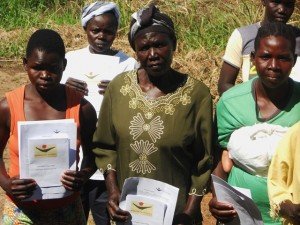
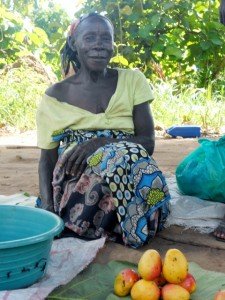
WfWI Interim African Regional Director Karen Sherman shares thoughts about her recent visit to South Sudan, including the difficulties of moving around the country, for both WfWI staff and WfWI - South Sudan participants.
Little was moving as we made our way along the dusty stretch of dirt road connecting Juba to Yei in the scorching mid-day sun. What should have been less than a two-hour drive took more than double the time due to the difficult terrain, which was more akin to a slalom course, requiring the driver to swerve from side to side to avoid large ditches and pot holes. Herds of goats and cows grazed by the side of the road while a handful of cars, motorcycles, and trucks – some ferrying soldiers, others daily commuters – rumbled onward.
Small groupings of grass and mud huts dotted the rural landscape. White markers denote areas previously cleared of landmines. Most of the villagers had sought some kind of shelter from the oppressive heat. Men gathered under traditional tukuls playing cards or drinking tea. Yet the women were out working, always working, carrying heavy loads of firewood, produce, or water on their heads in preparation for the evening meal; most had small infants swaddled around their backs. A typical day in South Sudan.
The vegetation grew denser and more varied as we approached Yei, with some areas appearing positively lush. Located within the Greenbelt Zone in Central Equatoria State, Yei River County is the new program site for Women for Women International in South Sudan. With a population close to 500,000 and few organizations providing gender-specific programs or services, Yei is home to many socially-excluded women who have significant potential to impact their families and communities.
Central Equatoria’s fertile land and consistent rainfall offer a promising opportunity for women to earn a sustainable income through agri-business and related sectors. In fact, the majority of households depend on crop farming or animal husbandry for consumption and livelihoods. Additionally, the state’s prime location at a major crossroads between Uganda and the cities of Yambio and Juba is ideal for women to access markets and trading routes to sell their products.
Central Equatoria is still recovering from decades of civil war, intertribal violence, and the influx of refugees fleeing conflict, mostly from neighboring Democratic Republic of the Congo. War has all but decimated the local infrastructure: 44% of the population lives below the poverty line, with an average income the equivalent of $8 per month. Education and health indicators are among the lowest in the world, reflecting the impact of protracted conflict and limited provision of social services. The situation is potentially dire given the impending fiscal crisis in South Sudan.
Women, in particular, bear the brunt of these challenges. Female-headed households make up a significant percentage of the urban and rural poor. Women account for 84% of the population who are unable to read and write.# They encounter limited economic opportunities, assume a majority of domestic responsibilities, and face discriminatory cultural practices such land ownership rights and widespread sexual and gender-based violence, including rape and domestic violence. South Sudan’s Deputy Minister of Gender, Child and Social Welfare considers violence against women as one of the key contributing obstacles to the country’s development.
“No one thinks about the women,” says Jennifer, a prominent leader in a coalition of eleven women’s groups from the Mugwo Payam, or District, in Yei County. At a recent meeting, she and other women spoke openly about the hardships and humiliations that come with daily life. Men frequently attack women on the road to the market, taking their produce or animals by force or stealing the money from their pockets to buy alcohol, according to several in the group, most of whom had experienced violence firsthand.
The prevalence of HIV and alcoholism among men and women in the area is primarily attributed to poor education; however, poverty, frustration, and an utter lack of hope and opportunity are large contributing factors. Educating women was considered the top priority by coalition members.
Although the women expressed strong interest in becoming active producers and community leaders, most lack the knowledge and skills to stand up for their rights and participate in the formal economy. Women for Women International addresses these challenges through its transformative yearlong education program, which integrates rights awareness and life skills with market-based skills and business training. With these skills, women rebuild their lives post-conflict and lead change in their families and communities. It is about creating voice and choice.
In South Sudan, as well as many other parts of the world, what women lack most is voice and choice. By investing in their social and economic empowerment, women gain the self-confidence, means, and status to advocate for their rights and contribute to public dialogue around critical issues of prosperity, peace, and stability – exactly what is needed to propel this new nation forward.
1. Key Indicators for Central Equatoria, 2010.The Republic of South Sudan National Bureau of Statistics.
2. Key Indicators for Central Equatoria, 2010. The Republic of South Sudan National Bureau of Statistics.
Motorbikes will help WfWI staff travel to remote locations in our countries of operation. Check out this great rip report from one of our DC-based staffers about traveling in Rwanda and the DR Congo. Nicole Weaver is WfWI's Chief Information Officer.
I was nervous crossing the border from Rwanda to the Democratic Republic of Congo (DRC). I know many of my colleagues at Women for Women International travel there, but I’ve heard reports of sporadic and random violence in the DRC. As our 4×4 wound its way through the mountainous border region with its tea plantations and volcanoes, I felt a sense of foreboding.
The border itself is a scruffy-looking parking lot with a few immigration buildings and a lot of people standing around waiting to be processed. There are two gates—the first lets you out of Rwanda and the second lets you into the DRC. The site is a no man’s land, and you could wait 30 seconds or 30 minutes to get through.
I climbed down from the first car in a torrential downpour and completed departure formalities and walked to DRC immigration, where I was examined, stamped and waved through. Today was a 20-minute day.
Our destination, Goma, is a town close to the border and one of four sites operated by Women for Women in the DRC. Within a few minutes I was in town, bouncing along a poorly paved road in a traffic pattern that seemed to have few rules except “every man for himself.” The contrast with Rwanda is marked: Where Rwanda is clean and organized, Congo is chaotic and dirty. Compared to the last few miles of sparsely populated rural countryside in Rwanda, Goma struck me as noisy, crowded and stressed. Roads in Rwanda had occasional potholes; roads in Goma are mostly potholes punctuated by a few stretches where the pavement has not yet given up.
My hotel was on the shores of the serene Lake Kivu. Grace Fisiy, our agribusiness specialist, and I decided to take a walk—I still had my lingering concern about security, but Grace assured me it was safe (she is from Cameroon and has traveled all over Africa, so I trust her instinct).
The dirt in this area is black. Mt. Nyiragongo erupted in 2002, destroying 15% of the buildings and leaving 120,000 people homeless. It also left behind black fertile soil and dust everywhere. The volcanic rock is so plentiful, it is a favored building material, meaning the buildings are also black. As we walked, chatting about Cameroon and family, I gradually realized I had completely relaxed. I did learn a new word on that walk—mzungu, Swahili for white man, which was muttered occasionally as we passed groups of bored security guards!
The next day, Women for Women’s driver arrived and took us to the office. After some meetings at the office we headed to the vocational skills center, where participants learn soap-making, knitting, cookery and bread-making. There were no classes that day, but about 150 newly enrolled women listened to an orientation, learning what to expect from the program and what Women for Women expects from them. As I stood in the doorway, listening and snapping a couple of pictures, the trainer asked the women if they had any questions. One woman at the far side of the room stood and said, “We want to know who the visitor is,” looking at me. I introduced myself and explained that I was visiting from headquarters and that my job was to find them sponsors (applause) and make sure their letters get to their sponsors (cheers). They said they wished God would take care of me for many years.
We could not do our work without the hard work of our in-country trainers, who will be the primary beneficiaries of the motorbikes. The trainers, who work with women in our program to teach them everything from vocational skills to health knowledge to important information about their rights, work tirelessly to help women in our program gain knowledge they can use to improve their lives. In addition to our main country offices, we often have satellite offices, and some trainers travel long distances to work with participants in these offices. Motorbikes will help trainers travel between offices more quickly, thereby allowing them to reach more women.
Like many of our program participants, our trainers often have their own amazing stories of triumph. Some were even program participants themselves, who come back to Women for Women International to teach other women the valuable skills they learned in the program. Read below for one woman's journey from victim to suvivor to active citizen.
Viviane is a skills trainer for WfWI-DRC. She has been making soap since 2003, and a soap trainer for WfWI since 2005. In that time she has trained over 1,000 women many of whom have gone on to become teachers themselves or open successful businesses producing soap. Once forced to discontinue her education after working hard to get to university, Viviane has become a great success and single-handedly supports her six children, all of whom are in school, while continuing as a trainer and running her own soap-making business.
Viviane Mahongole Barhumvanya works with Women for Women International-DRC training women to make soap. Since 2005, Viviane has trained over 1,000 of WfWI-DRC’s participants to become skilled soap makers. Some of the women Viviane has trained have gone on to become trainers themselves. Many others have been hired by production companies or opened small businesses of their own producing and selling soap.
Viviane is a good teacher. She’s dedicated to the position as evidenced by her four-year long commitment to training WfWI-DRC participants. In addition to her training, Viviane is herself a skilled soap maker and runs a soap-making business out of her home, supplying soap to 50-some business groups.
Viviane pursued her education at a young age. She graduated from elementary school in Kivu and secondary school in Bukavu. She went on to university at the Rural Development College, but her financial situation unfortunately prevented her from finishing. Instead, Viviane pursued soap making to earn a stable income. Becoming a teacher has been a rewarding experience. A single mother of six children, she encourages her children and wants to provide them with the best education. Her oldest daughter is in her first year of university, and her second recently graduated from high school. Her younger children, three sons and one daughter, are all still in high school. Education for all her children, especially her daughters, is one of Viviane’s most important goals in life.
Over the years, Viviane’s dedication to her students and work as a trainer has earned her the utmost respect of her superiors, and she is rewarded with greater responsibility. “…[O]ur department leaders…involve me in the analysis and designing of training modules. My unit gives me additional tasks related to the management of the solidarity small cash box recently created in our department.” She’s proud of all that she has accomplished, and all that her students are accomplishing each day. This year, Viviane and twenty other women from WfWI-DRC were accepted into a business and management training program sponsored by Goldman Sachs and taught by instructors from the University of Dar es Salaam. Once forced to leave school when it became too expensive, Viviane is thrilled now that she will be able to continue her education as part of this program. She is proud of her achievements, and is just one more example of the positive, multiplied change that occurs when women are empowered to become business-women and teachers.
We could not do our work without the hard work of our in-country trainers, who will be the primary beneficiaries of the motorbikes. The trainers, who work with women in our program to teach them everything from vocational skills to health knowledge to important information about their rights, work tirelessly to help women in our program gain knowledge they can use to improve their lives. In addition to our main country offices, we often have satellite offices, and some trainers travel long distances to work with participants in these offices. Motorbikes will help trainers travel between offices more quickly, thereby allowing them to reach more women.
Like many of our program participants, our trainers often have their own amazing stories of triumph. Some were even program participants themselves, who come back to Women for Women International to teach other women the valuable skills they learned in the program. Read below for one woman's journey from victim to suvivor to active citizen.
When you meet Alice Kiza Nahayo, you’ll find her full of glowing optimism. As a successful, joyful, and confident literacy trainer for Women for Women International-DRC, it’s hard to imagine the tragedies she has endured throughout her life. Yet Alice has had a long journey – she actually started out in the Women for Women International family as a participant. The depth of her personal triumph is apparent when she tells her story of survival from an orphan and victim of gender-based violence and rebirth as a loving mother and teacher.
Born in Burundi in 1968, Alice was orphaned in early childhood and raised under the harsh realities of a racist headmistress in an orphanage torn by Hutu and Tutsi tribal tensions. Brutal tribal conflicts govern the region where Alice, a Tutsi minority, grew up, and eventually lead to the horrifying Rwandan genocide of 1994. Alice experienced harsh discrimination in the orphanage that she is unable to describe to this day. She married as a young woman, eager to leave the hardships of her childhood behind, and became optimistic that she would finally feel at home in a place where she belonged. Alice was happy with her four children and felt that her life would be forever changed.
But after the birth of her fourth child, Alice’s husband began to beat and insult her daily. Her husband’s family mistreated her as well. One day, Alice’s husband beat her so badly that her right arm was broken; he set fire to her high school diploma, her prized possession and a symbol of her past achievements. With nowhere to turn, Alice escaped to Uvira, a city the province of South Kivu in the Democratic Republic of the Congo (DRC). She fled with her youngest son, who was quite ill at the time and for whose safety she was also very concerned.
Although she was now safe from the violence and discrimination of her husband and his family, Alice had few options for survival upon arrival in Uvira. As refugees, she and her son were given no assistance. As a woman and a Tutsi, options for employment were difficult to come by for Alice. They were without food, shelter, and her son’s poor health condition was worsening by the day. Eventually he died and Alice buried him in their new home. She was devastated. She felt that there was nothing left for her. That’s when Women for Women International-DRC (WfWI-DRC) found Alice.
Alice began as a participant in the WfWI-DRC program in March 2008, receiving direct financial aid, rights awareness and vocational skills training and psychosocial support from other participants, trainers, and her sponsor. At first, Alice was shy, sickly, and incapable of sharing her experiences with the group. Over time, the warm and familial atmosphere shared by the women participants in the Women for Women program drew Alice out of her shell and allowed her to become more confident and more willing to speak about and overcome her past tragedies. Her favorite subject was that of women’s rights, which sparked her interests and allowed her to regain her self-esteem.
Alice’s new-found confidence gave her the courage to share her knowledge and empower other participants in the WfWI-DRC program. She began to teach the other women about the realities of domestic violence, herself a survivor of life-threatening beatings by her husband. She excelled in her vocational skills training in culinary arts. The program staff considered her to be one of the most dynamic members of her group, a fact confirmed when she was invited to train fellow women in the program. She is now a literacy trainer for other women in the WfWI-DRC program.
“I am very happy to have been socially integrated in the community of my refuge,” Alice said of her experience with Women for Women in Uvira. “I am able to earn an income to sustain myself and my daughter.” The women she trains with are often heard to say that they hope to become like Alice one day. She has come such a long way from tribal discrimination in the orphanage, violence and humiliation at her husband’s hand, and extreme poverty and social exclusion as a refugee; her inner strength to overcome these many hardships is an inspiration. That she is now helping and inspiring other women to rebuild their lives is the ultimate testament to her strength and success.
Women for Women International began its work in South Sudan several years ago. Read the trip report from the planning committee who first worked to expand our services there about why it was an important place for WfWI to go next.
Women for Women International is launching operations in southern Sudan, an area almost entirely without basic infrastructure, such as roads, health facilities or schools. It is expected that more than two million displaced Sudanese people will return to southern Sudan in the coming months. The media and international community have focused much of their attention on Darfur. However, that region is only one piece of a complex puzzle and it appears that much of the world has very little understanding of the devastating reality beyond Darfur. Women for Women International sent an assessment team to Sudan in July 2005 to evaluate the feasibility of helping the country's socially excluded women rebuild their lives, families and communities after conflict. What began as a two-week trip has turned into a long-term commitment to working in southern Sudan. We witnessed Sudan's harsh realities firsthand. We found a vast country with a tangled and complex history of conflictÑa history that you can see on the faces of the Sudanese people.
We conducted extensive interviews with women at the grassroots level and met with representatives from the government and community based organizations (CBOs). We confirmed reports that women are bearing the brunt of the horror, suffering through unthinkable acts of gender-based violence and sexual slavery, trying to manage survival for them and their families in what were often subhuman living conditions. Amid the horror stories, we also found hope. We discovered a strong civil society and an organized women’s movement with clear optimism for the future of Sudan and keen insight into what is needed to make those hopes a reality. If the international community plans to assist with the country’s reconstruction in any meaningful way, it must seek the wisdom and counsel of Sudanese women.
Sudan gained its independence from the United Kingdom and Egypt in 1956. It has spent most of the years since then embroiled in what has been called “one of Africa’s longest running civil wars.” A Comprehensive Peace Agreement (CPA) was signed in January 2005, which achieved a fragile peace between rebel forces in southern Sudan and the government in Khartoum, but the protracted violence and insecurity have devastated Sudan’s infrastructure and the country currently ranks near the bottom of nearly all development indices. What makes the situation in Sudan so complex is that there are currently three separate, highly volatile situations in different parts of the country. While there are hopes that the CPA will help to stabilize the country as a whole, it only directly addresses the situation in the South. Sudan’s Darfur region is in the western part of the country, near the border with Chad. In 2004, the United States government issued a statement saying that violence in Darfur had risen to the level of genocide.4 The United Nations is expected to dispatch a contingent of peacekeepers to the Darfur region to supplement existing forces from the African Union. While the international community focuses on Darfur, Sudanese people in other parts of the country are trying to maintain the fragile peace as they begin rebuilding their country.
The following issues are those most frequently mentioned by the women we interviewed as being critical to the country’s future: income generation and employment opportunities for women; girls’ education and illiteracy among women; access to resources, including water, electricity, housing and jobs; customary and family laws regarding early marriage, wife inheritance, ghost marriage and criminal ramifications of adultery, polygamy and divorce rights; gender-based violence; and women’s health, including HIV/AIDS, female genital cutting, reproductive health and maternal and infant mortality and morbidity.
We spoke with Sudanese women’s organizations that are deeply committed to these issues. These organizations are also in dire need of resources and support to build and sustain their organizational capacities. They identified the following primary needs: expand the reach and resources of
CBOs through international partnerships; train women leaders in advocacy, coalition-building strategies and negotiation skills; launch a national advocacy program about the importance of including women in reconstruction and transitional development agendas at the local, regional and national levels; promote organizational and staff development with tools and financial resources that improve institutional capacity.
A critical window of opportunity exists for women’s participation in the development and reconstruction of Sudan. During our assessment, we uncovered both a great need and a great desire for our services and resources, particularly in southern Sudan. Not only has the protracted civil war destroyed any semblance of infrastructure, but the area has some of the highest female illiteracy and malnutrition rates in the world. Over the last several months, internally displaced people (IDPs) and refugees have begun to return to southern Sudan. It is expected that more than a third of Sudan’s two million IDPs will ultimately return to this region. Economic opportunities for women are vital in making sure that women are fully involved at all levels of society. Despite the devastation wrought by protracted conflict, the population, especially women, is eager and hopeful for change. Women for Women International aims to use our expertise with women and post-conflict societies to help integrate socially excluded women and women’s organizations in Sudan’s reconstruction and development.
Project Reports on GlobalGiving are posted directly to globalgiving.org by Project Leaders as they are completed, generally every 3-4 months. To protect the integrity of these documents, GlobalGiving does not alter them; therefore you may find some language or formatting issues.
If you donate to this project or have donated to this project, you will get an e-mail when this project posts a report. You can also subscribe for reports via e-mail without donating or by subscribing to this project's RSS feed.
Washington,
DC,
United States
http://www.womenforwomen.org