By Lisa Owens Viani | Communications Manager
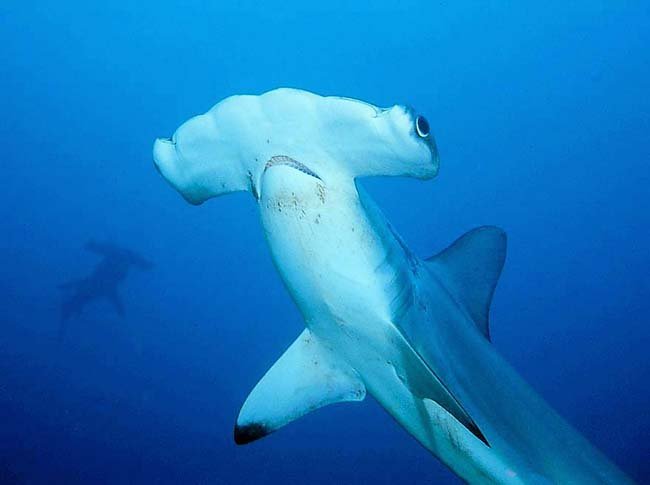
With an estimated 97 million sharks being harvested each year, serious protection measures can’t come soon enough. In March, at the Convention on International Trade in Endangered Species of Wild Fauna and Flora (CITES) Conference of the Parties in Bangkok, member nations took action. They agreed to list the oceanic whitetip shark, three species of hammerhead shark (scalloped, smooth, and great), the porbeagle shark, and both species of manta rays in CITES Appendix II, an action that means increased protection but that still allows legal and “sustainable” trade. Countries supporting the listing included Brazil, Colombia, the European Union, Costa Rica, Honduras, Ecuador, Mexico, Comoros, Egypt, the United States, and countries in West Africa, with opposition coming from Japan, Gambia, India, Grenada, and China. Sharks continue to be overharvested to meet Asian demand for shark fin soup and through bycatch; fishermen also catch some shark species for their meat, while others kill manta rays for their gill plates in support of the Chinese medicinal trade.
Says CORAL’s Conservation Programs Director Rick MacPherson, “The immediate outcome of the CITES listing for those species is that these seriously threatened sharks and rays can finally get some breathing room to recover. Of course CITES protections must be enforced or the designations are meaningless. But what these historic steps indicate is that short term financial interests don’t always trump long-term conservation vision.”
The Pew Charitable Trust’s Angelo Villagomez says CORAL’s and many other NGOs’ efforts undoubtedly contributed to the vote. “CITES decisions are not made by consensus, but by a vote. Fiji, Mexico, Honduras, and the United States were very supportive of the CITES shark proposals, and CORAL’s work on domestic campaigns in CITE S member countries surely played a part in that.”
Fiji
The CITES decision comes as CORAL continues to push for greater shark protections in Fiji. CORAL has been publishing an ongoing series of editorials in the Fiji Sun, urging the government to adopt stronger standards, including a possible temporary moratorium on shark fishing, in its new National Plan of Action for Sharks. In late January, CORAL assisted the Fijian government and the Fiji Times in an investigation of the deaths of 27 baby scalloped hammerhead sharks on Nukulu Island.
And with Pew, our partners in this initiative, CORAL taught a “Pacific Shark School” in January in Suva. The school brought together shark conservation leaders from different islands and included a “Shark Biology 101” section and focused on strategies for conservation and work plans for each place.
“The most valuable part of the shark school was seeing how the training encouraged and inspired participants,” says Rick MacPherson. “It takes more than just ideas to succeed in conservation. It takes passionate and skilled professionals to bring home the win. The shark school was an exciting opportunity to unite shark conservationists across the Pacific who returned to their home campaigns with new tools and energy.”
Indonesia
Greater protection for sharks and rays is also on the way in Indonesia, where the Regency Government of Raja Ampat signed the shark and manta ray sanctuary it had designated back in 2010 into law. CORAL and many other NGOs—as well as CORAL’s partner, the Misool Eco Resort—have advocated for years for better shark protections in Indonesia. The law protects sharks and rays in 46,000 square kilometers (18,000 square miles) of ocean off the coast Raja Ampat. Sharks are starting to show signs of recovery in marine protected areas there.
Andrew Miners, Managing Director of the Misool Eco Resort, says the sanctuary “sends a clear signal to the national government that the destructive fishing of sharks and rays is extremely detrimental to Indonesia’s growing marine tourism industry and the local communities that are supported by it.” Manta ray tourism in Indonesia generates more than $15 million per year vs. three percent of that amount from a manta ray fishery.
CORAL is also working to create a network of locally managed protected marine areas in the Sunda-Banda region of Indonesia, which will benefit sharks and rays.
Could we do all this without you? Absolutely not! So thanks so much for your continued support.
Project reports on GlobalGiving are posted directly to globalgiving.org by Project Leaders as they are completed, generally every 3-4 months. To protect the integrity of these documents, GlobalGiving does not alter them; therefore you may find some language or formatting issues.
If you donate to this project or have donated to this project, you can receive an email when this project posts a report. You can also subscribe for reports without donating.



Support this important cause by creating a personalized fundraising page.
Start a Fundraiser