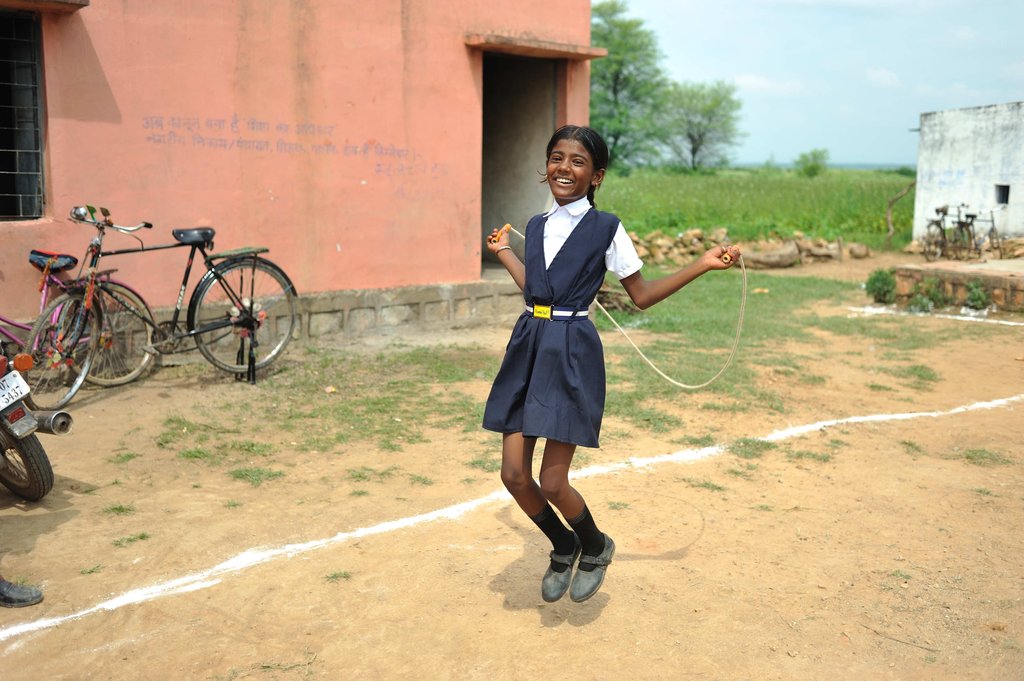
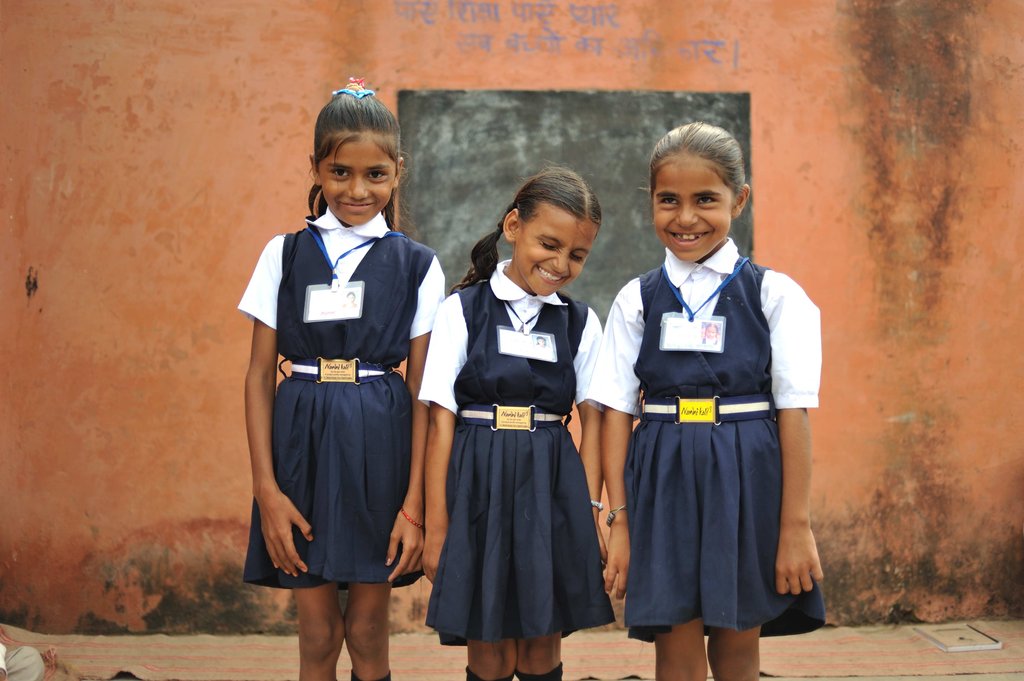
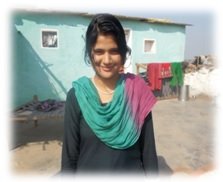
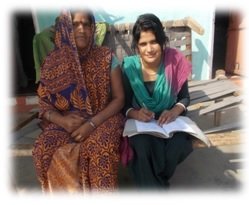
One of the brightest girls of Government School Jaatkheda, Manisha, who hails from Radhapura in Sheopur district, is one industrious girl who through sheer hard work has prevailed over the challenges posed by the poor economic condition of her family.
Manisha comes from a poor agricultural family, which includes Manisha’s father, Ramkumar, her mother, Anokhi, her two brothers and one sister. Manisha’s father, who is the only earning member of the family, is a farmer who earns a meagre salary. Though Manisha’s parents have always wanted to secure a good education for their children, their precarious economic situation made it difficult for them to accomplish this.
Then thanks to the support provided by the Nanhi Kali project, this became possible. The Nanhi Kali project, which aims at providing quality education to girls from economically disadvantaged backgrounds by giving academic, material and moral support, took Manisha into its fold and Manisha utilised this to the fullest extent. Manisha attends classes regularly (she has attended 85% of the classes) and works enthusiastically which is reflected in the results she has achieved. Before she became a Nanhi Kali, she was not interested in coming to school or studying in general. But since she became a Nanhi kali, her attendance has shot up. She is showing interest in studies and taking efforts to improve.
Her teachers are full of praise for this Nanhi Kali. One of them said, “Manisha is a very promising student. She always maintains discipline be it in the classroom or the Academic Support Centre. She is respectful towards her teachers and elders and is quite friendly with her classmates”. She continued, “Manisha got this opportunity to continue her studies thanks to her supportive parents and the Nanhi Kali project. I hope she continues her studies and keeps up the good work that she’s doing”.
The parents of the Nanhi Kali too are determined to educate their daughter and appreciate the role played by the Nanhi Kali project in helping them to achieve their dream.“The material support provided by the Nanhi kali project helped a lot in reducing the financial burden related to education and the tuition classes have helped her [Manisha] in securing good marks” they remarked.
Manisha on her part wants to acquire a Masters Degree and become a teacher. We express our deepest appreciation for the hard work put in by this Nanhi Kali and wish her luck for all her future endeavors.
Links:

Since its inception Project Nanhi Kali has adopted a holistic approach towards educating girls across the country. Over the years, efforts are being made to not only improve learning levels in government schools but also work towards reducing the dropout rates in schools.
Issues like poor financial resources, anemia, confusion arising due to biological changes in woman’s body and securing low marks in exams have been identified as leading causes of dropouts among adolescents.
To minimize the expenses incurred on books and stationary, kits are distributed to Nanhi Kalis on a regular basis, wherein books, pencils, uniforms along with sanitary pads are distributed.
To address the health issues, counseling sessions are conducted in collaboration with government officials and social workers. Over the years the sessions have emerged as a powerful tool to combat commonly occurring health disorders in Sheopur, Madhya Pradesh. An essential component of the counseling session is to spread awareness about the usage of iron and folic acid supplements among parents and adolescents. Information related to the right dosage of medicines, benefits of medication and availability of doctor etc is given by our team in collaboration with the government officials. Another concern addressed in these sessions is the usage of sanitary pads, provided in the kits distributed by theNanhi Kali project.
In addition to counseling sessions, community and change agent meetings are held on regular basis. The community meetings offer a ground to discuss the problems persisting within the community and arriving at a convergent solution.


Links:
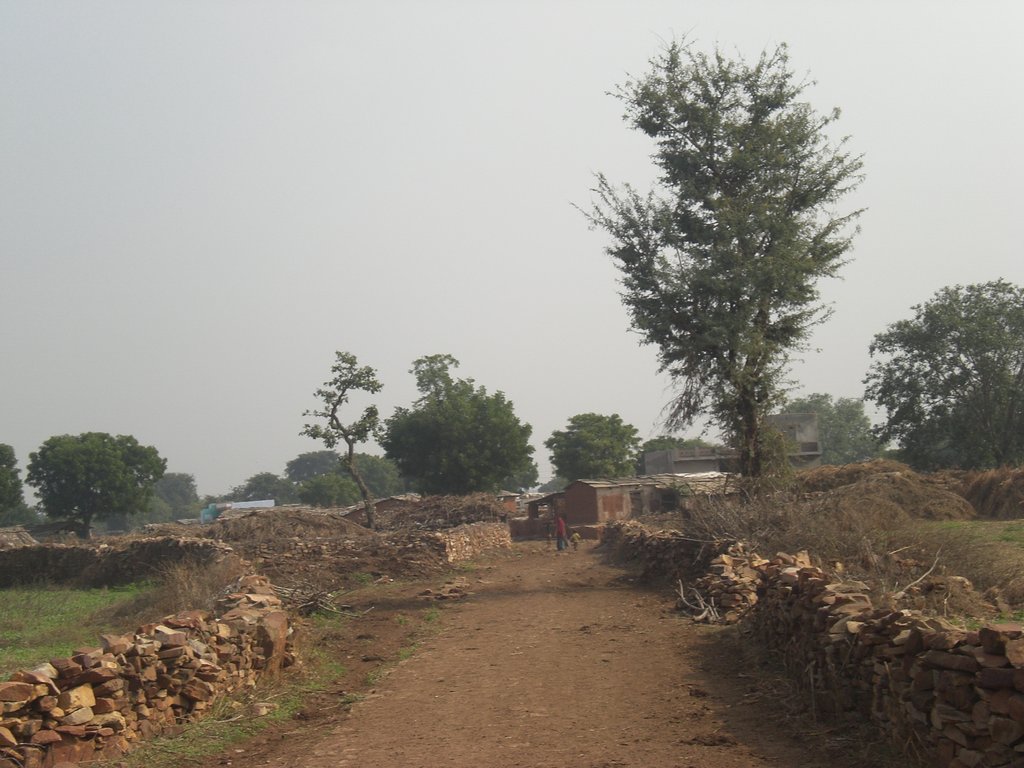
It is said that change is the only permanent thing in the world. That is, until you reach the Karahal block in the Sheopur district of Madhya Pradesh, India. Time has stood still here. The tribal community of Karahal is adversely affected by abysmal poverty, complete lack of health facility, malnutrition, lack of livelihood resources, water shortage and high rate of under five mortality. The village health centres are defunct and schools have poor infrastructure and education facilities. In this village girls are not given the opportunity to study, in fact 80 per cent of the girls here are out of school either because they have to look after younger siblings or contribute to the household income, or married off by the young age of 13. The region has the lowest literacy rate in the entire state which stands at below 20%.
In spite of these harsh and unfavorable circumstances many young girls, who are part of the project, ”Nanhi Kali – for the girl child”, are driven to bring about a change. Bhavna is one such teenage girl from a remote village of Chainpura in the Karahal block of Sheopur district who with determined eyes says, “I want to be a doctor when I grow up and treat the people of my village”
A first generation learner, Bhavna was not keen to attend school. Her parents’ poor financial condition made it difficult for her to attend school or complete basic education, let alone think of a career or financial independence. The parents are agricultural laborers with a monthly income of merely INR 1500. They had been farmers for generations and it was beyond anyone’s imagination to be anything else. They are a family of four who live in a thatched house made of mud which leaks rain water during monsoons. Though herself a juvenile, Bhavna is adept at cooking, fetching water and caring for babies. She looks after her baby sister while her parents go out for work. She could thus hardly get any time to come to school.
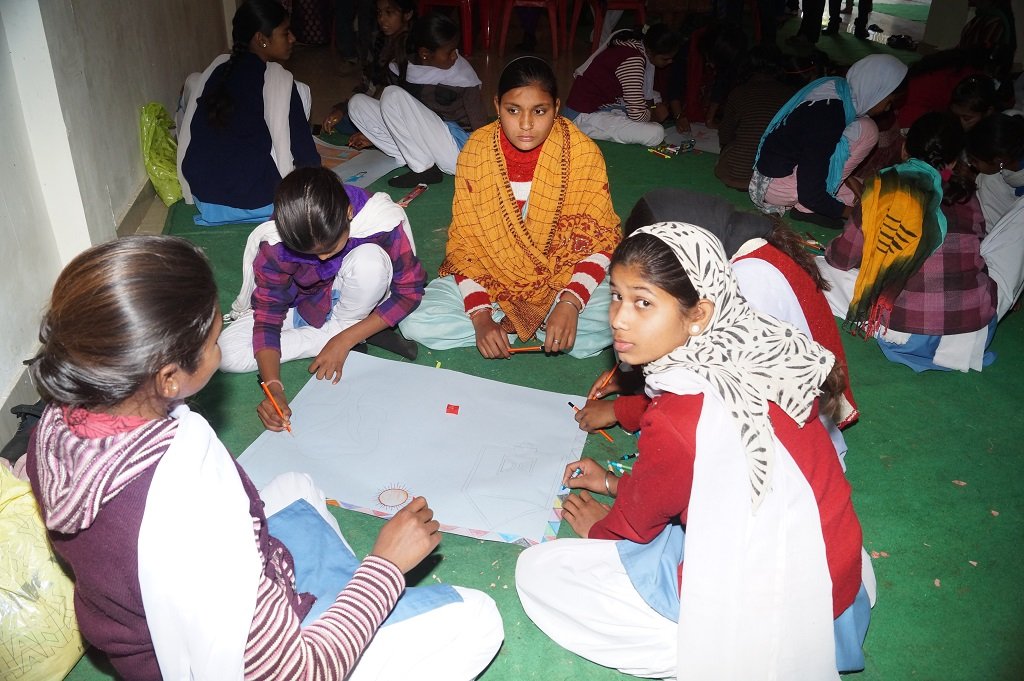
That is, till she became a Nanhi Kali. As part of the Nanhi kali program she received support in the form of a material kit which comprised of uniforms, school bag, shoes socks etc. to enable her to go to school with dignity. Apart from this, she receives academic support through a 1-2 hour class conducted before or after school hours called the Academic Support Centre, where concepts in Maths, Science and Language are taught to bridge the gaps in learning and enable children to attain grade specific competency levels. The teaching methodology includes the extensive use of innovative teaching tools and activities such as storytelling, group games etc which make learning not only meaningful but also fun. The Nanhi Kali team also works with the parents and community to sensitize them on not only gender equity but also issues related to adolescent health & hygiene.
Bhavna is now the first proud member of her family to learn how to read and write. Not only has she maintained her attendance in school but Bhavna has also proved herself in her studies. From 42% in 2008-2009, her learning levels improved to 75% in 2011-2012. Through the project we hope to reach out to many more girls like Bhavna and give them the opportunity to obtain quality e4ducation.
The importance of Girl Child Education cannot be stressed more. Education enhances lives. It ends the generational cycles of poverty and disease and provides the means for sustainable development. A high quality basic education will better equip girls with knowledge and skills needed to adopt healthy lifestyles, and to take an active role in social, economic, and political decision-making as they transition to adolescence and adulthood. We believe education will also radically change the perception towards girl children from being considered as a burden today, to becoming potential leaders and building blocks of the society. This only is true empowerment!
Links:

Sheopur is one of the most backward districts of Madhya Pradesh with only 15% of the villages connected by roads. Agriculture is the main occupation and majority of the people are landless laborers and marginal farmers who migrate seasonally in search of work. The district is situated on the border of Madhya Pradesh and Rajasthan – and by definition, border districts are neglected. The average literacy rate in the Sheopur district is 58.02%. The male literacy rate is 70.30% while the female literacy rate is only 44.45%. 80% of the girls here do not attend school regularly or drop-out of school, because they have to either look after younger siblings or contribute to the household income, or are married off by 13 years of age.
This is the story of Ramkatha from a village named Karnyakhedli, in the middle of the Sheopur District of Madhya Pradesh. Improved agricultural techniques have left many farmers here moderately well-off. Tractors and motorcycles dot the landscape. Yet traditional practices are still largely observed. For most children, education comes to a halt when their labour is required in the fields. Caste lines here are still rigid. Ramkatha comes from a scheduled caste of manual labourers, for whom education has had no meaning.
Project Nanhi Kali helped Ramkatha break with her community’s tradition. In 2010, she became the first scheduled caste girl in Karnyakhedli to complete 10th standard. In her village, women are not allowed to step out of home and rarely into a school. Ramkatha now wakes up every morning at 5:00 am to travel to college, an hour away by bus, and returns home to study by the light of a kerosene lamp.
Astonishingly she is exempted from housework. Her parents say they will support her for as long as she chooses to study- and that they owe their conviction to the constant support and guidance from Project Nanhi Kali. They soon had to ask themselves a question never before asked in her village: “What will she do?” Ramkatha’s answer: “Police inspector.”
“There is nothing special about me,” Ramkatha says of her accomplishment. “It’s because of Nanhi Kali,” She expects more girls to follow in her footsteps. She herself has four younger sisters; another dozen children belong to the joint family in which she lives.
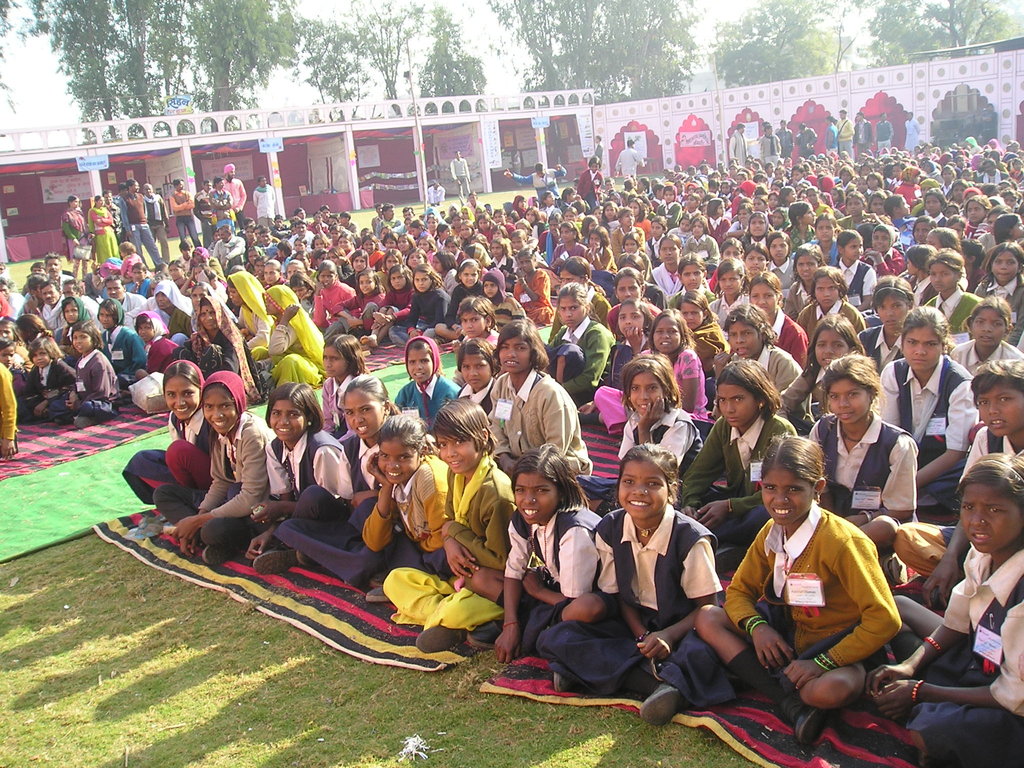
Across the Sheopur district there are 7500 Nanhi Kalis in 189 villages. The project covers 30% of the 895 widely scattered schools in the district. As word of Ramkatha’s success gets out, it will have a positive impact on the education of girls across the region.

Links:
Project Reports on GlobalGiving are posted directly to globalgiving.org by Project Leaders as they are completed, generally every 3-4 months. To protect the integrity of these documents, GlobalGiving does not alter them; therefore you may find some language or formatting issues.
If you donate to this project or have donated to this project, you will get an e-mail when this project posts a report. You can also subscribe for reports via e-mail without donating or by subscribing to this project's RSS feed.
Mumbai,
Maharashtra,
India
http://www.nanhikali.org