By Leah Ambwaya | Evaluator for GlobalGiving
One day before our visit, I call and talk to Mohamed, the CEO of Carolina for Kibera. He is more that willing to meet our team and so he gives us an appointment to meet him and his team.
As we approach the offices, we notice about three four-wheel drive vehicles with diplomatic number plates parked outside the offices which are in the sprawling Kibera slums. I call Mohammed just to let him know that our team has arrived. “Sorry Leah, I am in the field , but just get to the office and talk to the people there.” This takes me by surprise, but I realize that this being a community project each and every person is empowered with information.
The security person ushers us to a meeting place, and then calls one of the officers from the main office to come and attend to us. He introduces himself as Ben Hagai, a program officer for Sexual and reproductive health. As we settle down to talk, Mohamed walks in and requests Ben to let him talk to us. This soft spoken man then takes us step by step on how the organization was started and its mission. He is full of praise of their relationship with GlobalGiving.
“If I can remember, GG gave us money in 2003 which we used to establish the health clinic, (Tabitha Medical Clinic). Since then, they have not given us any monetary support, but the fact they profile our work on their site has given us a lot of mileage for which we are truly grateful," says Mohamed.
"GG has created a lot of awareness through online documentation of our work," he says. However, this gentleman puts more emphasis on GG being able to ensure that projects are accountable to communities they serve. "GG funded projects should form coalitions for purposes of sharing information, experiences, best practices; this is the BIG brother BIG sister kind of relationships."
“Just giving money without follow-ups is dangerous,” says Mohamed. "At Carolina for Kibera, we have received leverage just by being on the GG website."
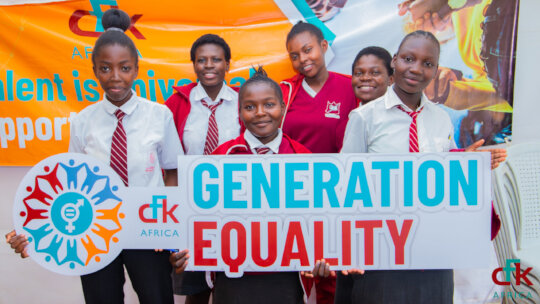
We seek to talk to some of the beneficiaries of the project and so he takes us to a building about 300 meters from the office site and here we meet some girls who have been and are still beneficiaries of the organization.
=============================
We met Maureen Wandia, she is full of praise of the project.
"I joined the project when I was 12 years. I have now just completed high school and gotten myself placement at the office at Brain Trust."
I ask her what that means, and she explains, "I help other girls realise their dreams. I have been mentored and given opportunities by this project, so it is my time now to give back."
She goes ahead to explain, "When I talk to the other girls, I remind them that living in a slum is not the end of life. Rise up and give your life a direction, show others that you can make a difference. That is what i do at Brain Trust."
"Binti pamoja has changed my life," she says.
=============================
Linet Nyanchama (21 years) was busy typing on her computer as we talked to Maureen. She looks at us with expections. She has a story to tell. I ask, "So when did you join the project?"
"I was 14 years", she says.
I can tell, from the confidence on her face that she is truly empowered.
"I am a peer educator. I discuss issues of sexaulity and sexual maturation with younger girls. I also facilitated the formation of the peer education group as a way of giving back to my community in Kibera. This project has seen me through school and are paying for my college education. And besides they have offered me a job."
I ask her how much she earns, and without coersion, she discloses her allowances - ksh.900.00. She is the proud earner of a salary of 9000.00 kenya shillings which is close to a dream to majority of the Kibera residents.
"I wish that the world could encourage more girls to realise their dreams," Says Linet.
=============================
Jackline Angwanda is another beneficiary of Carolina for Kibera. She says that she was introduced to the project by a friend and since then she has never regretted. She is a partial orphan with 4 siblings. She is the sole bread winner for her family.
"How do you manage to provide for your family?" I asked.
"My mother taught us how to share and be responsible to others from an early age, and this is a value that I urge other girls to emmulate. We should go beyond our families and help the community," she concludes with a parting shot. "If you empower girls, you eradicate poverty and I see this through the girls at Carolina for Kibera."
"Our organization is of young people, you can see our CEO and even all the other officers," says Jackline.
By Rye Barcott | President
Project reports on GlobalGiving are posted directly to globalgiving.org by Project Leaders as they are completed, generally every 3-4 months. To protect the integrity of these documents, GlobalGiving does not alter them; therefore you may find some language or formatting issues.
If you donate to this project or have donated to this project, you can receive an email when this project posts a report. You can also subscribe for reports without donating.